Insurance
2027 Marketplace Premiums: What Early Retirees 50–64 Can Do Before Open Enrollment
Proposed 2027 rates are up again, the subsidy cutoff is back, and for people too young for Medicare the most important number is their own income.
 Margaret Linwood
Updated Sep 22, 2026 · 11 min read
If you buy your own health insurance and you're between 50 and 64, this was probably the most expensive year you've had. The extra premium tax credits that had been in place since 2021 expired at the end of 2025. KFF found that people who signed up for 2026 marketplace coverage saw the amount they pay, after tax credits, rise 58% on average. Paid-up enrollment fell from 21.8 million people to 19.2 million.
Now the 2027 numbers are coming in. Insurers have filed proposed rates in all 50 states and Washington, D.C., and across 276 insurers the median proposed increase is 15%, according to the Peterson-KFF Health System Tracker. Proposals run from a 1% cut to a 54% increase. Insurers point to higher prices for hospital care, doctor visits and drugs, and to a sicker pool of customers after healthier people dropped coverage this year.
15%. That's the median premium increase ACA marketplace insurers have proposed for 2027, on top of a median 20% increase that was finalized for 2026, according to the Peterson-KFF Health System Tracker.
These are requests, not final prices. State regulators review them, and some get trimmed. Some go the other way. Last year the median proposal was 18% and the final figure landed at 20%. Final rates normally show up shortly before open enrollment starts on November 1.
For this age group, though, the rate increase is only half the story. Often it's the smaller half. The bigger one is a line on the income scale.
Why this lands hardest between 50 and 64
Two rules combine.
The first is age. HealthCare.gov puts it plainly: premiums can be up to three times higher for older people than for younger ones. A 15% increase on a 62-year-old's premium is a lot more dollars than 15% on a 30-year-old's.
The second is the subsidy cutoff. From 2021 through 2025 there was no upper income limit for the premium tax credit; if the benchmark plan cost more than 8.5% of your income, the credit covered the difference. That ended on December 31, 2025. The IRS now states the rule the old way: you may qualify if your household income is at least 100% but no more than 400% of the federal poverty line.
At 400%, the credit doesn't taper off. It stops.
For 2027 coverage the line is set with the 2026 poverty guidelines, because the marketplace uses the guidelines in effect when open enrollment begins.
| Household size | 400% of poverty line for 2027 coverage (48 states and D.C.) |
|---|
| 1 | $63,840 |
| 2 | $86,560 |
| 3 | $109,280 |
| 4 | $132,000 |
Alaska and Hawaii have higher figures.
What can one dollar over the line cost?
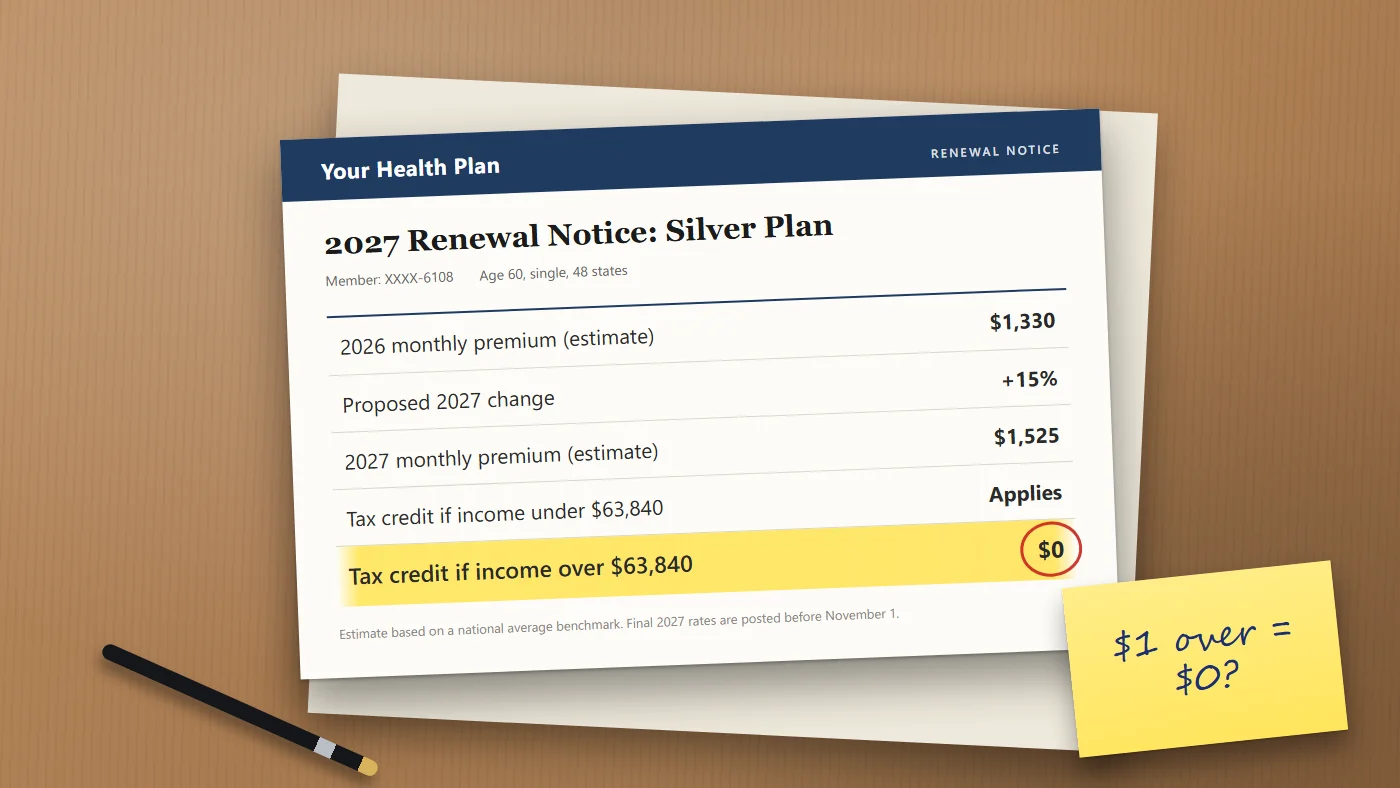
The prices below aren't quotes. They're our estimates. KFF reports that the national average benchmark silver plan for a 40-year-old costs $625 a month in 2026. Run that through the federal default age curve and the same plan for a 60-year-old comes to roughly $1,330 a month, or about $15,900 a year. If 2027 rates rise 15%, that's about $1,525 a month, or $18,300 a year.
Now take a single 60-year-old with $63,000 of income in 2027, just under the line. The IRS has set the 2027 cap at 10.22% of income for people between 300% and 400% of the poverty line, so her payment for the benchmark plan tops out around $6,440 a year. The tax credit covers the rest.
Give her $64,000 instead. The credit is zero, and she pays the full price. On these estimates that's about $18,300 against $6,440, a gap of close to $12,000 a year caused by an extra $1,000 of income. One dollar above $63,840 would do the same.
For a married couple it's worse. Two 60-year-olds pay two age-rated premiums, so the full price roughly doubles, while the line for a household of two only rises to $86,560. A couple with $86,000 of income would pay about $8,800 a year for the benchmark plan in 2027. At $87,000 they'd face the full price, around $36,600.
Your own numbers will differ, sometimes by a lot. Premiums vary widely by county, and a few states with their own marketplaces add state subsidies on top of the federal credit. The shape of the problem is the same everywhere.
There's a second effect, too. If your income is under the line, your payment for the benchmark plan is tied to your income, not the sticker price, so when rates rise 15% most of that increase is absorbed by a bigger tax credit. Over the line, all of it's yours.
So the most useful thing you can do before November 1 isn't guessing at premiums. It's working out where your 2027 income will fall and how much control you have over it. Many early retirees have more than they think, because they decide which accounts to draw from.