You pay the card every month. You're never late. And when the next statement shows up, the balance looks almost the same as the last one.
That isn't a mistake on your part, and it isn't a billing error. It's how the minimum payment is built. On many cards the minimum is set to cover that month's interest plus about 1% of what you owe, so at today's rates roughly two-thirds of an early minimum payment goes to interest and only a third touches the debt.
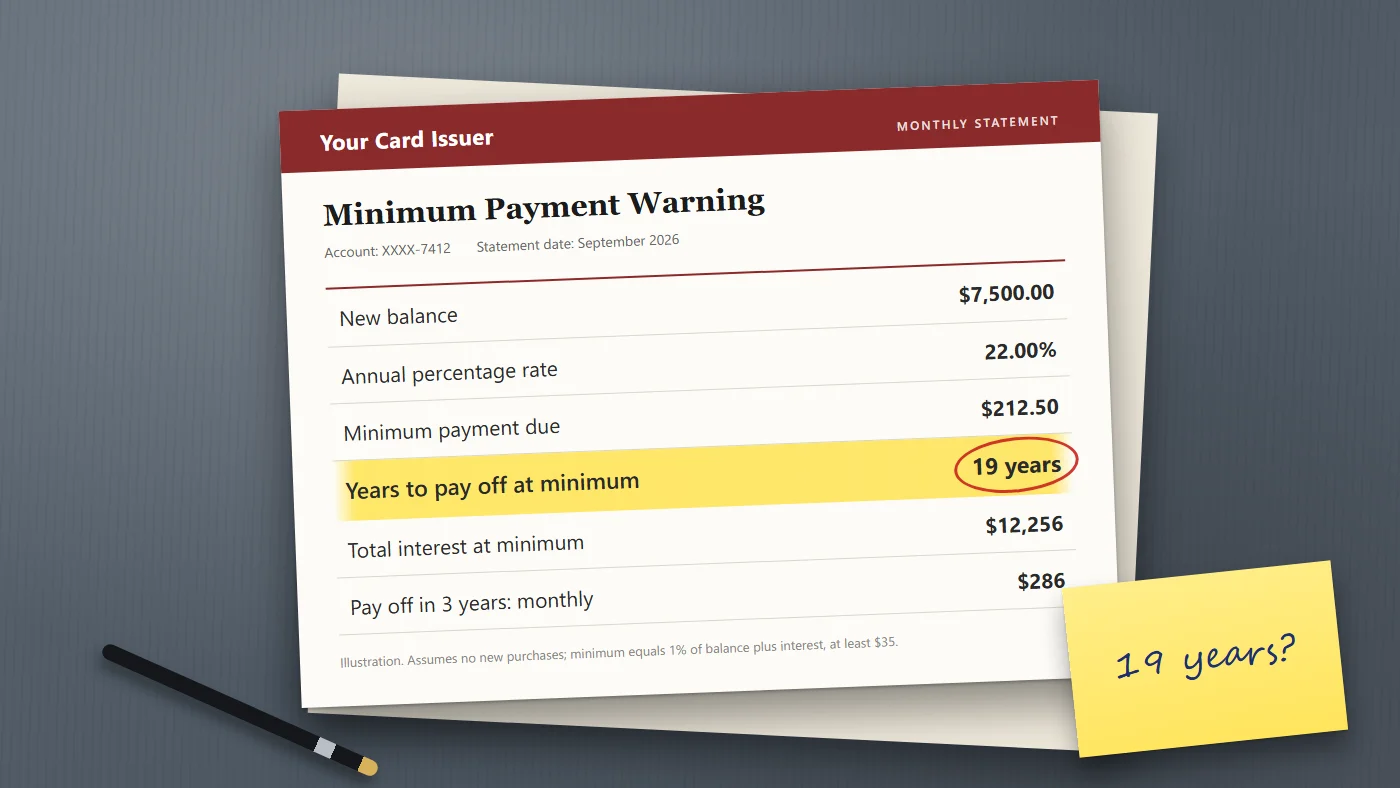
Here are real numbers. Take a $7,500 balance at 22% APR, stop using the card, and pay only the minimum each month. You'd make 237 payments. That's 19 years and 9 months. Along the way you'd hand over $12,256 in interest on top of the $7,500 you borrowed.
Those figures don't come from a bank brochure. They come from a month-by-month calculation, and the assumptions and the table are below, so you can hold them up against your own statement.
Where the 22% and the $7,500 come from
The rate is the Federal Reserve's. In its G.19 consumer credit release of September 8, 2026, the Fed put the average rate on credit card accounts that were charged interest at 22.15% for the second quarter of 2026. Across all card accounts, including the ones paid in full every month, it was 20.94%.
The balance is close to what a typical card borrower owes. LendingTree looked at anonymized credit reports for more than 400,000 of its users and put average card debt at $7,756 in the first quarter of 2026. Nationally, Americans owed $1.263 trillion on credit cards in the second quarter of 2026, according to the New York Fed.
So $7,500 at 22% isn't a worst case. It's an ordinary one.
Carrying a balance is ordinary, too. In a Federal Reserve survey covering 2025, 45% of adult cardholders said they'd carried a balance for at least one month in the past year. Is your balance bigger or smaller? The curve has the same shape either way. Only the dollar amounts change.
The math, month by month
The assumptions, stated plainly:
- Starting balance of $7,500, with no new purchases and no fees.
- 22% APR, which is 1.8333% a month.
- A minimum payment equal to 1% of the balance plus that month's interest, and never less than $35. Many large issuers use a formula like this one. Yours is spelled out in your cardholder agreement.
| Month | Balance at start | Minimum payment | Goes to interest | Goes to the debt | Balance at end |
|---|
| 1 | $7,500.00 | $212.50 | $137.50 | $75.00 | $7,425.00 |
| 12 | $6,715.05 | $190.26 | $123.11 | $67.15 | $6,647.90 |
| 36 | $5,275.88 | $149.48 | $96.72 | $52.76 | $5,223.12 |
| 60 | $4,145.16 | $117.44 | $75.99 | $41.45 | $4,103.71 |
| 120 | $2,268.05 | $64.26 | $41.58 | $22.68 | $2,245.37 |
| 180 | $1,240.99 | $35.16 | $22.75 | $12.41 | $1,228.58 |
| 237 | last payment | | | | $0.00 |
Look at month 1. You send $212.50, the bank keeps $137.50 as interest, and $75 comes off what you owe.
Now jump to month 60. After five full years of on-time payments, you've paid $6,227 in interest and still owe $4,104. Ten years in, you still owe $2,245.
19 years and 9 months. That's how long a $7,500 balance at 22% APR takes to clear on minimum payments alone, under the assumptions above. Total interest: $12,256, or about $1.63 in interest for every dollar borrowed.
Why does the payment keep shrinking?
Most people notice the rate. Fewer notice the second thing in the table: the minimum payment gets smaller every month.
It starts at $212.50. A year later it's $190. After five years it's $117. Because the payment is a percentage of the balance, every dollar of progress lowers the next bill, and a lower bill means slower progress, so the debt feels lighter each year while the finish line keeps sliding out toward two decades.
You can see what that one feature costs with a single change. Keep paying $212.50 a month, the amount of the very first minimum, and never let it drop. The same debt is gone in 58 months, just under five years, with $4,682 in interest. Same card. Same rate. The only difference is that you turned down the smaller bill the card kept offering you.
And the $35 floor? It barely matters here. In this example the formula stays above $35 until about month 180, and by then you've already paid roughly $11,500 in interest.
All of this assumes you never use the card again. Pay $212 and charge $150 in the same month, and the balance barely moves. That's the most common reason a balance stays frozen for years.
Your own version of this math is already printed on your statement, in a box most people skip. The rest of this article shows where to find it, what three different payment choices do to the 19 years, and which outside options are worth pricing.