Retirement
Required Minimum Distributions: The Rules at 73, the 25% Penalty and How to Avoid It
The rule is simple, the deadlines are odd, and the penalty lands on people who were careful with money their whole lives.
 Ray Castellano
Updated Sep 22, 2026 · 11 min read
If you were born in 1953, you turn 73 this year. From here on, the IRS requires you to pull money out of your traditional IRA and most workplace retirement accounts every year. Need the cash or not.
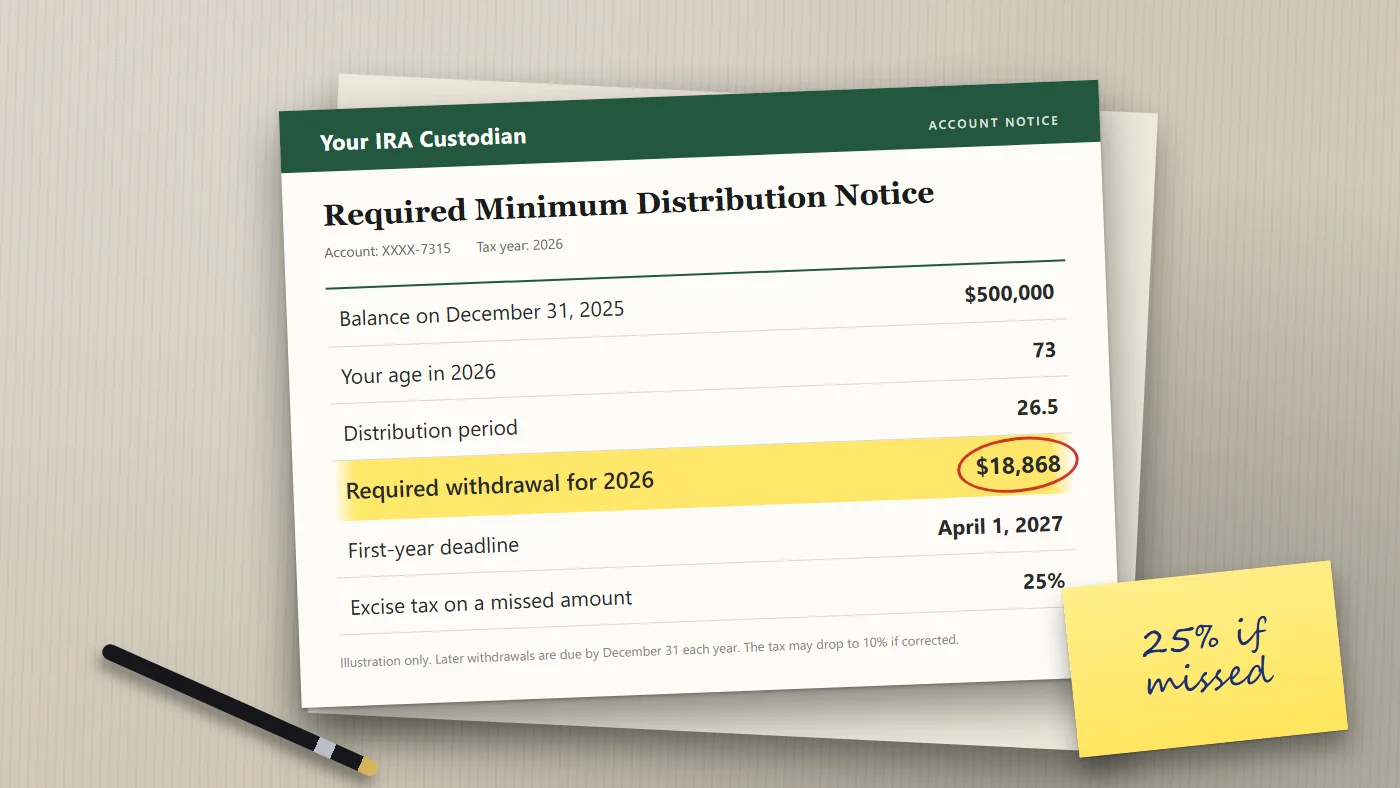
Officially, it's the required minimum distribution, or RMD. Skip it, or take too little, and you owe an excise tax of 25% of the amount you didn't withdraw. Say your IRA held $500,000 at the end of last year. Your first RMD is about $18,868. Miss it entirely and the tax is about $4,717, and that's on top of the regular income tax you'll still pay when the money finally comes out.
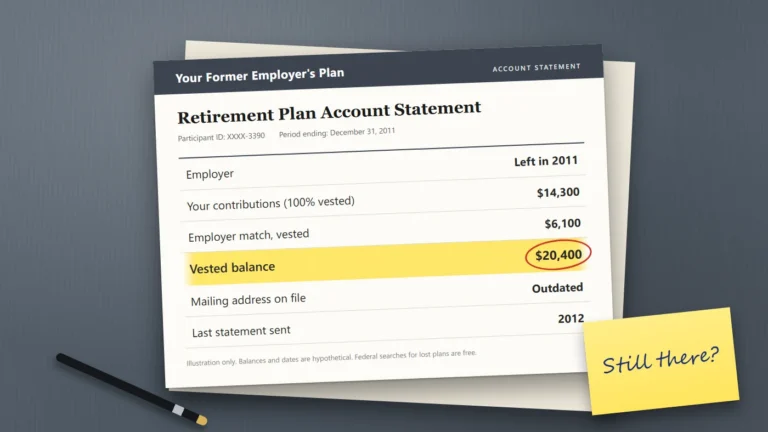
Most people who get caught aren't careless. They're the savers who left an account alone for forty years, the surviving spouse who inherits the paperwork along with the accounts, the retiree with a 401(k) still sitting at an employer he left a decade ago and a mailing address the plan hasn't had in years. It's a rule that punishes you for not touching your money, which is exactly what you were told to do for decades.
Why the rule at all? You skipped income tax on this money when you earned it, and the deal was always that you'd pay the tax later. At 73, later arrives. Each year you take last year's December 31 balance, divide it by a number from an IRS table, withdraw at least that much and report it as income.
The number to remember: 25%. That's the excise tax on any RMD amount you miss. It drops to 10% if you take out the missed money and file the correction within the IRS "correction window," which generally runs through the end of the second year after the miss. Before 2023 the penalty was 50%.
Who has to take one?
Almost everyone with pre-tax retirement savings. IRS rules cover traditional, SEP and SIMPLE IRAs, plus 401(k), 403(b), 457(b), profit-sharing and other defined contribution plans.
Roth accounts are the big exception. RMD rules don't apply to Roth IRAs or to designated Roth accounts in a workplace plan while the owner is alive. Your heirs will face withdrawal rules. You won't.
Your birth year sets the starting age. Under the SECURE 2.0 Act, people born from 1951 through 1959 start at 73, and people born in 1960 or later start at 75. If you were born in 1959, the statute was drafted in a way that seems to give you both ages. In proposed regulations, the IRS says 73.
There's also a still-working exception. If you're still employed at 73, your current employer's plan may let you put off RMDs from that plan until the year you retire. You can't use it if you own more than 5% of the business. It never applies to IRAs. And it doesn't reach old 401(k) accounts left behind at former employers.
The April 1 trap in year one
Your very first RMD gets a special deadline: April 1 of the year after you turn 73. Every RMD after that is due by December 31.
That extra three months looks generous.
It isn't free. Turn 73 in 2026, wait until March 2027 to take the first withdrawal, and you still owe the second one by December 31, 2027. Two taxable withdrawals land in one tax year. On a $500,000 account that holds its value, that's roughly $38,000 of income in 2027.
For plenty of households, that stack is enough to push income into a higher bracket, make more of your Social Security taxable, or trigger the Medicare income surcharge known as IRMAA, which is set using your tax return from two years earlier. So a doubled RMD in 2027 can raise your Part B and Part D premiums in 2029. Taking the first RMD by December 31 of the year you turn 73 avoids all of that. Waiting only makes sense if this year's income is unusually high and next year's will be much lower.
How the math works
You need two numbers: your account balance on December 31 of last year, and the "distribution period" for the age you reach this year, which comes from the Uniform Lifetime Table in IRS Publication 590-B. Divide the first by the second.
| Age this year | Distribution period | RMD per $100,000 of balance |
|---|
| 73 | 26.5 | about $3,774 |
| 75 | 24.6 | about $4,065 |
| 80 | 20.2 | about $4,950 |
| 85 | 16.0 | $6,250 |
| 90 | 12.2 | about $8,197 |
Watch the direction. Each year the divisor shrinks, so the required share keeps climbing: about 3.8% of the account at 73, more than 6% at 85, more than 8% at 90. If your investments do well, the dollar amount can rise for a long time.
There's one exception to the table. If your spouse is your sole beneficiary and is more than 10 years younger than you, you use the Joint Life and Last Survivor table in Publication 590-B instead, and it produces a smaller RMD.
Division is the easy part. Where people actually get into trouble is the account-by-account rules, the calendar, and the first few weeks after they realize they missed one, which is what the rest of this guide covers, along with the legal ways to make future RMDs smaller.