Medicare's own fact sheet gets to the point fast: in most situations, Medicare won't pay for health care or supplies you get outside the U.S. That goes for Part A and Part B. It applies in a hospital in Lisbon, at a clinic in a Mexican port town, and on a cruise ship once it's more than six hours from a U.S. port.
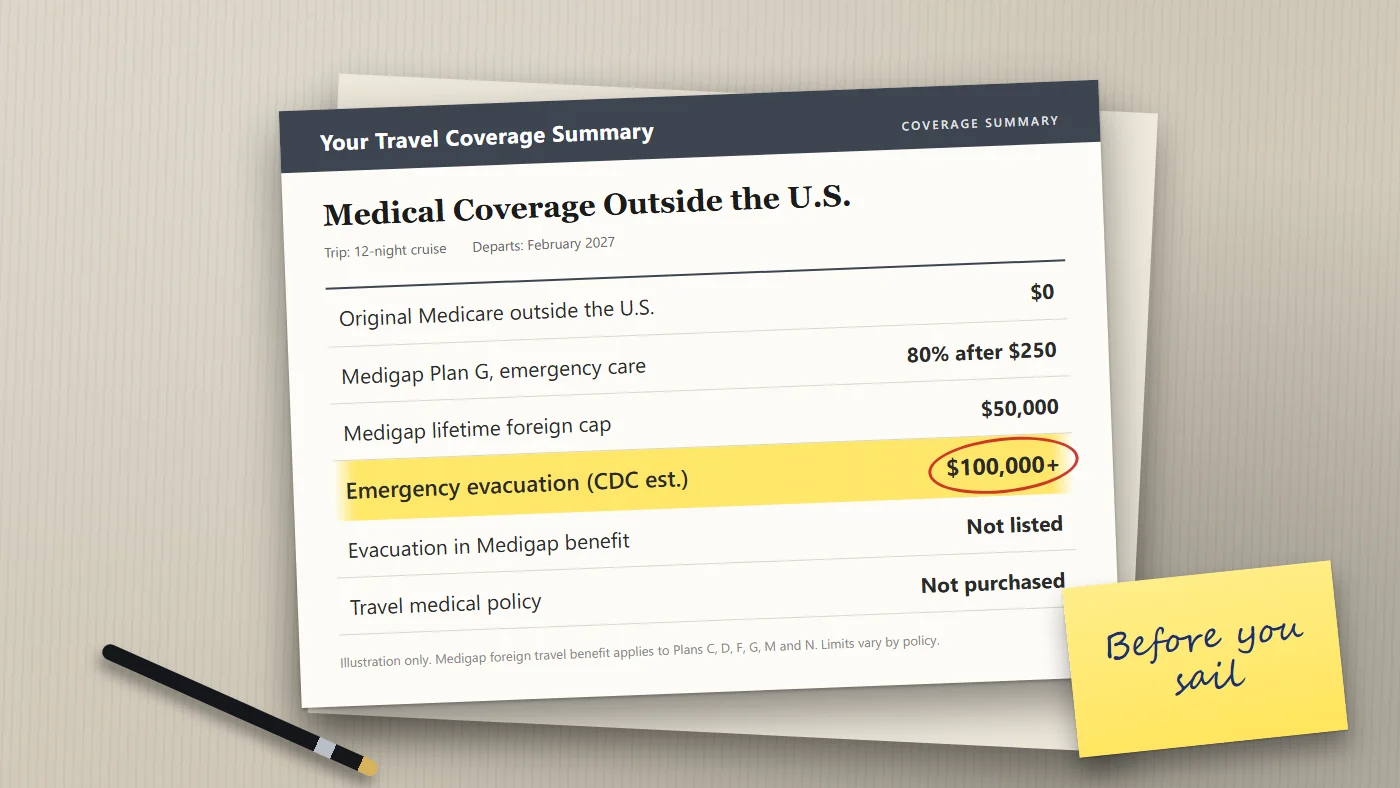
It's a bigger gap than it sounds. The Centers for Disease Control and Prevention, in its guidance for travelers, says a medical evacuation from a remote area to a high-quality hospital "could otherwise cost more than $100,000." That's the flight. Not the treatment. And many hospitals abroad expect payment before they treat or release a patient, by card or in cash.
None of this is a reason to stay home. It just means the Medicare card in your wallet is a domestic document, and you need something else in the bag for the days you're away. The choices are few and well understood: a Medigap plan with a foreign travel benefit, a Medicare Advantage plan that adds travel coverage, or a travel medical policy bought for the trip. Plenty of travelers end up combining the first and the third.
The gap in one number: more than $100,000. That's what the CDC says an emergency medical evacuation can cost. Original Medicare's share of that flight, and of the foreign hospital bill that usually comes first, is generally zero.
Where does "the U.S." end for Medicare?
For Medicare, the U.S. means the 50 states, the District of Columbia, Puerto Rico, the U.S. Virgin Islands, Guam, American Samoa and the Northern Mariana Islands. A hospital in San Juan is covered like a hospital in Ohio. A hospital in Cozumel isn't.
Medicare lists three situations in which it may pay for care in a foreign hospital. Few vacationers fit any of them. You're in the U.S. when a medical emergency hits and the foreign hospital is closer than the nearest U.S. hospital that can treat you. You're driving through Canada, without unreasonable delay and by the most direct route, between Alaska and another state when an emergency happens, and the Canadian hospital is the closest one. Or you live in the U.S. and a foreign hospital is closer to your home than the nearest U.S. hospital that can treat you, emergency or not.
Even then, Medicare pays only its usual share, and you still owe the deductibles and coinsurance. It won't pay for an ambulance ride home afterward.
Cruise ships get their own rule. Medicare may cover medically necessary care you get on board if the doctor is legally allowed to treat you there and the ship is in a U.S. port or no more than six hours away from one. Past six hours, you're on your own.
Prescriptions are simpler. Medicare drug plans can't cover drugs you buy outside the U.S., so if you take daily medication, pack enough for the whole trip plus a few extra days, in the original containers.
What Medigap pays abroad
If you have Original Medicare plus a Medigap policy, look at the letter of your plan. Medicare's 2026 Medigap guide shows a foreign travel emergency benefit in Plans C, D, F, G, M and N. Plans A, B, K and L don't have it. Older Plans E, H, I and J, no longer sold, include it too.
It's a standardized benefit, and it's narrower than the word "covered" suggests.
| Feature | What the Medigap foreign travel benefit does |
|---|
| What it covers | Emergency care that begins during the first 60 days of a trip outside the U.S., when Medicare doesn't otherwise cover it |
| What it pays | 80% of the billed charges for certain medically necessary emergency care |
| What you pay first | A separate $250 deductible each year |
| Lifetime cap | $50,000 in total, over your lifetime |
| What it leaves out | Evacuation isn't a listed benefit, and care that starts after day 60 or runs past the cap is on you |
Read that last row twice.
Say you hold Plan G and break a hip on day 4 of a Mediterranean cruise, then run up a $40,000 hospital bill in Italy. After the $250 deductible, Medigap pays 80% of the remaining $39,750, which comes to $31,800. You owe $8,200, plus whatever it costs to get home. And $31,800 of your $50,000 lifetime cap is gone for good.
So why do so many Medigap holders still buy a trip policy? Because Medigap is a decent backstop for a short emergency, but it isn't built for the two most expensive parts of a bad trip: the air ambulance and the long hospital stay.
And if you're on Medicare Advantage?
Medicare Advantage plans have to follow Medicare's rules on care outside the U.S., but some add their own coverage for emergency and urgently needed care while you travel. Does yours? Call and ask. Ask what the benefit covers, whether there's a dollar limit, whether it includes evacuation, and how a foreign claim gets filed. Then check it against the plan's Evidence of Coverage.
If your plan has no travel benefit, or a thin one, you're in the same spot as someone with Original Medicare alone.
That's the coverage side. The rest is the buying side, which is where the fine print does its damage: what a travel medical policy actually includes, the questions that separate a good one from a cheap one, and the paper trail that gets a foreign bill paid.