Retirement
Denied Social Security Disability? How the Appeal Works and Why Age 50 Changes the Rules
The first decision is made from paper by an examiner who never meets you. The hearing is where most approvals happen, and your age matters more than you think.
 Ray Castellano
Updated Sep 22, 2026 · 11 min read
You worked for thirty or forty years. Then your back, your heart or your hands gave out. You applied for Social Security Disability Insurance, waited months, and got a letter saying you can do "other work."
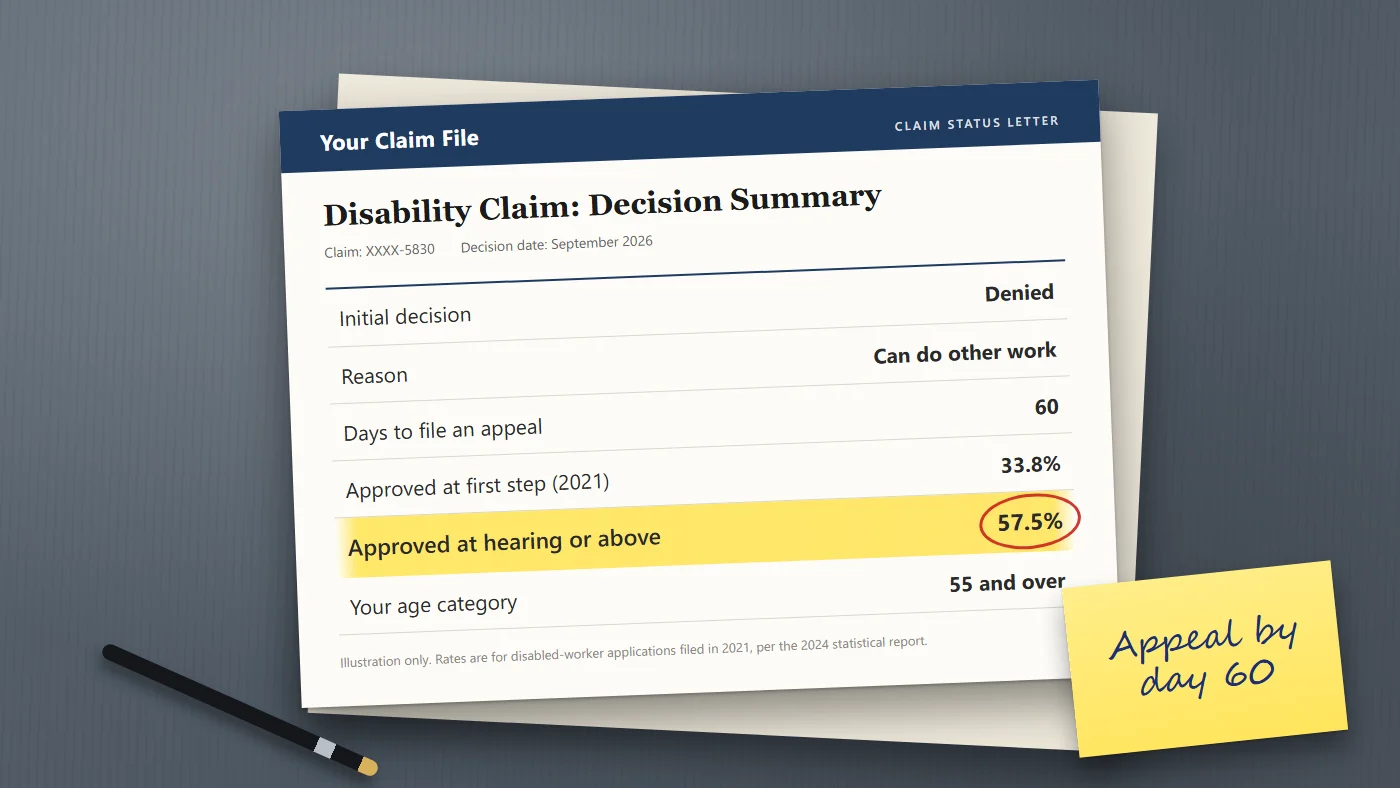
That letter is common. For disabled-worker claims filed in 2021, Social Security's own figures show examiners approved about 34% at the first medical decision, and the rest, roughly two-thirds, were denied on medical grounds. Plenty of other applicants never got that far. They were turned away before anyone read a medical record, most often for not having enough recent work credits.
The same report shows something your denial letter won't mention. Of the claims decided at a hearing before an administrative law judge or higher, about 58% were approved. That isn't because judges are soft. A hearing is simply the first time a person, not a file, is in the room.
Is the system slow? Very. The paperwork is dull and the deadlines are strict. But the road from a first "no" to an approval is well marked, and the one factor you can't change, your age, starts working for you once you pass 50.
The numbers, by level. For disabled-worker applications filed in 2021, Social Security's statistical report shows an allowance rate of 33.8% at the initial level, 13.8% at reconsideration, and 57.5% at the hearing level or above. Across claims filed from 2014 through 2023, about 29% were ultimately awarded benefits.
Why the first decision is usually no
Your initial claim doesn't go to a judge, or even to a Social Security employee who meets you. It goes to a state agency called Disability Determination Services, where an examiner and a consulting doctor read your medical records and decide from paper if you meet the rules.
Strict? By design. Your condition has to have lasted, or be expected to last, at least 12 months or result in death. And it has to keep you from doing any substantial work, not just your old job. Social Security keeps a list of impairments that qualify on their own, but most people don't fit a listing neatly, so the examiner has to judge what work you could still do. Working from a file with gaps in it, and with no chance to ask you a single question, the examiner often lands on "other work exists."
Denial reasons are tracked. The agency's report sorts them into a few buckets: the impairment isn't expected to last 12 months, it isn't severe, you can still do your usual work, or you can do another kind of work. Insufficient medical evidence is its own reason. It's also one of the easiest to fix.
A first denial doesn't mean your case is weak. It means the paper hasn't carried it yet.
So what changes at 50?
Claims are decided in a set sequence of steps. At the last one, the agency asks whether there's other work in the national economy you could adjust to, given what you can still do physically, your age, your education and your past work.
For that step the agency uses tables called the medical-vocational guidelines, better known as "the grid." They're written into federal regulations, and they treat age as a real limit on how well a person can adjust to new work.
| Your age | How the grid labels you | What it can mean |
|---|
| 18 to 44 | "Younger individual" | Usually expected to adjust to other work unless your limits are severe |
| 45 to 49 | Younger, with one narrow rule | Can be found disabled if limited to sedentary work, unskilled or without transferable skills, unable to do past work, and illiterate (section 201.00(h)(1)) |
| 50 to 54 | "Closely approaching advanced age" | If limited to sedentary work, ordinarily found disabled when past work is gone and skills don't transfer, unless recent education leads directly to sedentary work (for example, rules 201.09, 201.10, 201.12, 201.14) |
| 55 and over | "Advanced age" | Can be found disabled even if you can still do light work, when your education doesn't lead directly to skilled work and you have no transferable skills (for example, rules 202.01, 202.02, 202.04, 202.06) |
The regulation is blunt about the 50-to-54 group. Once someone that age is restricted to sedentary work, has no transferable skills and can't go back to past work, "a finding of disabled ordinarily obtains."
That word "ordinarily" does a lot of work.
Consider a 58-year-old warehouse worker with a high-school diploma, a long unskilled work history and a spine condition that limits him to light work. Under the grid (rule 202.04), that combination points to "disabled." Now make him 42. Same file, same diploma, and the answer usually comes back "not disabled."
Two details matter here. The grid only comes into play when your condition doesn't match a listing outright. And when you're within a few months of the next age category, the agency can use the older one if it would change the result. Whether that happens for you often depends on whether anyone raises it.
That covers why the first answer is often no, and why your age can turn it into a yes. The rest is the calendar. You get 60 days to appeal each decision, and letting that window close usually means starting over from scratch.