Medicare
Cataract Surgery Costs With Medicare: What's Covered and What the Premium Lens Adds
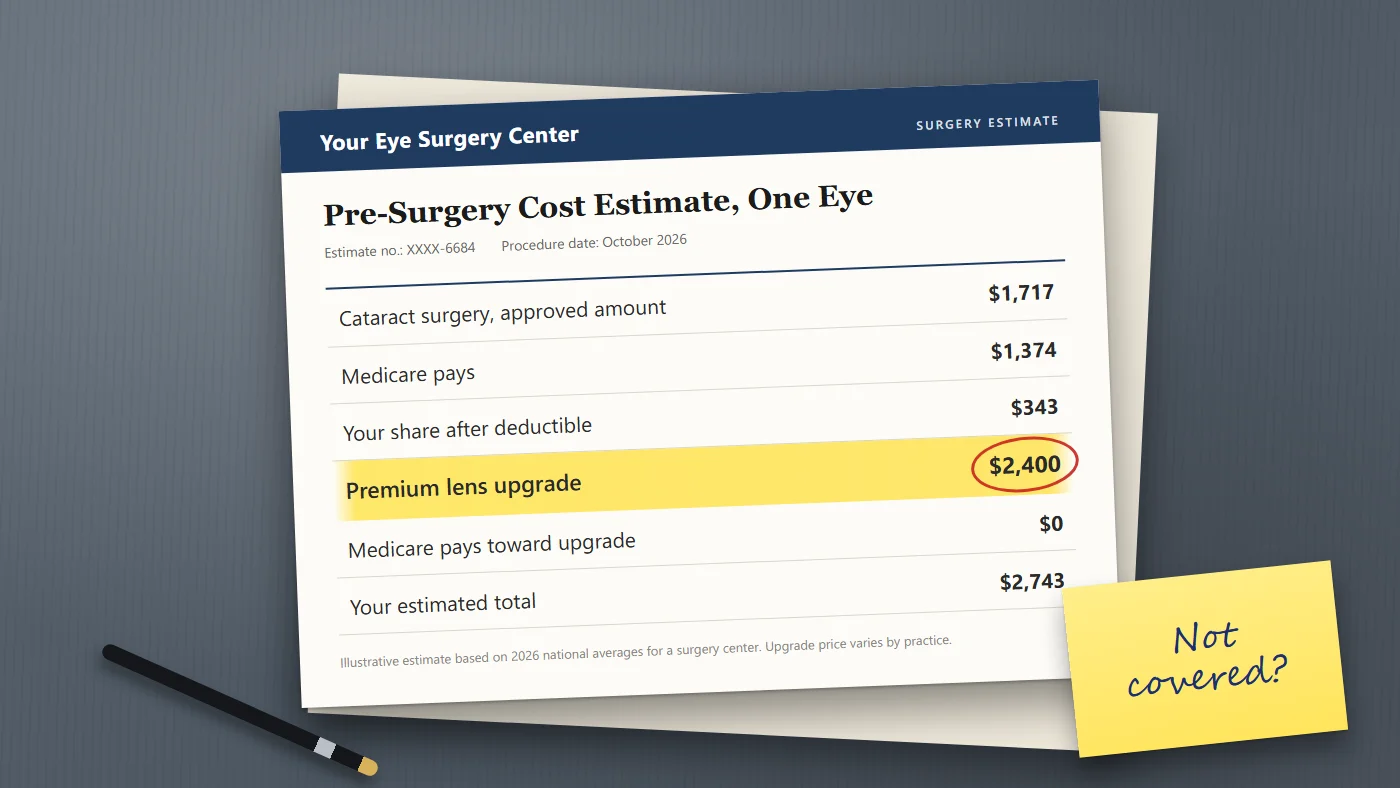
Medicare's own 2026 estimate puts your share of cataract surgery at $343 per eye at a surgery center. The lens upgrade offered at the consult is a separate, uncovered charge that can run $1,500 to $3,000 an eye.
 Margaret Linwood
Updated Sep 22, 2026 · 10 min read
Few operations come with a price Medicare will show you ahead of time. Cataract surgery does. Look it up in Medicare's Procedure Price Lookup and you'll find a 2026 national average for your share: $343 per eye at an ambulatory surgical center. At a hospital outpatient department, it's $563. Both figures cover the surgeon and the facility, and both assume you've already met the Part B deductible.
Then comes a conversation plenty of people don't see coming. Somewhere between the exam and the surgery date, the office explains that Medicare covers a "conventional" lens, and it offers an upgrade: multifocal, extended-depth, toric, "premium." Medicare won't pay for that part. So what does it cost you? Roughly $1,500 to $3,000 per eye, going by the price guides clinics have published for 2026, and some quotes run higher. Do both eyes and it can turn into a $6,000 decision, stacked on top of a surgery you were told was covered.
Covered or not? Both, which is what makes it confusing. The surgery is covered. The extra cost of a premium lens isn't, and your surgeon is allowed to bill you for the difference. That permission goes back to two CMS rulings, one from 2005 and one from 2007.
How many people run into this? A lot. Past age 80, more than half of Americans either have cataracts or have already had surgery to remove them, according to the National Eye Institute.
This article is about the money: what Medicare pays, what the upgrade adds, how the facility changes your share and what to ask before you sign. Whether a particular lens suits your eyes is a question for you and your surgeon. Nothing here answers it.
What Medicare covers, and what it doesn't
The benefit fits in one sentence on Medicare.gov: Part B covers cataract surgery that implants "conventional intraocular lenses." Your share is 20% of the Medicare-approved amount, owed to the facility and to the doctor once you've met the Part B deductible ($283 in 2026).
There's a second covered item most people never hear about. After each cataract surgery that implants a lens, Part B covers one pair of eyeglasses with standard frames or one set of contact lenses. You pay 20% of the approved amount, plus the full cost of any upgraded frames, and you've got to buy from a supplier enrolled in Medicare. Ask the surgeon's office for the paperwork before you head to the optical shop.
Medicare stops at the lens that does more than a conventional one, such as correcting presbyopia or astigmatism. It pays what it would've paid for a conventional lens and the covered surgery. Your provider can charge you for the rest, as long as you're told first. That arrangement started with presbyopia-correcting lenses, in CMS Ruling 05-01 (May 2005). CMS Ruling 1536-R extended it to astigmatism-correcting lenses in 2007.
The number to remember: $343 per eye, Medicare's 2026 national average for your share of standard cataract surgery at a surgery center. A premium lens upgrade is billed separately and isn't covered. Published 2026 price guides put it at about $1,500 to $3,000 per eye.
Where you have it changes your share
One procedure, code 66984, carries two different price tags in Medicare's tool. Why? The facility fee.
| 2026 national averages, one eye | Ambulatory surgical center | Hospital outpatient department |
|---|
| Doctor fee | $462 | $462 |
| Facility fee | $1,255 | $2,357 |
| Total cost | $1,717 | $2,819 |
| Medicare pays | $1,374 | $2,256 |
| You pay (average) | $343 | $563 |
Source: Medicare.gov Procedure Price Lookup, based on 2026 payments and copayments. Amounts vary by location, and the tool notes that treatment may include more than one procedure.
Two things follow. Because most surgeons operate at only one or two places, the facility is often settled the moment you pick the surgeon, well before anyone mentions a price, so it's a question for the very first visit. And a Medigap policy may pay some or all of the 20%, which is why many people with a supplement see a bill near zero for the covered part. A Medicare Advantage plan sets its own copays for outpatient surgery, listed in its Evidence of Coverage.
None of that touches the upgrade. With Medigap, with Advantage or with Original Medicare alone, the premium lens difference is a non-covered charge. It comes out of your pocket. All of it.
What should the "premium" quote contain?
"Premium" covers several different products and services, and the quote should say which ones you're paying for.
There are two big families: a presbyopia-correcting lens, designed to reduce reliance on reading glasses, and an astigmatism-correcting (toric) lens, designed to correct astigmatism. Some do both. Each carries its own price, and the surgeon's fee for placing one may run higher than for a conventional lens, too.
Some offices fold laser-assisted steps or extra measurements into the upgrade package. Under CMS guidance, the extra charge is allowed for the part tied to the vision correction you chose, not for the cataract removal Medicare already pays for. A clean quote shows which is which.
Say you're getting both eyes done. The covered surgery leaves you $343 per eye, $686 for the pair, before any supplement. Then the office quotes a premium lens package at $2,400 per eye. Add it up and you're at $5,486 out of pocket. And the upgrade's slice of that? $4,800. Even if a Medigap plan picks up the $686, you still owe the $4,800.
Those numbers are made up. The split isn't: the two parts are billed and covered differently, and you should see them on separate lines before you decide anything.