Taxes
IRS First-Time Penalty Abatement and Payment Plans: What to Ask For and How
A clean three-year record can get a late-filing or late-payment penalty removed with one phone call, and the IRS has started doing part of it automatically. Who qualifies, what to say, and what a payment plan actually costs.
 Ray Castellano
Updated Sep 22, 2026 · 10 min read
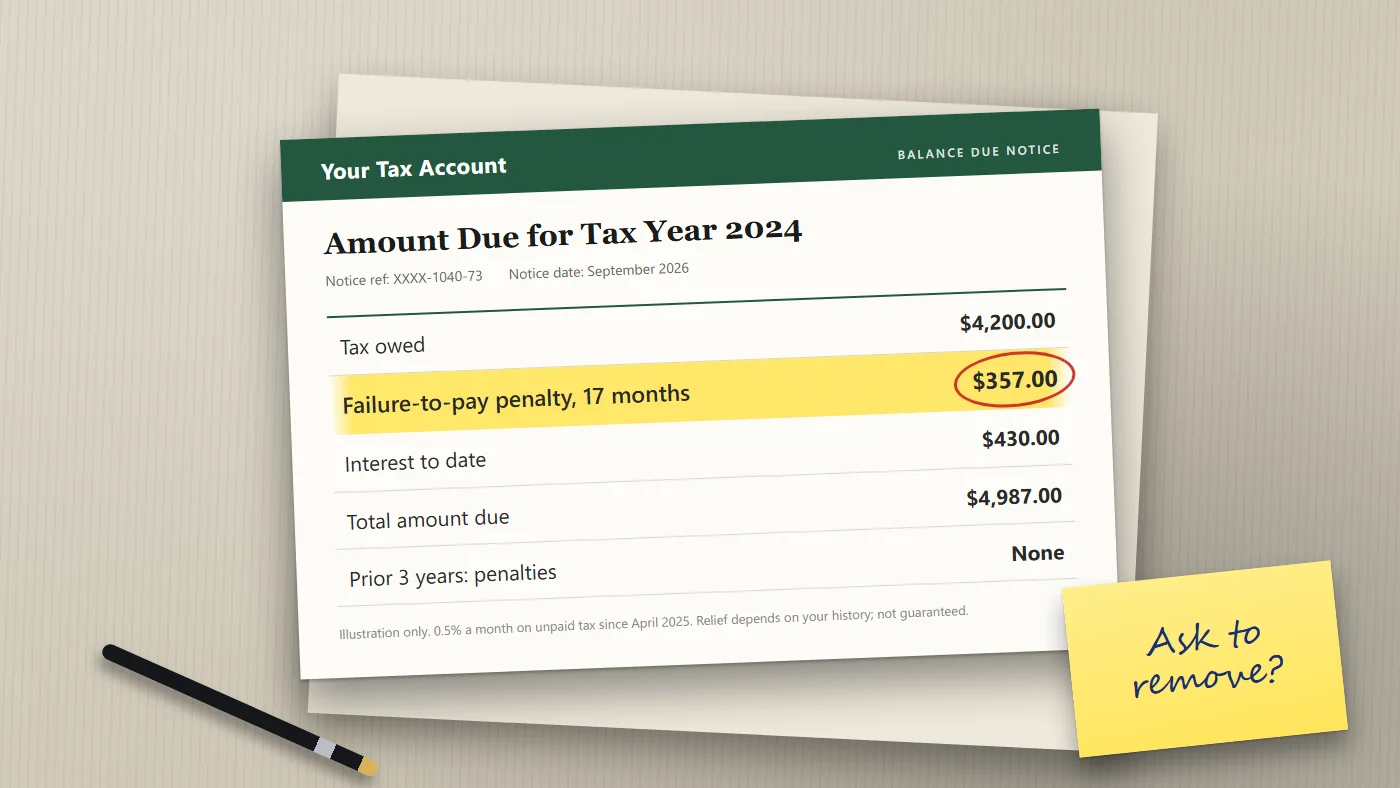
The envelope says Department of the Treasury. Inside is a notice with a balance, and under the tax you expected sits a line you didn't: a penalty, often with interest already stacked on top of it.
The IRS hands out a lot of these. In fiscal year 2025 it assessed 46.7 million civil penalties on individual, estate and trust income tax accounts, worth $33.1 billion. The most common one by far was the failure-to-pay penalty, assessed 24.3 million times.
Now the number the notice leaves out. That same year the IRS removed 3.9 million of those penalties, worth $7.5 billion, including more than 3.1 million failure-to-pay penalties. One of the main ways that happens is a policy called first-time abatement. You use it by asking.
Asking costs nothing. You don't need a lawyer. There are exact conditions, though, and if you don't meet them the answer is no. Below: the conditions as the IRS words them, what to say on the phone, what a payment plan costs, and where the "settle for less" offers you see advertised actually fit.
Which penalties can come off?
First-time abatement covers three penalties. Two of them show up on ordinary individual notices.
| Penalty | How it's figured | Cap | Notes |
|---|
| Failure to file | 5% of the unpaid tax for each month or part of a month the return is late | 25% | For returns due after December 31, 2025, a return more than 60 days late carries a minimum of $525 or 100% of the tax due, whichever is less. |
| Failure to pay | 0.5% of the unpaid tax for each month or part of a month | 25% | Drops to 0.25% a month during an approved payment plan if you filed on time. Rises to 1% a month if you don't pay within 10 days of a notice of intent to levy. |
| Failure to deposit | Applies to employers who miss payroll tax deposits | Varies | Not relevant to most individual filers. |
When both the filing and payment penalties run in the same month, the filing penalty is reduced by the payment penalty. So the combined charge is 5% a month, not 5.5%, and after five months the filing penalty maxes out while the payment penalty keeps going.
Interest is its own animal. The IRS charges it on unpaid tax and on penalties, compounded daily, at the federal short-term rate plus 3 percentage points. For the quarter starting October 1, 2026, the rate on individual underpayments is 7%. You can't get interest removed by itself, but the IRS says it'll automatically reduce or remove the interest tied to a penalty when that penalty comes off.
The first-time abatement rules, word for word
The IRS calls this administrative relief, and it rests on one idea: a clean record. Its first-time abate page, last reviewed July 14, 2026, says you may qualify if you have a timely compliance history, meaning:
- The same type of return was filed on time for the prior three years. For a Form 1040, that's your three prior individual returns.
- In those three years, no penalty was assessed (other than an estimated tax penalty), or one was assessed and later removed for reasonable cause or because of an IRS error.
The IRS also wants you current now, with required returns filed or on extension, and the tax paid or a payment arrangement in place. Owe a balance you haven't dealt with? Ask about a payment plan on the same call.
There are limits. The relief doesn't apply to returns filed once or only rarely, and the page lists only the three penalties above, so an accuracy-related penalty from an audit isn't covered. Nothing is guaranteed, either. The agent reviews your account history, and a penalty from two years ago means no. At that point the fallback is reasonable cause, covered further down.
3.15 million. That's how many failure-to-pay penalties the IRS removed from individual, estate and trust accounts in fiscal year 2025, out of 24.3 million assessed, according to the IRS Data Book. Their value: $5.0 billion.
One timing detail costs people money. The failure-to-pay penalty keeps growing until the tax is paid in full. If the IRS grants first-time abatement while you still owe, the penalty already assessed comes off, but new penalty keeps piling up on the unpaid balance every month until it's paid, so the cleaner order is to pay the tax first, or at least set up a plan, and only then ask.
What changed in 2026. The same IRS page says that starting in summer 2026, the agency is applying what it calls an automatic exemption from penalty. If you file or pay late but have the clean three-year history, the IRS says it won't assess the penalty at all. You don't have to ask. It covers Form 1040 and several business returns, beginning with 2025 tax year returns.
If that holds, a penalty on a 2025 return with a clean history behind it may never show up. Penalties for 2024 and earlier, and any case the automatic check misses, still go the old route: you call and ask. So the rest of this piece is about that call.