Debt & Credit
The Scams Targeting Americans Over 60 Right Now — and How to Lock Down Your Identity
The calls sound more real than they used to. The defenses are still simple, mostly free, and take about an hour to set up.
 Ray Castellano
Updated Sep 22, 2026 · 11 min read
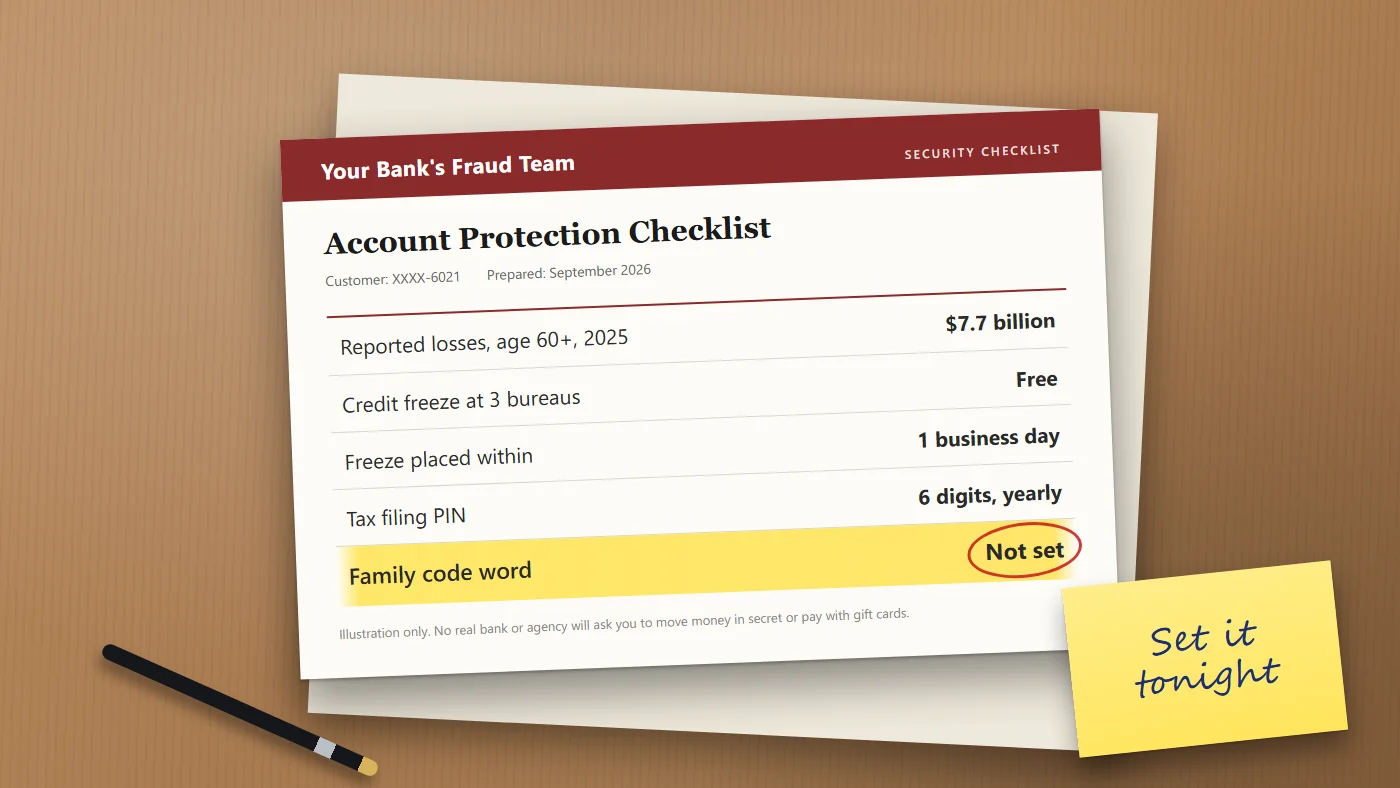
Americans age 60 and older filed 201,266 fraud complaints with the FBI's Internet Crime Complaint Center in 2025, and they reported losing $7.7 billion. That's up 59% from 2024. It's one year, one agency, and it counts only the people who came forward.
Most of that money isn't lost to clumsy emails with bad spelling. It goes out over the phone, in calm conversations with someone who claims to be your bank, a federal agent, a computer technician or your grandchild. The newest version of that last one uses software to copy a real voice.
You don't need to become a security expert. Nearly every one of these scams depends on two moves: getting you to act fast, and getting you to send money in a way that can't be reversed. Learn to spot those two moves and most of the scripts fall apart.
There's a second, quieter risk. After years of data breaches, your Social Security number and date of birth may already be in criminal hands, sitting in a file somebody bought for a few dollars. You can't pull that information back. You can make it much harder to use, and the main tools are free.
The number: $7.7 billion. That's what people 60 and older reported losing to fraud in 2025, according to the FBI's Internet Crime Complaint Center, across 201,266 complaints. The average reported loss was about $38,500. The FBI has said for years that many victims never report, so the real total is likely higher.
The call that sounds like your grandchild
What follows is the pattern as the Federal Trade Commission and the FBI describe it, pieced together from their warnings rather than from any one family's story.
The phone rings. A young voice, shaky and upset, says there's been a car accident or an arrest. It sounds like your grandson. He begs you not to tell his parents. Then someone else takes the phone, a "lawyer" or an "officer," who says bail or a fee has to be paid today.
Could that really be a fake? Yes. The FTC warns that all a scammer needs is "a short audio clip" of a family member's voice, which he can pull from videos posted online, plus a voice-cloning program. In December 2024 the FBI put out a public alert saying criminals are generating short audio clips of a loved one's voice to pose as a relative in a crisis and ask for money right away.
These callers lean on two pressures, according to the FTC. Urgency: you're the only one who can help, and it has to be now. Secrecy: don't tell anyone. They'll ask for a wire transfer, cryptocurrency, a payment app, or gift cards with the numbers read over the phone. What those methods share is that once the money moves, it's very hard to get back.
The five scripts behind most of the losses
| Script | How it starts | How they want to be paid | The tell |
|---|
| Family emergency | A call from a "grandchild" in trouble, sometimes with a cloned voice | Wire, gift cards, crypto, payment app | "Don't tell Mom and Dad" |
| Fake bank or fraud department | A call or text about suspicious charges on your account | "Move your money to a safe account" | Your real bank won't ask you to move money to protect it |
| Government impersonator | A caller says your Social Security number is tied to a crime | Crypto ATM, cash, gold handed to a courier | Threats, plus a demand for secrecy |
| Tech support | A pop-up says your computer is infected and gives a number to call | Remote access to your computer, then a bank transfer | Real security warnings don't ask you to call a phone number |
| Investment and crypto | A friendly contact online shows you "profits" on a trading site | Crypto deposits that keep growing | Deposits are easy, withdrawals never go through |
Investment fraud cost people over 60 more than any other category in 2025: about $3.5 billion in reported losses. Cryptocurrency was behind most of it. Tech-support scams came second, at just over $1 billion.
The FTC looked at the biggest losses in a report published in August 2025. Among older adults hit by impostor scams, the number of reports of losses of $10,000 or more rose more than fourfold from 2020 to 2024. Reports of losses above $100,000 rose nearly sevenfold. The FTC tied these cases to three lies: someone is using your accounts, your information is being used to commit crimes, or your computer has a security problem. Each one ends the same way. The caller offers to help you "protect" your money by moving it.
Then there's the courier version, which the FBI has warned about since early 2024. Victims are told to pull out cash or buy gold bars, and a courier shows up at the house to collect. The FBI's warning is blunt: the U.S. government and legitimate businesses will never ask you to buy gold or other precious metals.
Knowing the scripts helps. A handful of habits and account settings help more, because they still work on a day when you're tired, worried or caught off guard, and they take about an hour.