Retirement
How to Find a Lost 401(k) From an Old Job — and What to Do With It
The money doesn't disappear when you forget a plan, but it can be moved, cashed out or handed to a state without you knowing. A few free searches cover most cases.
 Ray Castellano
Updated Sep 22, 2026 · 10 min read
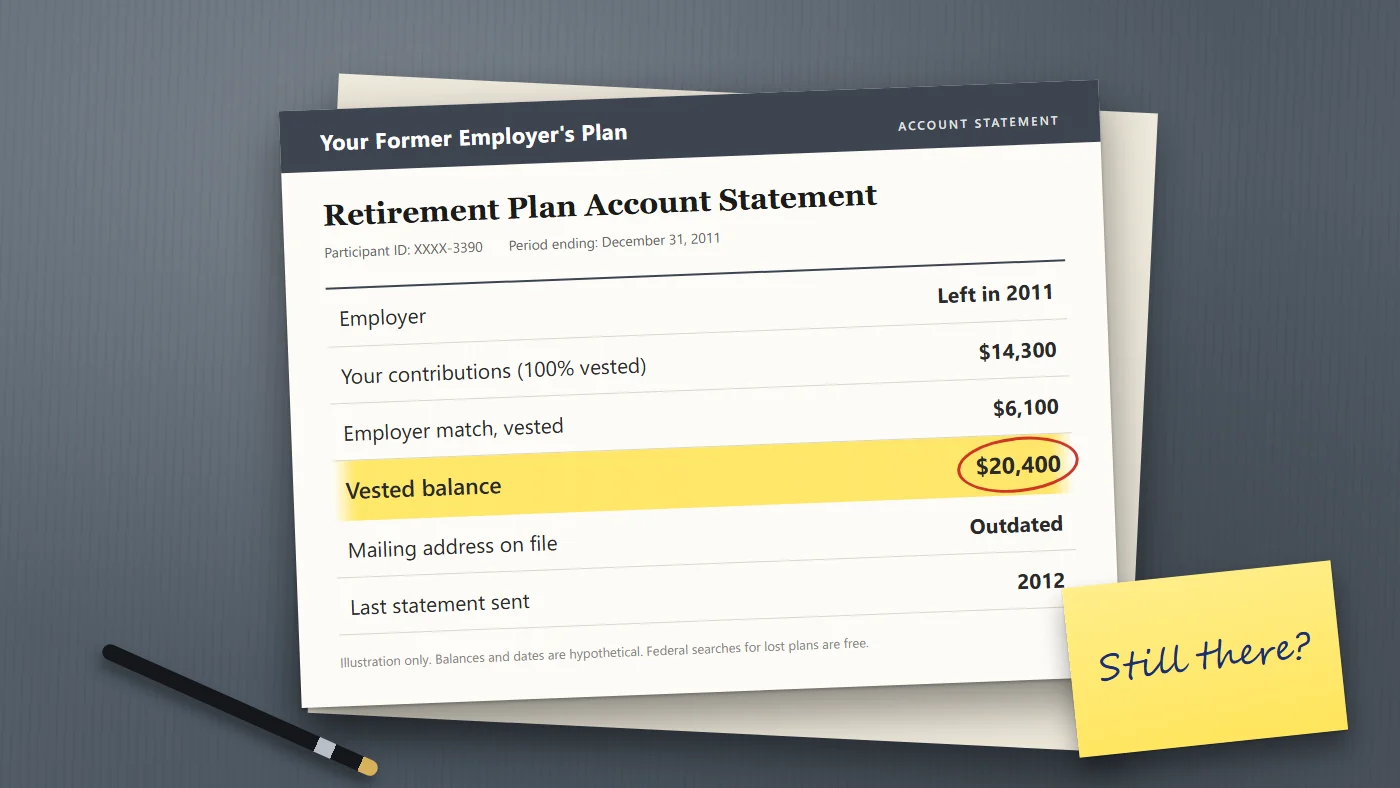
Think back through your work history. The job in the 1990s that lasted three years. The company that got bought. The one you left in a hurry. If any of them offered a 401(k) and you signed up, there may be an account with your name on it that you haven't looked at in a decade or more.
That money doesn't vanish. Your own contributions are always yours, and so are vested employer contributions. But a forgotten account can move without your say. Plans are allowed to push small balances out to an IRA you never picked, companies merge and switch recordkeepers, and uncashed checks end up with state unclaimed property offices. The account's still yours. You just have to find where it went.
The search is free and takes an evening. Since December 2024 the Department of Labor has run a database built for exactly this, and the federal pension insurer keeps another for plans that shut down. How much money slips through? In fiscal year 2025 alone, the Labor Department's enforcement staff helped 8,015 people collect $512.5 million in pension benefits their old plans owed them but hadn't paid.
This article covers where to look, in order, and then what to do once you find the account. That second decision is where people lose money to taxes.
Where does a forgotten account end up?
An old 401(k) balance can be in one of five places, and each has its own search.
Still in the old plan. The most common case. The employer's still around, the plan's still around, and your balance has been sitting in the default investment. The statements stopped when you moved and didn't update your address.
In a different plan under a different name. The company was bought, merged, or changed recordkeepers, so the plan may have a new administrator and a new sponsor name.
In an IRA you didn't open. Federal rules let a plan force out small balances after you leave. Under the tax code, a plan can pay out a vested balance of $7,000 or less without your consent (the cap was $5,000 before 2024), and the Labor Department's participant guide says amounts over $1,000 have to go into an IRA rather than to you in cash unless you choose otherwise. That IRA usually sits with a custodian the plan chose, parked in a conservative investment, and it may be charging a fee that's been nibbling at a small balance for years.
With the Pension Benefit Guaranty Corporation. PBGC holds unclaimed benefits for people who weren't paid when their retirement plan ended. Most are traditional pensions, but its search also covers 401(k)-style plans that closed and sent missing participants' money to PBGC.
With a state unclaimed property office. If the plan mailed a distribution check and nobody cashed it, the money can eventually be turned over to the state of your last known address.
| Where it might be | Free search | What you need |
|---|
| Private-sector pension or 401(k)-type plan, if you're 65 or older | DOL Retirement Savings Lost and Found, lostandfound.dol.gov | A Login.gov account verified with a state ID |
| Plan that ended and sent money to PBGC | PBGC unclaimed benefits search, pbgc.gov | Last name and last four digits of your Social Security number |
| Employer out of business, plan being wound down | EBSA Abandoned Plan Search | Plan or employer name and location |
| Any plan that still files annual reports | EBSA Form 5500 search | Employer name |
| Uncashed check turned over to the state | unclaimed.org, run by the state administrators' association | Your name and past states of residence |
$512.5 million. That's what 8,015 people collected in fiscal year 2025 with help from the Labor Department's enforcement program for terminated vested participants in pension plans, an average of about $64,000 each. The figure counts lump sums and the present value of lifetime payments the plans owed but hadn't paid.
The federal database that didn't exist two years ago
Congress ordered the Retirement Savings Lost and Found in the SECURE 2.0 Act and gave the Labor Department until December 29, 2024, to build it. It's live at lostandfound.dol.gov.
What's in it? Private-sector plans, both traditional pensions and 401(k)-type plans, that reported a former employee with a vested benefit. The core data comes from Form 8955-SSA, which plans have filed for years to report people who left with benefits they hadn't claimed. A newer intake portal lets plans add current data, and the Labor Department's data request to plans asks for former employees who are owed a benefit and are 65 or older. So if you're younger, your old plan may not show up yet.
You can search only for yourself. You'll need a Login.gov account verified with a state-issued driver's license or ID, plus a phone number tied to public records. Results show plans linked to your Social Security number, along with the administrator's contact information.
Two caveats from the department itself. A listing shows that you once participated, not that money is still there, because the benefit "may have already been paid out, rolled over into another retirement account, or provided as an annuity." And the contact details can be stale, since they come from older filings that don't reflect later mergers or administrator changes.
The database doesn't cover IRAs, government plans, some religious employers' plans, or Social Security. That's why the other searches still matter, and why the order you run them in makes a difference.