Debt & Credit
How to Get Out of a Timeshare: The Legitimate Exits and the Scams to Avoid
The resort won't tell you how to leave. The exit company on the radio will charge you thousands to make one phone call. There's an order that works.
 Margaret Linwood
Updated Sep 22, 2026 · 10 min read
About 10 million U.S. owner families hold a timeshare, according to the industry's own trade group. Plenty of them signed years ago, when the kids were young and the sales presentation came with a free breakfast. Now the maintenance bill shows up every year, often a little bigger than the last one, for a week nobody uses anymore.
Will the resort buy it back for anything close to what you paid? No. Resale sites are crowded with identical weeks listed for a dollar and no takers. And the companies advertising "guaranteed timeshare cancellation" have a record that should worry you. In one case brought by the Federal Trade Commission and the Wisconsin Attorney General, a group of exit companies took more than $90 million from owners, mostly older adults. In April 2026 a federal court ordered the man who ran it to pay $140 million.
Yet there are legitimate ways out. The first one costs nothing. Even the FTC's own advice opens with a line most owners have never heard: start by contacting your timeshare company directly.
What follows walks through the exits in the order that costs you least, describes how a scam sounds on the phone, and takes on the question exit salesmen lean on hardest. Will your children be stuck with the fees?
$90 million and $140 million. The first is what the FTC says one group of timeshare exit companies took from consumers. The second is what a federal court ordered its operator to pay in April 2026: $95 million for consumer redress and a $45 million civil penalty. The FTC's complaint said the companies told owners they couldn't exit without paying, then denied nearly every refund.
Why can't you just sell it?
A timeshare isn't real estate in the usual sense, even when it comes with a deed. It's a crowded market with almost no buyers, and the few people who do want a week at your resort can usually get one from the developer in the lobby, with financing and a full sales staff eager to help, or on a resale site for next to nothing. The FTC puts it plainly: the market is overcrowded, and it might be hard, if not impossible, to sell a timeshare.
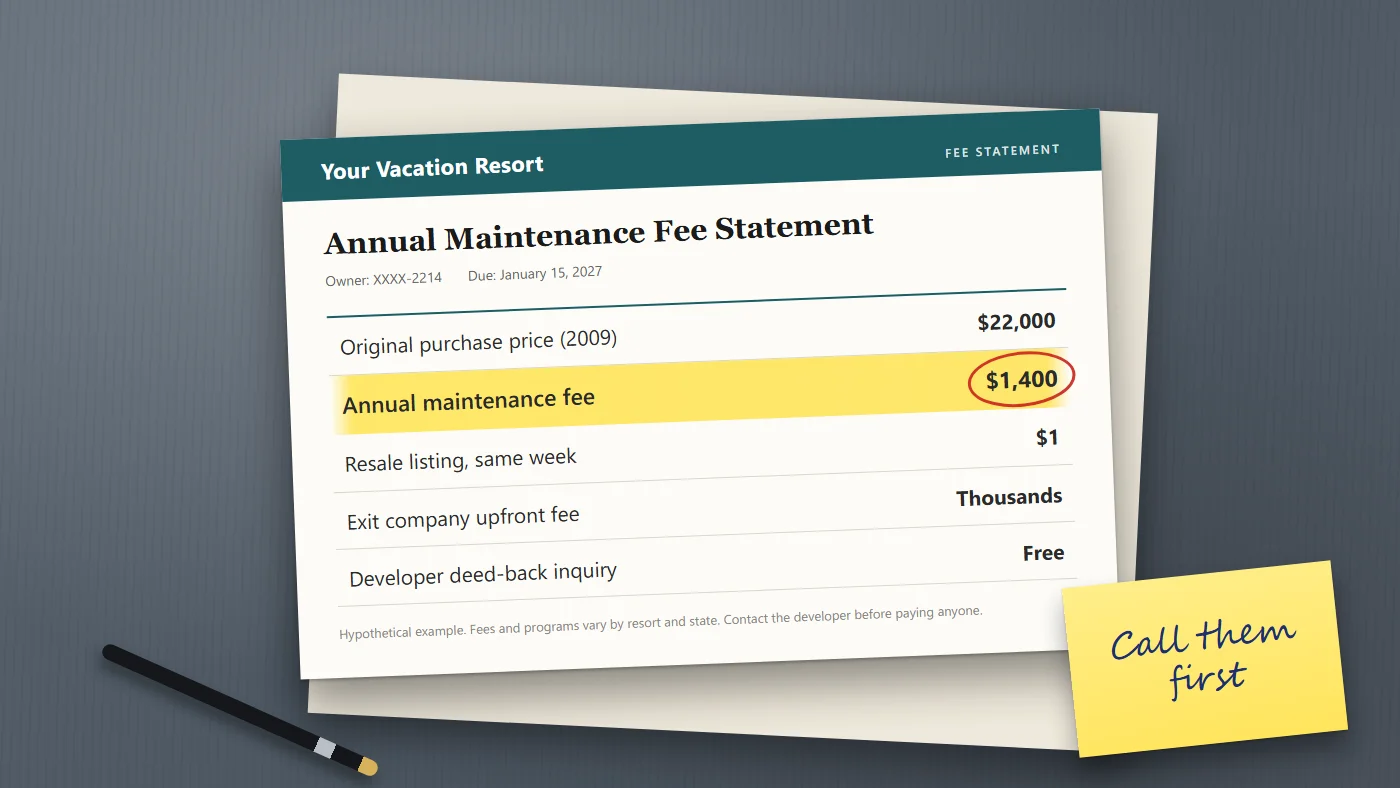
Say an owner paid $22,000 for a deeded week in 2009 and now pays about $1,400 a year in maintenance fees. On the resale market that week may be worth close to nothing. What she paid barely matters now. The $1,400 does, because it comes due every year for as long as she owns the week, plus any special assessment when the resort needs a new roof or a pool rebuilt.
Ten more years of that is $14,000, before a single increase.
That's why "we have a buyer for your unit" works so well as a lie, and why the FTC flags the "lots of buyers ready to purchase" pitch as doubtful.
The four exits, cheapest first
| Exit | Cost to you | Who it works for | Where it gets hard |
|---|
| Rescission (cancel the purchase) | Free | Buyers still inside the state's cancellation window | The window is short |
| Deed-back or buyback through the developer | Often free; sometimes a fee or one more year of dues | Owners who are paid up, with no loan balance | The developer decides, and not every resort has a program |
| Resale or giving it away | Low, if you pay nothing upfront | Desirable resorts and weeks | Most weeks sell for very little, and upfront-fee "listing" services are a red flag |
| Attorney-led exit | Legal fees | Owners with a real dispute: misrepresentation, fraud, an unenforceable contract | Costly, slow, and not a fit for "I just don't want it anymore" |
Even the Coalition for Responsible Exit, part of the owners' group ARDA-ROC, says it directly: you can exit your timeshare without an exit company, and the process is the same with or without one. Those words don't come from a consumer watchdog. They come from the industry.
Signed recently? Cancel now
Timeshare laws in many states give buyers a rescission period. In Florida, one of the biggest timeshare states, you have until midnight on the 10th calendar day after the later of two dates: the day you signed, or the day you received the last of the required documents. And that right can't be waived, by you or by anyone acting for you. Other states set their own windows, commonly somewhere between a few days and two weeks, so read the cancellation paragraph in your own contract.
Inside the window? Send a written cancellation exactly the way the contract says, usually by certified mail to a specific address. Do it today. Don't call the sales office first, and don't agree to an "upgrade" meeting.
A different rule covers contracts you signed with an exit company at a hotel seminar or in your living room. The FTC's Cooling-Off Rule gives you three business days to cancel many sales made at your home or at a seller's temporary location, like a rented hotel ballroom. Three business days, not ten. In the $90 million case, the FTC alleged that the companies pushed people into contracts they were told they couldn't cancel, in violation of that rule.
That covers the owners who moved fast. Everyone else has a longer road, and it starts with a phone call that costs nothing.