Picture $100,000 sitting in a savings account the year you turn 65. You could hand it to an insurer, and it would mail you a check every month for as long as you live. So what would that check actually be?
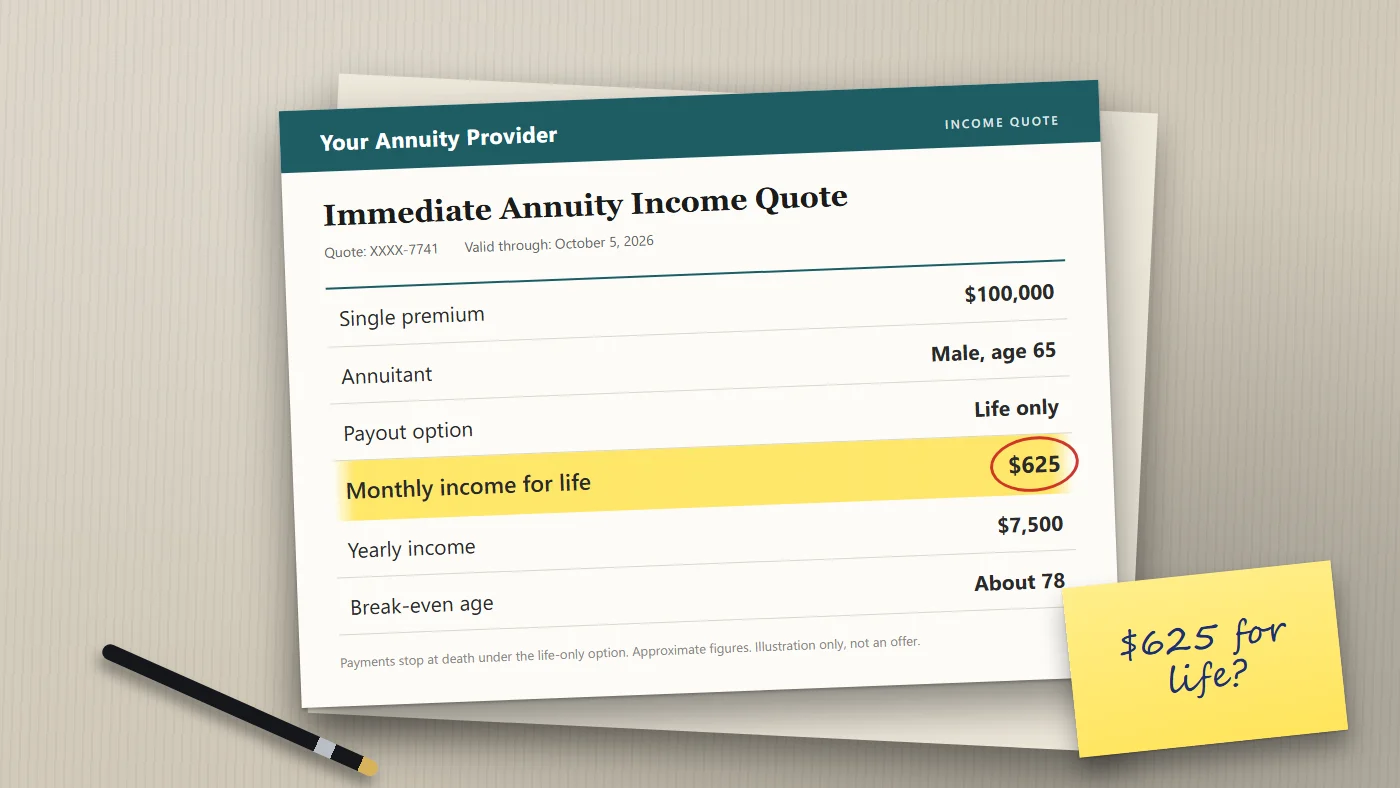
For a man, about $625 a month.
For a woman the same age, a bit less: about $590.
If that sounds modest for six figures, you're reading it right. It isn't built to make you rich; it's built to keep arriving in your 80s and 90s. Both estimates are for the plainest version of the product, a single premium immediate annuity that covers one life, and they come from an Annuity.org analysis. CBS News published it on September 2, 2026.
Can you do better by shopping? Sometimes. A survey of the best quotes on offer, dated July 29, 2026, had the same 65-year-old man at $689 a month. Call his realistic range $625 to $690. Treat every number in this article as approximate, though. Payouts drift up and down with interest rates, and your own quote will hinge on your age, sex, state and which insurer you ask.
Of all those, age moves the check the most.
Sign at 60 and the $100,000 gets you roughly $530 a month. Wait until 70, and it's about $750. By 75, about $920. The reason is a little grim: the older you are on the day you buy, the fewer checks the insurer expects to mail.
And plenty of people are signing. Americans put a record $123.9 billion into annuities in the second quarter of 2026. That's LIMRA's preliminary count, and it marked the 11th quarter in a row above $100 billion.
The worry behind all that money isn't hard to spot. If you're in your 60s, you may need savings to last 25 or 30 years. Few private-sector workers retire with a traditional pension now. And one bad market year, at the wrong moment, can take a bite out of a nest egg that never grows back. Savings can run dry at 88. An annuity for life is a contract to keep paying at 88, at 98 and beyond.
That promise costs something, and the monthly figure won't tell you what. Start with the table, then the fine print.
What $100,000 buys, by age
Figures assume life-only coverage and a first check right away, from the same Annuity.org analysis. All approximate.
| Age at purchase | Man, per month | Woman, per month | Man, per year |
|---|
| 60 | $530 | $503 | $6,360 |
| 65 | $625 | $590 | $7,500 |
| 70 | $750 | $703 | $9,000 |
| 75 | $920 | $859 | $11,040 |
| 80 | $1,150 | $1,080 | $13,800 |
Notice the women's column runs lower at every age. The insurer expects a woman to collect for more years, on average, so it slices the same money thinner.
Now take the man who buys at 65. His checks add up to $7,500 a year, and it's tempting to divide by $100,000 and call that a 7.5% return. Don't. Part of every check is your own money coming back; interest and risk pooling cover the rest. Break-even is the fairer yardstick.
Break-even math: $100,000 ÷ $7,500 a year = 13.3 years. A man who buys at 65 gets his own money back at about age 78. Every check after that is the payoff for living a long time.
What does that look like in a real budget? Say you're 65 and single. Your basic bills run $2,900 a month, and Social Security sends $2,300. You're $600 short, every month. An immediate annuity bought with $100,000 closes roughly that gap for life, and that's the job this product does well.
Die at 70 on a life-only contract and the insurer keeps what's left. Live to 95, though, and you'll have collected about $225,000. It's insurance against a long life, and it pays best for the people still here at 90.
What you give up for the check
Access to the money. With an immediate annuity, the $100,000 isn't yours anymore. You can't pull out $20,000 for a roof or a hospital bill, and in most contracts the decision can't be undone once a short free-look period, set by state law, has passed.
Protection from inflation. The check is usually flat. Run 3% inflation for 20 years, and that $625 buys about what $346 buys today. Some insurers will sell you a yearly raise of 2% or 3%. The starting check shrinks noticeably to pay for it.
Money for heirs. Life-only means exactly that. You can add protection, and each kind costs you monthly income. Go back to our 65-year-old man. Add a 10-year guarantee and his check slips to about $608, per the same analysis. Make it a couple, both 65, with a joint annuity that pays until the second death, and it's about $536.
For a married couple, that joint figure is usually the one that counts, because a contract written on the husband's life alone stops when he dies, and his widow can be left with less income and no lump sum.
A shot at better rates later. The payout's locked on the day you buy. If rates rise next year, new buyers get bigger checks and yours stays put; if they fall, you come out ahead, and since nobody can call that in advance, some buyers spread their purchases over several years.
None of this makes an annuity a bad idea. It just means "how much does it pay?" is the first question, not the last. Next come how much of your savings to lock up and which product you're really being shown, because most things sold as an "annuity" aren't the one in that table.