Medicare
Your Annual Notice of Change: The 5 Lines to Read Before You Renew Your Medicare Plan
The letter your plan mailed in September is the only warning you get before its 2027 prices take effect, and staying silent until December 7 counts as accepting them.
 Margaret Linwood
Updated Sep 22, 2026 · 11 min read
If you're in a Medicare Advantage plan or a stand-alone Part D drug plan, your insurer had to get a document to you by September 30. It's called the Annual Notice of Change, or ANOC. It may have come as a thick envelope or, if you signed up for paperless delivery, as an email pointing you to your online account.
It looks like the rest of the fall mail from insurers, and that's the problem. This one isn't an ad. It's your plan telling you, in writing, what it'll charge and cover starting January 1, 2027: premium, deductible, copays, drug list, pharmacy network, extras. Any of it can change, and the plan doesn't need your agreement.
Your silence is the agreement. Do nothing between October 15 and December 7 and you're renewed into the 2027 version of the plan automatically.
For a lot of people that works out fine. For others, January brings a higher specialist copay, a drug that moved up a tier, or a dental allowance cut in half, and by then the main window to switch has closed.
Most of that is avoidable with twenty minutes and a pen. KFF found that 43% of Medicare Advantage enrollees didn't review their own plan for changes in premiums or other costs during a recent open enrollment, and 44% didn't check for changes in what it covers. Nearly 7 in 10 people on Medicare didn't compare their coverage with any other option.
Why read it closely this year?
Some years the changes are small. The 2027 plan year has more moving parts than usual.
The federal limits that drug plans build on are going up. The maximum Part D deductible rises from $615 to $700, and the cap on out-of-pocket drug costs goes from $2,100 to $2,400. A federal program that held down stand-alone drug plan premiums in 2025 and 2026 ends December 31, and plans are free to pass some of that along.
Insurers have been trimming, too. KFF counted 9% fewer Medicare Advantage plans in 2026 than in 2025, and among the plans that stayed, fewer offered an over-the-counter allowance (66%, down from 73%), a meal benefit (57%, down from 65%) or rides to appointments (24%, down from 30%). Some large insurers have said publicly that they're pulling back further for 2027.
None of that tells you what your plan will do. Only the notice does.
The five lines that move your costs
Near the front of the notice there's a summary table with two columns, this year and next year. Start there. You're looking for five lines.
Monthly premium. A jump from $0 to $24 is easy to spot. It's also usually the least important of the five, because the others can cost more.
Maximum out-of-pocket amount. It's the most you can be billed in a year for covered medical care, which makes it your real exposure if the year goes badly, say a hospital stay followed by weeks of outpatient treatment and specialist visits. Federal rules let plans set it as high as $9,250 for in-network care in 2026. Plenty of plans sit well under that. So they've got room to raise it.
Drug deductible and the copay for your tiers. Watch for a deductible that now applies to tiers that used to skip it, and for a flat copay that's turned into a percentage. A $47 copay becoming 25% coinsurance on a $600 drug means paying $150 a fill.
Hospital and specialist copays. Inpatient stays are often priced per day for the first several days. A move from $295 to $395 a day doesn't look like much until you multiply it.
Extra benefits. Dental, vision, hearing, over-the-counter cards and gym memberships aren't required by Medicare, so they're the easiest things for a plan to cut. Check the dollar allowance, not just whether the benefit still exists.
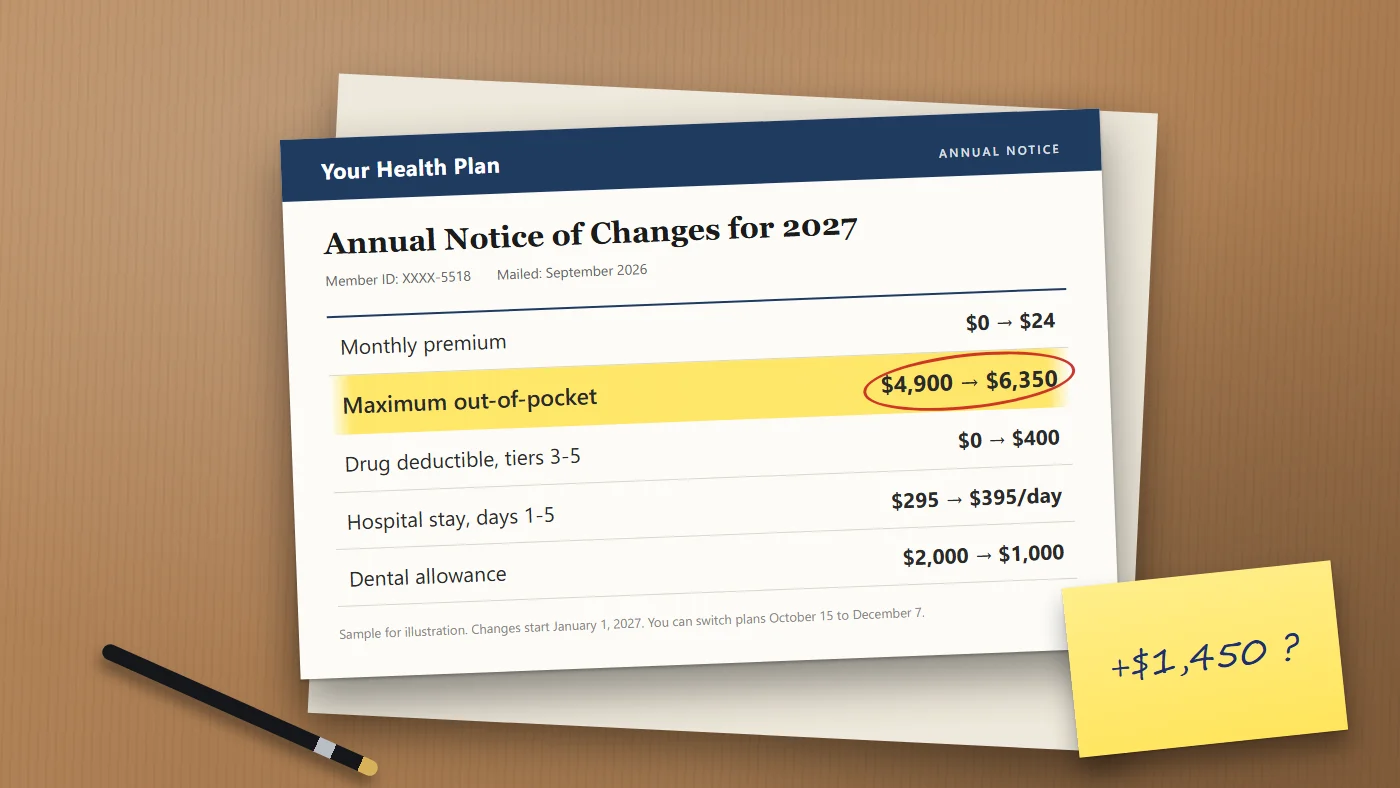
Say your notice looked like this. It's a made-up plan, but every line is the kind of change a real notice can carry.
| Line on the notice | 2026 | 2027 | What it means in a year |
|---|
| Monthly premium | $0 | $24 | +$288 |
| Maximum out-of-pocket | $4,900 | $6,350 | +$1,450 of risk in a bad year |
| Drug deductible (tiers 3 to 5) | $0 | $400 | Up to $400 more before coverage starts |
| Hospital stay, days 1 to 5 | $295 a day | $395 a day | +$500 for a five-day stay |
| Dental allowance | $2,000 | $1,000 | $1,000 less toward a crown or denture |
In this example the premium is the smallest change on the page: $288 a year. A year with one hospital stay, a brand-name drug and dental work adds about $1,900 more, and the ceiling on a truly bad year is $1,450 higher.
Someone who only checks the premium would call that a minor increase and renew.
There's something else the notice won't tell you, and for most people it's the question that matters more than any copay. You'll have to go find the answer yourself.