Medicare
2027 Social Security COLA: How Much of Your Raise Will Medicare Part B Take?
The raise is announced October 14, the Part B premium in November, and the second number is subtracted from the first before the money reaches your bank.
 Margaret Linwood
Updated Sep 22, 2026 · 11 min read
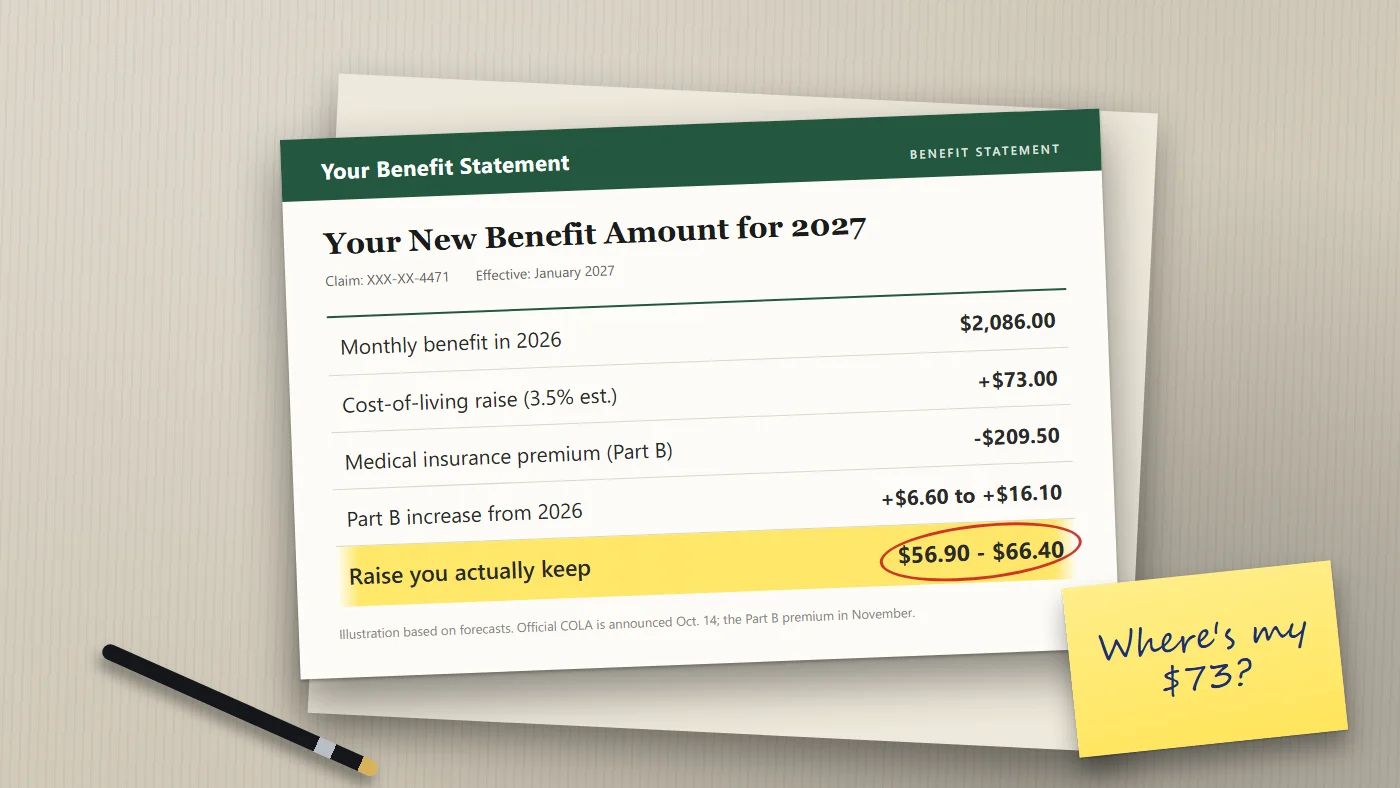
Social Security will announce the 2027 cost-of-living adjustment on October 14. The Senior Citizens League, which tracks the inflation data month by month, put its last forecast before the announcement at 3.5%. On the average retired worker's check, $2,086 a month as of July, that's about $73.
You won't see all of it. If you're on Medicare, your Part B premium comes out of your Social Security payment before the deposit lands, and that premium is going up too. It's $202.90 a month in 2026. The Medicare Trustees projected $209.50 for 2027 in their June report, while some private forecasters quoted in the financial press think it'll come in closer to $215 to $219, on the theory that the Trustees have lowballed costs before. Nobody outside CMS knows yet. The agency usually publishes the real number in November.
Two announcements, then, about a month apart. The second gets subtracted from the first.
Last year shows how that plays out. The 2026 COLA was 2.8%, which Social Security said worked out to about $56 a month for the average retiree. Then the Part B premium rose $17.90. Close to a third of the raise was gone before it reached anyone's bank account.
If the Trustees are right, 2027 looks gentler than that. If the private forecasts are right, it doesn't. Either way, the size of your own check decides how much of the raise you keep, and people with the smallest checks keep the smallest share.
Your raise, after Part B
The COLA is a percentage. The Part B increase is a flat dollar amount that's the same for nearly everyone. That mismatch is the whole story: a 3.5% raise hands a $3,000 check two and a half times as many dollars as a $1,200 check, and both pay the same premium increase.
The table runs a 3.5% COLA against both Part B forecasts. They're illustrations, not predictions for your account.
| Monthly benefit now | 3.5% raise | Left if Part B is $209.50 (+$6.60) | Left if Part B is $219 (+$16.10) |
|---|
| $1,200 | $42.00 | $35.40 | $25.90 |
| $2,086 (average retired worker) | $73.00 | $66.40 | $56.90 |
| $3,000 | $105.00 | $98.40 | $88.90 |
In the better case, Part B takes about 9% of the average retiree's raise. In the worse case it takes 22%. For someone living on $1,200 a month, the worse case eats 38% of the raise.
Why run the $219 column at all, if it's only a private guess? Because it's the high end of what's being floated, and if you're budgeting on a fixed income, planning around the worse number costs you nothing. If November comes in lower, the difference is a small pleasant surprise instead of a gap in the grocery budget.
In 2026 the average raise was about $56 a month and the Part B premium rose $17.90. Roughly one dollar in three never made it to the bank.
Why doesn't the raise keep up with Medicare?
The COLA is pegged to the Consumer Price Index for Urban Wage Earners and Clerical Workers, the CPI-W, averaged over July, August and September. It follows what working households spend money on. Groceries, rent, gas. It isn't built to follow what Medicare costs.
Part B runs on its own formula. By law the standard premium covers about a quarter of what Part B is expected to spend the following year on doctor visits, outpatient care and drugs given in a clinic, so when that spending grows faster than prices in general, the premium outruns your COLA. The Trustees' own projections put it at $255.50 a month by 2030.
A decent COLA year can still feel flat. One number follows the checkout line and the other follows health care spending.
The floor under your check
There's one protection written into the law, called the hold harmless provision. If the Part B increase in dollars is bigger than your COLA in dollars, your premium increase gets trimmed so your net Social Security payment doesn't fall below last year's.
With a 3.5% COLA it won't come into play for many people in 2027. A $6.60 increase is covered by the raise on any benefit above about $190 a month. Even a $16.10 increase is covered once your benefit tops roughly $460. Very few checks are that small.
It has gaps, though. The rule doesn't protect you if any of these apply:
- 2027 is your first year on Part B
- you pay the income-related surcharge known as IRMAA
- your premium is billed to you directly instead of withheld from your benefit
- your state already pays your Part B premium
So the floor is real, but it's only a floor. It promises your deposit won't shrink. It says nothing about how much of the raise you get to keep.
Part B isn't the only thing standing between your gross benefit and the money that shows up in your account, either. There can be up to three more deductions, and each one has its own fix. The notice that lists all of them arrives in December, after most of the choices that shape it have already closed.