Nobody wants to price out a nursing home. But if a parent or a spouse needed one next month, you'd want the number, so here it is. A shared room runs about $315 a day at the national median. Over a year that's $114,975. Want a private room? Closer to $129,575. Those medians come from CareScout's 2025 Cost of Care Survey, which came out in March 2026.
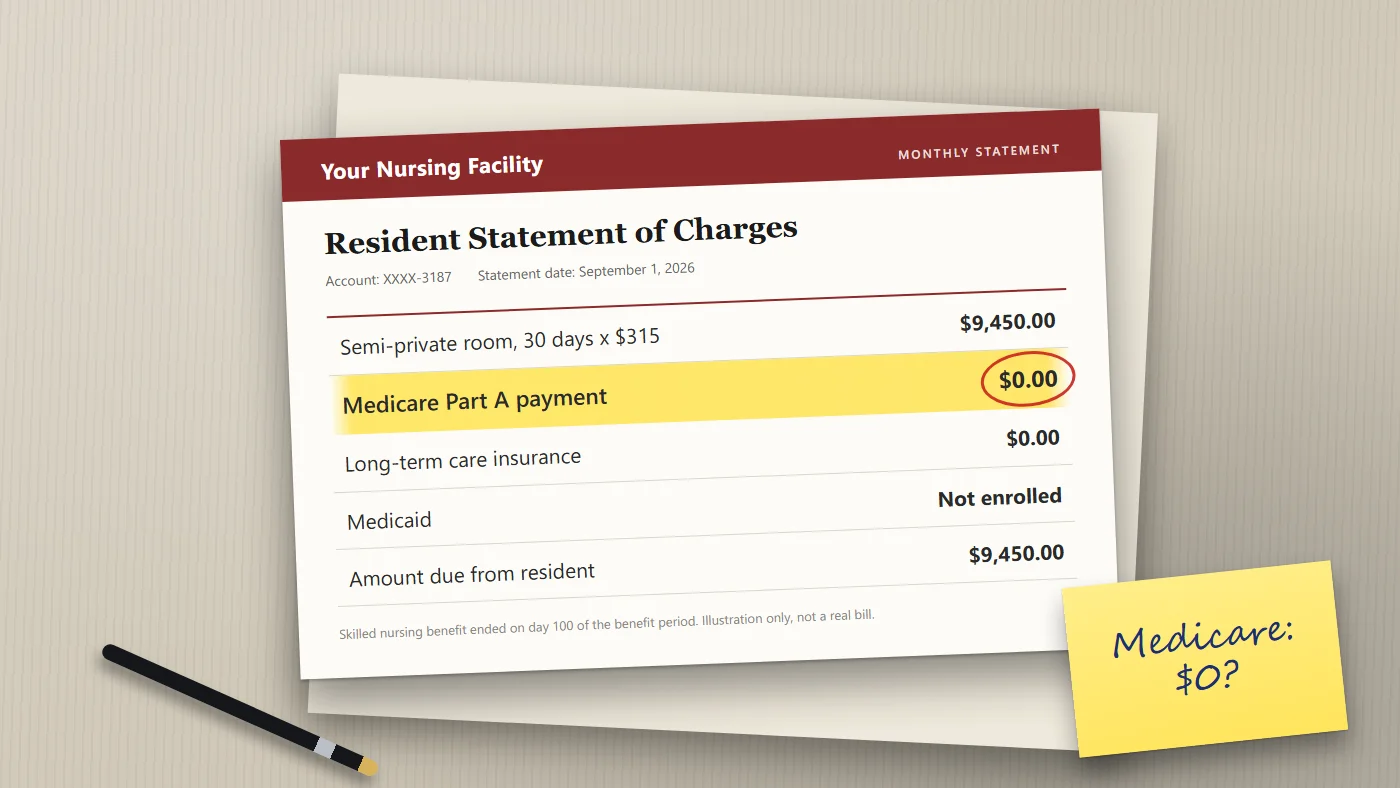
Now the part that catches families off guard. Medicare won't pay it. Its own website is blunt about that: "Medicare doesn't pay for long-term care." It'll cover a short stretch of skilled rehab after a hospital stay, and even that help stops on day 101.
So the money comes from somewhere else. First the family's savings. Then, when those run dry, Medicaid. That's how most nursing home stays end up getting paid, whether anyone planned it or not: of the roughly 1.24 million people in certified nursing facilities in July 2025, 63% had Medicaid as their main payer, KFF found.
A long shot? Probably not. If you're turning 65 now, your odds of needing some kind of long-term care are close to 70%, by the federal Administration for Community Living's estimate. And it's rarely quick. The average woman needs help for 3.7 years. For men it's 2.2. About one person in five will need it for more than five years.
For families, the bill starts before any invoice does. Maybe you're 55 and already driving to a parent's house twice a week. Then you're watching two things at once: their care now, and a preview of your own. You've got plenty of company, too, about 63 million family caregivers in 2025 by the count from AARP and the National Alliance for Caregiving. That's nearly 50% more than in 2015.
What care costs right now
Long-term care means help with ordinary life: bathing, dressing, eating, getting out of a chair, staying safe with dementia. It's custodial care, not medical treatment, and that label decides who pays.
The survey behind these national medians gathered more than 25,000 rates between July and November 2025.
| Type of care | Median rate | Per year |
|---|
| Nursing home, private room | $355 a day | $129,575 |
| Nursing home, semi-private room | $315 a day | $114,975 |
| Assisted living, one bedroom | $6,200 a month | $74,400 |
| In-home caregiver, 44 hours a week | $35 an hour | $80,080 |
| Adult day health care, 5 days a week | $95 a day | $24,700 |
Once you need most of a work week covered, care at home stops being a bargain; it costs more per year than a one-bedroom in assisted living. Assisted living, meanwhile, had the biggest increase of any category, up 5% in a year.
Prices swing by state and even by county. CareScout's lookup tool goes down to the ZIP code.
What does Medicare actually pay?
Part A covers a skilled nursing facility only when all of these line up. You were admitted to a hospital as an inpatient for at least three days in a row. You enter the facility within about 30 days of leaving. A doctor says you need daily skilled care, such as physical therapy or wound care.
Days spent in the hospital "under observation" don't count toward the three, even if you slept in a hospital bed the whole time. Ask the staff plainly: am I an inpatient?
If you qualify, the 2026 math per benefit period goes like this. Days 1 through 20 cost nothing beyond the $1,736 Part A deductible. Days 21 through 100 cost $217 a day. From day 101, it's all on you.
The number to remember: a full 100-day Medicare stay can still leave you with $17,360 in daily coinsurance (80 days at $217). After day 100, Medicare's share is $0.
Many Medigap plans pay that $217, so check yours. Medicare Advantage plans set their own copays for these days. Neither one pays for a permanent stay.
Coverage often ends well before day 100. Medicare pays while you need skilled care, and once the need drops to help with bathing and dressing and getting to the table, the benefit stops, whatever the calendar says. You do have the right to a fast appeal. The facility's notice explains how, and the window is short, so read it the day it arrives.
If you're married: what the healthy spouse keeps
Couples lose sleep over this one. One spouse moves into a nursing home, and the other watches the savings drain at about $9,600 a month.
Federal law does put a floor under the spouse who stays home, the one Medicaid calls the community spouse. Start with savings. In 2026 that spouse can keep as much as $162,660 in countable assets. The floor is $32,532, and your state's math decides where you land. The house, one car and personal belongings generally don't count while the spouse lives there.
Income gets a floor too. Since July 1, 2026, the at-home spouse's minimum monthly allowance has been $2,705, in every state but Alaska and Hawaii. The cap is $4,066.50.
The spouse in the nursing home gets far less room, usually $2,000 in countable assets. A few states go higher. California, which brought back its asset test in January, uses $130,000.
None of that makes the problem go away. It does mean "we'll lose everything" is usually wrong, and that the order in which you spend money matters a lot. Couples who learn the rules early tend to keep more than couples who learn them from the facility's billing office.
That's the price tag and the Medicare gap. The harder part is the decision: which of four ways to pay, what a policy costs at 55 or 65, and what to do while you still have choices.