A common family plan goes like this. Mom is in her late seventies and healthy, the house is paid off, and a friend says to put it in the kids' names now so a nursing home can never touch it. A deed gets signed. Everyone feels better.
Then the deed does its damage. When someone applies for Medicaid to cover a nursing home, the state reviews every gift and every below-market transfer from the previous 60 months. A house given away inside that window counts as a gift at full market value, and Medicaid refuses to pay for a stretch of time based on that value.
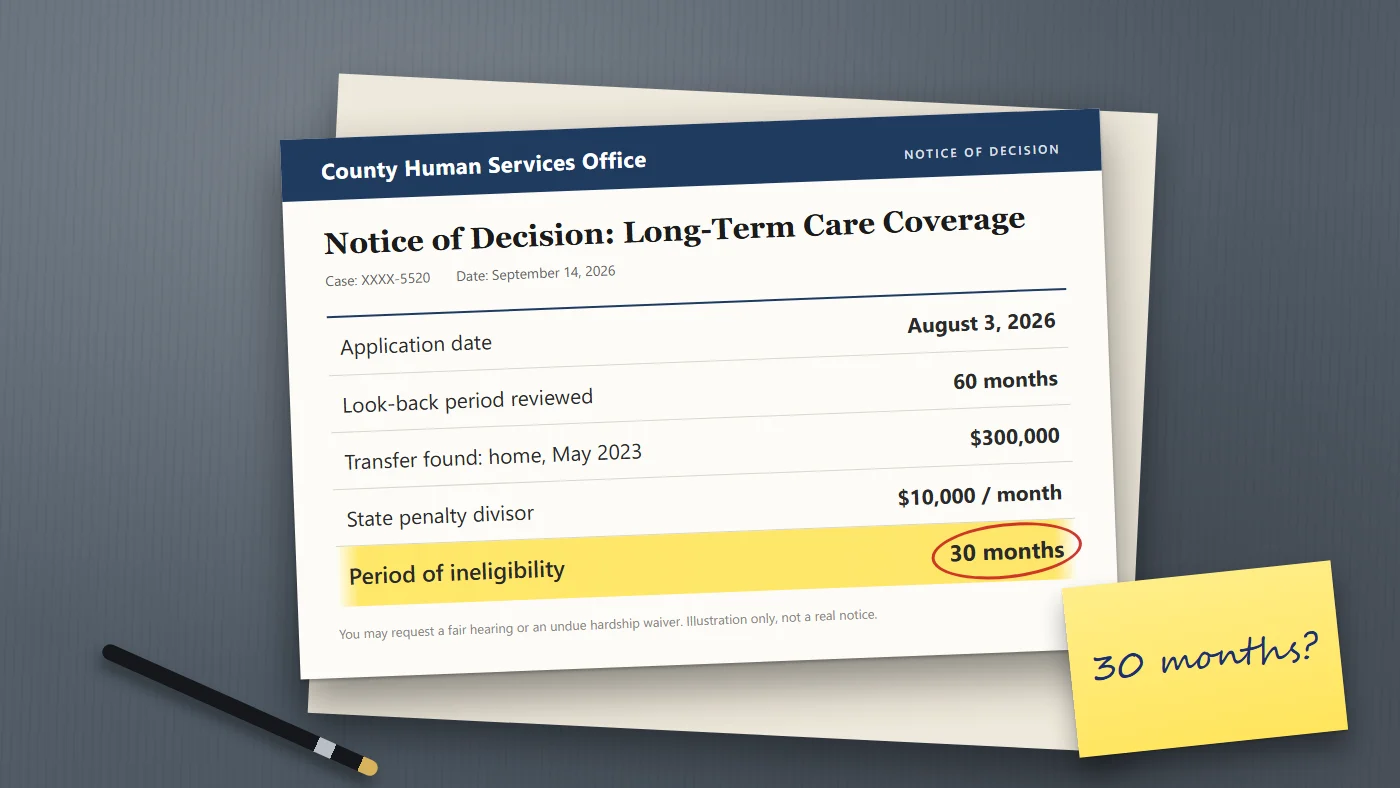
Say a widowed mother deeds her $300,000 home to her two children in 2023. In 2026 she needs nursing home care and has $40,000 left in savings. She spends that in about four months and applies. Her state divides gifts by $10,000, its figure for a month of private-pay nursing home care. Result: 30 months with no Medicaid payment. Not a dollar.
At the national median of $315 a day for a shared room, 30 months of care comes to about $287,000. She doesn't own the house that could have paid for it. Her children do. No law makes them give it back.
This isn't a niche problem. KFF's analysis of July 2025 data shows Medicaid is the primary payer for 63% of the roughly 1.24 million people in nursing facilities, so most families facing a long stay end up living under these rules.
There's a second rule fewer people have heard of. After a Medicaid recipient dies, the state has to try to recover what it spent on their care from the estate. For most people, the only thing of value left in that estate is the house.
How the look-back works
It's federal law, part of the Medicaid statute's section on transfers of assets. It applies when someone asks Medicaid to pay for nursing home care, and in most states for home and community-based waiver programs too.
Sixty months, counted back from the application date. California is the big exception. It brought back its asset test in January 2026, and its look-back runs 30 months before nursing home admission and counts only transfers made on or after January 1, 2026.
Every transfer for less than fair market value counts: the house deeded for $1, the $30,000 that went to a grandchild's tuition, the car signed over to a nephew. Add it all up and divide by the state's penalty divisor, roughly what a month of private-pay nursing home care costs there.
The formula: value of gifts ÷ state penalty divisor = months without Medicaid. A $300,000 house and a $10,000 divisor means 30 months. There's no maximum.
Divisors track local prices, so they vary a lot. California's is $14,440, which turns that $300,000 gift into 20 months (the state drops partial months). A state using $8,000 would impose about 37. A few states work with a daily figure instead.
Now the brutal part. That penalty clock doesn't start on the day of the gift, and it doesn't start when the family signs the deed or when anyone first notices a problem; it starts only when the parent is already in the nursing home, has applied and would qualify except for the gift. By then the savings are usually gone.
Can a nursing home take the house?
No. A nursing home is a business that sends bills. It can't seize a home, and Medicaid doesn't take title to houses from living people either.
What Medicaid decides is whether the house counts against the asset limit, which is $2,000 for a single applicant in most states. While a spouse lives there, it's usually exempt. It's also usually exempt if the applicant says she intends to return home, as long as the equity is under the state's cap. For 2026 that cap is $752,000 in most states and up to $1,130,000 in states that chose the higher figure. Starting in 2028, federal law holds the higher figure to $1,000,000 for homes that aren't on farmland.
So a single parent can often qualify for Medicaid and still own the house. The risk shows up later, at two points: if the state places a lien once the stay is considered permanent, and after death.
After death: estate recovery
Federal law requires every state to seek repayment from the estate of anyone who got Medicaid long-term care at 55 or older. That claim covers nursing facility care, home and community-based services, and related hospital and drug costs.
There are firm limits. No recovery while a surviving spouse is alive, or when the person leaves a child under 21 or a child of any age who's blind or disabled. Every state also has to offer a waiver when recovery would cause undue hardship.
How far does a state reach? Depends on the state. Some collect only from assets that go through probate. Others also go after homes held in joint tenancy, life estates and living trusts.
So giving the house away too late brings a penalty, and keeping it can mean a claim after death. What's left are five transfers the statute specifically allows, and the planning tools a lawyer can build around them.