Debt & Credit
Medical Debt and Your Credit Report: What the Rules Actually Are in 2026
The federal ban never took effect, so your protection now comes from three credit bureau policies, a patchwork of state laws, and your right to dispute.
 Margaret Linwood
Updated Sep 22, 2026 · 10 min read
On January 7, 2025, the Consumer Financial Protection Bureau finalized a rule that would have taken medical bills off credit reports entirely. Lenders would have been barred from using medical debt to decide if you get a loan. It made headlines for about a week.
It never took effect. Industry trade groups sued, and the Bureau, under new leadership, ended up agreeing with them. On July 11, 2025, a federal court in the Eastern District of Texas vacated the rule in a case called Cornerstone Credit Union League v. CFPB, holding that it went beyond the Bureau's authority under the Fair Credit Reporting Act.
If you only caught the first headline, you might think medical debt can't touch your credit anymore. That's not the law. Medical collections can still show up on your reports, and lenders can still see them.
You're far from unprotected, though. Three credit bureau policies keep most medical bills off reports. About fifteen states have passed their own bans. Federal tax rules limit what nonprofit hospitals can report and when. And you still have the same right to dispute a wrong entry that you've always had. None of these works automatically in every case, and each one has an edge where the protection stops.
15 million people, $49 billion. That's how much medical debt in collections was still sitting on Americans' credit reports after the credit bureaus made their changes, according to a CFPB report using June 2023 data.
Before those changes, the CFPB's estimate was $88 billion. The bureaus' policies swept out the small bills. What remained were the big ones, and the average medical collection left on reports rose from about $2,000 to more than $3,100.
Four layers that still protect you
| Layer | What it does | How firm it is |
|---|
| Credit bureau policies | Paid medical collections, collections under $500 and collections less than a year old are kept off reports | Voluntary. The bureaus adopted them and could change them |
| State laws | In about fifteen states, medical debt may not be reported or used in credit decisions | Law in those states, but a 2025 federal interpretation questions whether states can do this |
| IRS rules for nonprofit hospitals | No credit reporting for at least 120 days after the first bill, and only after a written 30-day warning | Federal regulation, applies to nonprofit hospitals only |
| Fair Credit Reporting Act | Right to dispute anything inaccurate, with an investigation that generally has to finish in 30 days | Federal law, applies to everyone |
The three credit bureau rules
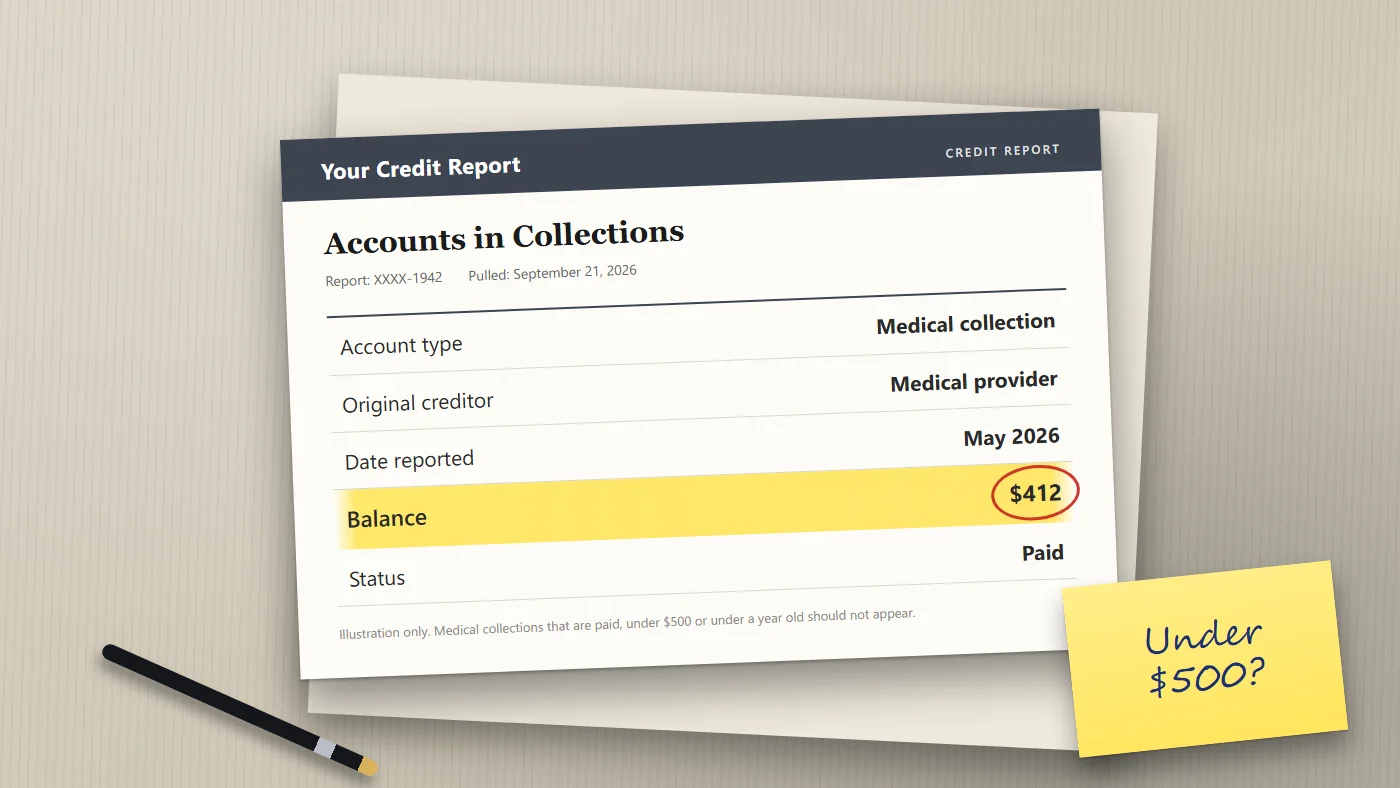
Equifax, Experian and TransUnion made three changes between July 2022 and April 2023. The CFPB summed them up in a blog post whose title says it all: anything already paid or under $500 should no longer be on your credit report.
Paid medical collections come off. That's unusual. A paid credit card collection can sit on your report for up to seven years. A paid medical collection should disappear.
Nothing under $500. Since April 11, 2023, medical collections with a balance below $500 aren't supposed to appear at all, paid or unpaid.
Nothing in the first year. An unpaid medical bill shouldn't show up as a collection until at least a year has passed. The old practice was about six months. The extra time lets you sort out insurance, appeal a denial or apply for a hospital's financial assistance.
Two limits matter here. These are company policies, not statutes; they've held since 2022 and 2023, but no law makes the bureaus keep them. And they only cover debt reported as a medical collection. Paid the hospital with a credit card, a personal loan or a medical credit card? That balance is now ordinary debt, and none of the three rules touches it.
Nothing here erases the debt, either. A $400 bill that can't appear on your report is still owed. A collector can still call about it and, in some cases, sue.
Where state law goes further, and the new doubt
Experian's consumer guidance lists fifteen states that bar medical debt from being reported or used in credit decisions: California, Colorado, Connecticut, Delaware, Illinois, Maine, Maryland, Minnesota, New Jersey, New York, Oregon, Rhode Island, Vermont, Virginia and Washington. The details differ. California's law, SB 1061, was signed in September 2024 and took effect in 2025; it bars credit reporting agencies from including medical debt in reports and bars lenders from counting it against you. New York has its own Fair Medical Debt Reporting Act.
Then there's a complication. On October 28, 2025, the CFPB published an interpretive rule saying the Fair Credit Reporting Act generally preempts state laws that touch broad areas of credit reporting, reversing a 2022 interpretation that had said the opposite. An interpretive rule is the agency's reading of the law. It isn't a court ruling. As far as we could confirm, the state laws remain on the books and in force, but expect the question to be fought out in court.
Live in one of those states and see a medical collection on your report? You've got an extra ground for a dispute. Anywhere else, the three bureau rules are your main protection.
Rules only help if your own reports follow them. Checking takes about an hour and costs nothing, and the dispute process has a few turns that are easy to get wrong.