Medicare
Medicare Part D in 2027: The $2,400 Cap, the $700 Deductible, and What to Do Before December 7
The same prescriptions can cost up to $300 more next year, a premium subsidy is ending, and the only window to react runs from October 15 to December 7.
 Margaret Linwood
Updated Sep 22, 2026 · 10 min read
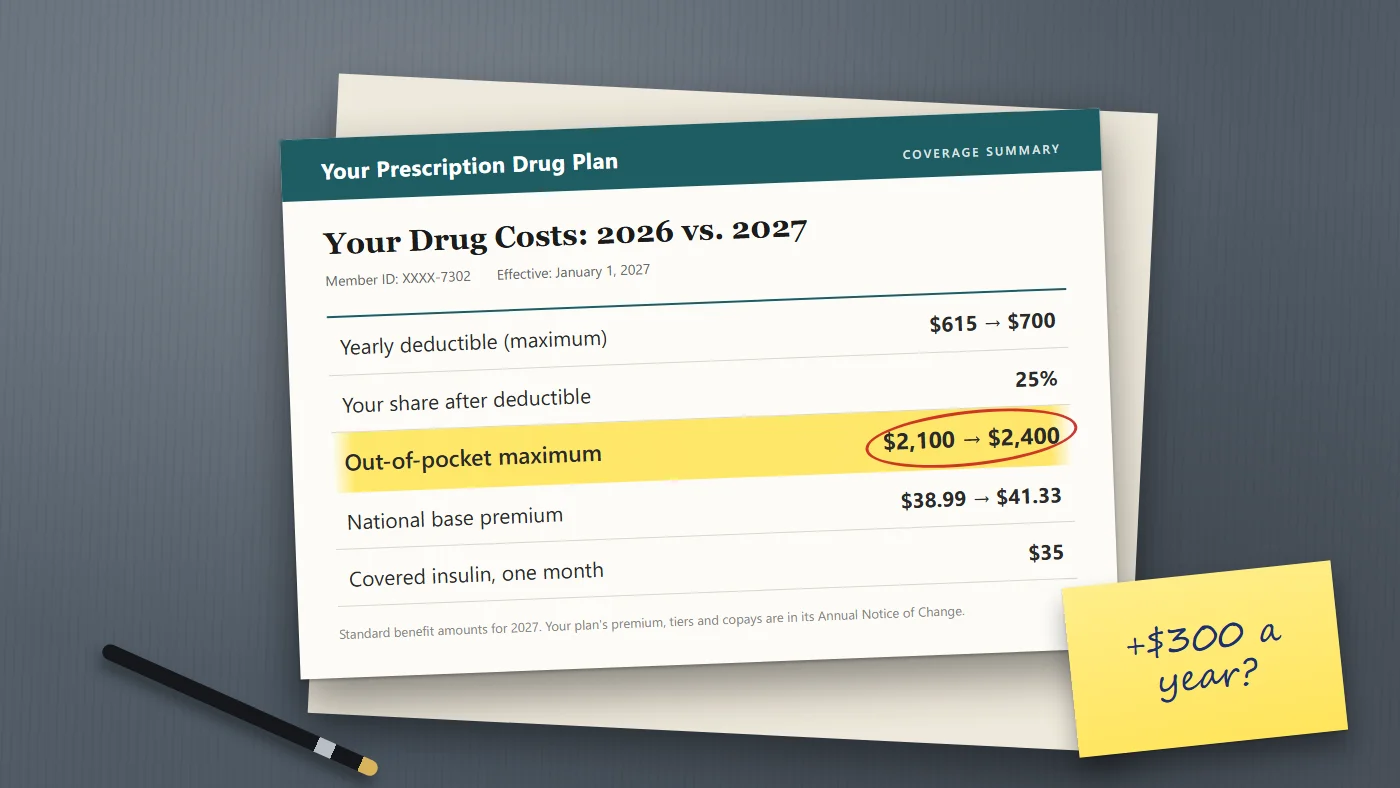
On January 1, 2027, two numbers in every Medicare drug plan move up. The most a plan can charge as a deductible goes from $615 to $700. The yearly cap on what you pay out of pocket for covered drugs goes from $2,100 to $2,400. Both figures are already posted on Medicare.gov.
Neither change needs your signature. If you do nothing this fall, your plan renews on its new terms, and the first time you notice may be at the pharmacy counter in January.
Plenty of people find out exactly that way. KFF, the health policy research group, found that 69% of people in stand-alone drug plans didn't compare their plan's drug coverage with any other plan during a recent open enrollment, and among people who get drugs through a Medicare Advantage plan, 82% didn't.
There's a third change that's had far less attention. For two years the federal government paid drug plan insurers extra money to hold premiums down. That program ends December 31, 2026. CMS announced it on July 28, in the same release that set the 2027 national base premium at $41.33, up 6% from $38.99.
A higher deductible, a higher ceiling and less protection against premium jumps, all on the same day. Open Enrollment runs October 15 to December 7. For most people, that's the only window to do anything about it.
What the new numbers do to three drug budgets
Under the standard Part D design, you pay the full price of your drugs until you meet the deductible. After that you pay 25% until your own spending hits the cap, and then you pay nothing for covered drugs for the rest of the year.
Real plans tinker with that. Many skip the deductible for cheap generics and charge flat copays instead of 25%. So treat the table as a picture of the standard design, not a quote for your plan.
| Full yearly cost of your drugs | You pay in 2026 | You pay in 2027 | Difference |
|---|
| $960 (a few generics, about $80 a month) | $701 | $765 | +$64 |
| $7,200 (one brand-name drug at $600 a month) | $2,100 | $2,325 | +$225 |
| $18,000 (a specialty drug at $1,500 a month) | $2,100 | $2,400 | +$300 |
The middle row is the one that surprises people. In 2026 that person hits the cap in November and pays nothing in December. In 2027 the same drug at the same price never reaches the new cap, so they're paying their 25% right through the last refill of the year.
The out-of-pocket cap rises from $2,100 to $2,400. For anyone whose drugs cost enough to reach it, that's $300 more in 2027 for the same prescriptions.
The cap is still the best thing that's happened to Part D. Until 2024 there was no limit at all on what you could spend in a year; the flat dollar cap started in 2025 at $2,000. It climbs a little each year because the law ties it to growth in Part D spending per person.
When does the bill show up?
Timing matters as much as the total. With a $700 deductible, the pain comes early.
Take the person on the $1,500-a-month drug. Under the standard design, their January pharmacy bill in 2027 is about $900: the full $700 deductible plus 25% of the remaining $800. February, March and April run $375 each. In May they reach $2,400, and after that the drug costs them nothing until next January.
Over twelve months that's a good deal. In the first week of January, with the holiday bills still open on the kitchen table and the winter heating bill on its way, a $900 pharmacy receipt is a hard one to absorb, especially if you've spent the last year paying the same modest copay every month and budgeting around it. There's a way to smooth it out, covered further down. You have to ask for it.
The subsidy that ends December 31
When Congress wrote the cap into law, insurers became responsible for more of the cost of expensive drugs, and stand-alone drug plan premiums were set to jump. To soften the landing, CMS ran a temporary program called the Part D Premium Stabilization Demonstration.
In 2026 it cut the base premium of participating plans by $10 a month and barred them from raising anyone's premium by more than $50 a month. KFF, citing MedPAC, says it lowered the average stand-alone plan premium by $16 a month in 2026 and $26 in 2025. About 24.9 million people are in stand-alone drug plans.
For 2027 both protections are gone. CMS says insurers now have enough experience with the redesigned benefit to price it without help. KFF reads it more cautiously: some stand-alone plan members could see bigger premium increases than they've had in recent years. Individual plan premiums weren't public as of this writing.
You'll also have fewer plans to pick from. KFF counted 360 stand-alone drug plans nationwide in 2026, 22% fewer than a year earlier, which left people with roughly 8 to 12 choices in their state. If your plan is being folded into another one, your Annual Notice of Change will say so.
You can't do anything about the federal numbers. What you control is which plan you're in when they take effect.
About an hour. One letter, one website.