For most people, picking a Social Security start date is a one-time call. You choose an age, you file, and the monthly amount you're approved for follows you for the rest of your life. Cost-of-living raises get layered on top, but the starting point doesn't change.
The rules behind that starting point are simpler than they look. Anyone born in 1960 or later reaches full retirement age at 67. File before then and the check shrinks, and at 62 it shrinks the most: you'd get 70% of your full amount. That 30% haircut doesn't go away on your 67th birthday, either. It's baked into every check that follows.
Waiting works the other way. Each year you hold off past 67 adds 8% to the benefit, and the credits keep coming until 70. By then you're at 124% of the full amount. Hold out any longer and you gain nothing.
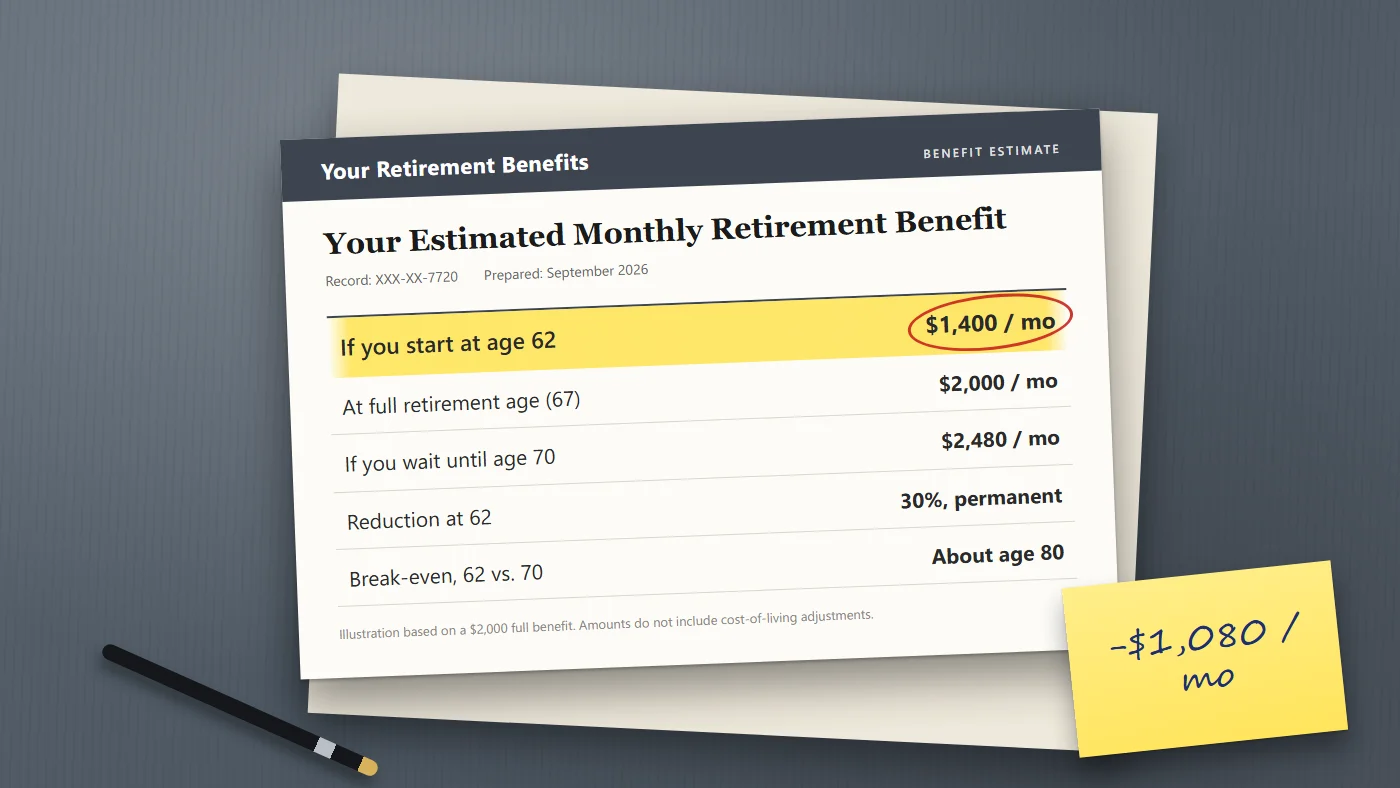
What does that look like in dollars? Picture a full benefit of $2,000 a month. It's a round number, and it isn't far from a typical retiree's check (Social Security put the average for retired workers at $2,071 in January 2026). File at 62 and you'd get $1,400. At 67 you'd get the whole $2,000. Hold out to 70, and the check comes to $2,480, roughly 77% more than the early version, from the very same work history.
None of this makes 70 the right answer for everyone. The person who files at 62 cashes 96 monthly checks before someone waiting for 70 sees the first one. What you're really asking is how long the bigger check needs to erase that head start. And will you be around when it does?
The number to know: 30%, and it's permanent. In the $2,000 example, filing at 62 rather than 70 leaves you $1,080 short every month. Make it to 90 and that shortfall comes to about $124,800, before any cost-of-living raises.
What each age pays on the same record
The table sticks with the $2,000 full benefit and leaves out cost-of-living adjustments and taxes, so the structure is easy to see. Each total counts every check from the claiming age up to the age shown.
| Claim at 62 | Claim at 67 | Claim at 70 |
|---|
| Share of full benefit | 70% | 100% | 124% |
| Monthly check | $1,400 | $2,000 | $2,480 |
| Yearly income | $16,800 | $24,000 | $29,760 |
| Total collected by age 80 | $302,400 | $312,000 | $297,600 |
| Total collected by age 85 | $386,400 | $432,000 | $446,400 |
| Total collected by age 90 | $470,400 | $552,000 | $595,200 |
Start with the age-80 row. The three totals sit within about $15,000 of each other. No accident. That's roughly the idea behind the formula: the early cuts and the delayed credits were set so someone with an average lifespan ends up with about the same lifetime amount, whatever age they pick. The choice starts to matter once you live a lot longer than average, or a lot shorter.
So when does waiting pay off?
Think of a race with a head start. The early claimer banks checks for years, the late claimer gets bigger ones, and the birthday when the two totals meet is the break-even age.
62 versus 67. Check in on the early claimer at 67. They've already cashed 60 checks at $1,400 apiece, so they're $84,000 up. From that point, the person who waited collects $600 more every month. At that pace the lead takes 140 months to disappear, which lands at about age 78 and 8 months.
67 versus 70. Those three extra years mean skipping $72,000 in checks. What comes back is $480 more a month. Recovering the difference takes 150 months, so break-even arrives around 82 and a half.
62 versus 70. This is the widest split. By 70, the early claimer has pocketed $134,400. The late claimer's check is $1,080 bigger, though, and that closes the distance at roughly 80 and 4 months.
What about cost-of-living raises? They barely move these ages. Your benefit starts picking up COLAs at 62 even if you haven't filed, so all three columns rise by the same percentage. In dollars that tilts toward the larger check: 3% of $2,480 beats 3% of $1,400. The 2027 raise is scheduled to be announced on October 14, 2026.
A break-even age is a blunt tool. It ignores income tax on benefits, what the early checks might earn if invested, and the cost of pulling extra money from savings while you wait, which can hurt in a bad market. It also treats a dollar at 85 the same as a dollar at 63, when a guaranteed check often matters most at the age you can't work anymore. Use it as a starting point.
Now line those ages up against how long people actually live. A man who's made it to 65 has, on average, about 18 more years ahead of him, which gets him to around 83. For a woman the same age it's roughly 20.7 more, close to 86. Those figures come from Social Security's own period life table. They're averages, too, and plenty of people blow past them, especially people who reach 65 in good health.
For a single person in average health, then, it's close to a wash. It tilts toward waiting if you're healthy, if your parents lived into their 90s, or if you're a woman. It tilts toward claiming early if you have a serious health condition or nothing else to pay the bills with, because money in hand counts for more. Married? One more rule often outweighs everything above.