Insurance
Medical Alert Systems in 2026: Monthly Costs, Hidden Fees and What Actually Matters
The advertised price is $20 to $60 a month. The bill can be about twice that in year one once equipment, activation, fall detection and a protection plan are added. Here's what each fee is, which ones you can decline and what Medicare does and doesn't pay.
 Margaret Linwood
Updated Sep 22, 2026 · 10 min read
The CDC says more than 14 million older adults, about 1 in 4 people 65 and over, report a fall every year. In its recent data, falls among older people led to about 4.5 million emergency department visits a year, and about 1.4 million of those visits ended in a hospital stay. Add one more number: about 28% of adults 65 and older who live in the community live alone, according to the Administration for Community Living's 2023 profile.
Put those facts together and you've got the whole sales pitch for a medical alert system, a wearable button tied to a call center that answers around the clock. The pitch is simple. Pricing isn't.
The National Council on Aging, which reviews these systems and updated its cost guide in January 2026, puts the monthly monitoring fee at $20 to $60, with the average around $39.95. That's the number in the ads. The charge on your card can run much higher once a one-time equipment fee of up to $200, an activation fee of $25 to $100, fall detection at about $10 a month and a protection plan at up to about $7 a month get stacked on top.
Original Medicare doesn't pay for any of it. So this guide sticks to the money: what each fee buys, which ones you can decline, what a year really costs and what to check in the contract before the first charge. It won't tell you if you or a parent needs one. That's a family decision.
What does the monthly fee actually buy?
Monitoring. When the button's pressed, a call center operator answers through the device, talks to the wearer and calls a family contact or emergency services. That service is the product, and the hardware is mostly a way to reach it.
Systems come in two families. In-home systems use a base station plugged into a wall outlet, connected through a landline or a built-in cellular chip, with a button on a wrist or around the neck that works inside the home. Mobile systems are a single wearable with its own cellular connection and GPS, so the button works away from the house. They cost more.
NCOA's yearly estimates run $275 to $485 for an in-home landline system and $384 to $519 for a mobile one. Those assume the advertised monthly rate. The extras below are what push a real bill past them.
The number to remember: Monitoring is advertised at $20 to $60 a month. Add fall detection at about $10, a protection plan at about $7, and spread a $200 equipment fee over the first year, and a $30 plan can cost more than $60 a month in year one.
Five add-on fees, and which ones to push back on
Equipment: $0 to $200, one time. Some companies charge it, some waive it as an incentive, and some spread it into the monthly rate. Ask whether the device is bought or leased, and if it's leased, what you owe if it's lost or sent back late.
Activation or installation: $25 to $100. Not every company charges one. It's a fee to ask about dropping before you give a card number.
Fall detection: about $10 a month. People often assume it's included. It usually isn't. A sensor in the pendant or watch tries to spot a fall and call the center without a button press, but companies describe it as a backup to the button, not a replacement, and say it can miss falls or set off false alarms. Price the plan both ways.
Protection plan: $1 to about $7 a month. It covers loss or damage. Compare it with what the hardware costs to replace: if a pendant is $150 to replace and the plan is $7 a month, the plan only comes out ahead if you'd replace the device about every 21 months or sooner.
Accessories and caregiver apps. Wall buttons, lockboxes, a second pendant for a spouse, an app that shows a family member where the device is. Useful for some households. Optional for all of them.
It's the cable-bill pattern. The advertised price is real, and so are the add-ons, so write down the full first-year number before you hand over a card.
What a year costs, three ways
The table shows made-up but realistic first-year totals built from NCOA's published ranges. Your quotes will differ.
| Setup | Monthly fee | One-time fees | Add-ons per month | First-year total |
|---|
| In-home, no extras | $25 | $0 | $0 | $300 |
| In-home with fall detection | $30 | $50 activation | $10 fall detection | $530 |
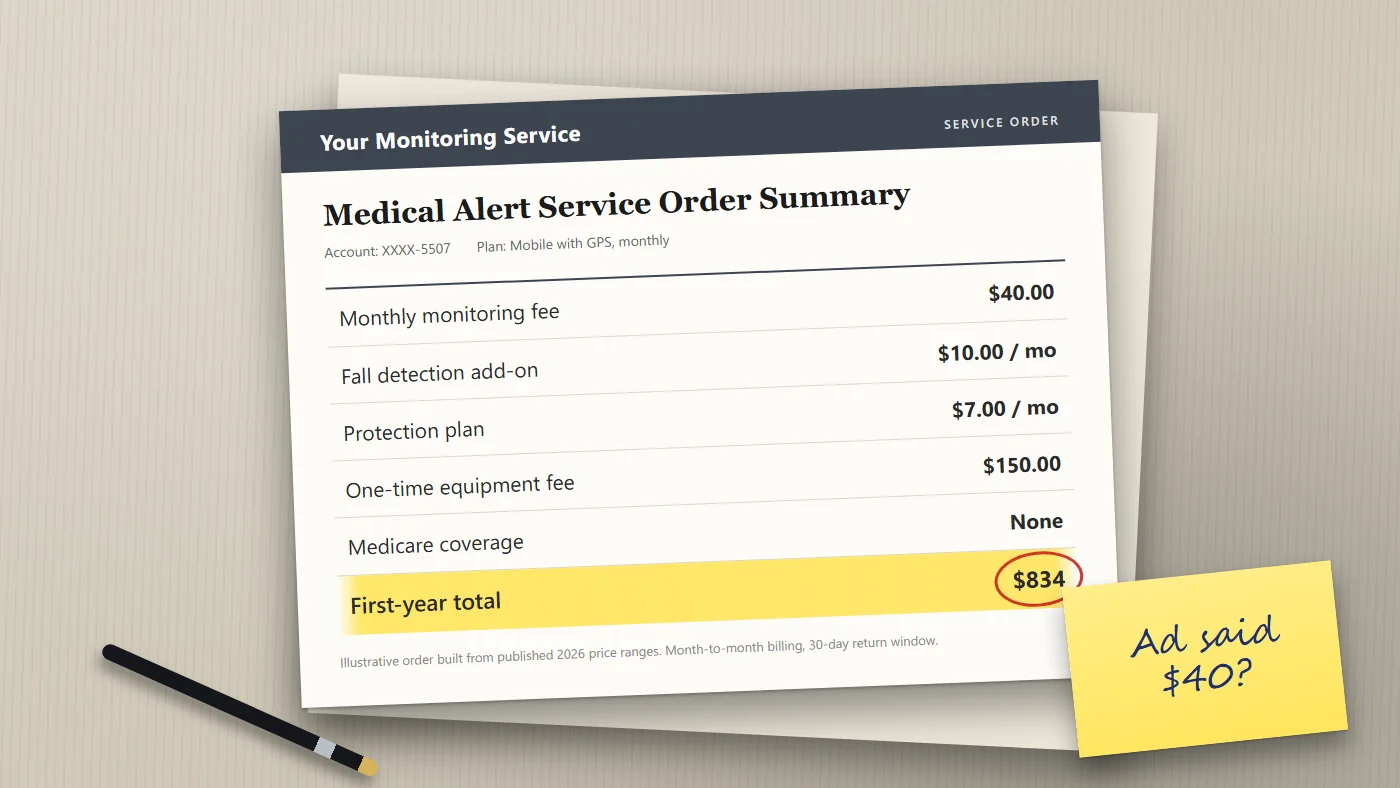
| Mobile with GPS, fall detection, protection plan | $40 | $150 equipment | $10 + $7 | $834 |
Between the cheapest and the fullest setup, the gap is $534 a year, and more of it comes from add-ons and the device than from monitoring itself. One-time fees hit hardest in year one, too. Comparing two offers? Look at the first 12 months and the second 12 months separately.
Is any of this covered? Barely. Original Medicare doesn't pay for medical alert systems. Some Medicare Advantage plans include one as an extra benefit, sometimes through a specific company. Long-term care insurance may cover part of the cost, though there can be a waiting period, and NCOA says eligible veterans may get a system free or at low cost through the VA. Everyone else pays full price.
That's what the ads leave out. The contract leaves out more.