Debt & Credit
How to Cancel Dealer Add-Ons and Get a Refund — Even a Year Later
The extras sold in the finance office are separate contracts with their own cancellation terms, and the CFPB says you can cancel them at any time.
 Ray Castellano
Updated Sep 22, 2026 · 11 min read
You agree on a price for the car. Then someone walks you to a small office to "do the paperwork," and an hour later you drive home with a loan a few thousand dollars bigger than the price you negotiated. The difference is a stack of products you may barely remember signing for: an extended warranty, GAP coverage, maybe a protection package or credit insurance.
The Federal Trade Commission describes the moment well. "Often, add-ons can cost thousands of dollars and are mentioned only at the end of an already difficult and time-consuming day at the dealership." By then most buyers just want the keys. Plenty of them don't read the itemized list until a year or two later, when they refinance or trade the car in.
What the finance office doesn't stress is that these products are separate contracts, and they can usually be cancelled. The Consumer Financial Protection Bureau puts it plainly about optional add-ons sold with auto loans: "You have the right to cancel these add-on products at any time and reduce your costs." Cancel early and the refund may be the full price. Cancel later and it's usually prorated, meaning you get back the unused part, sometimes minus a fee.
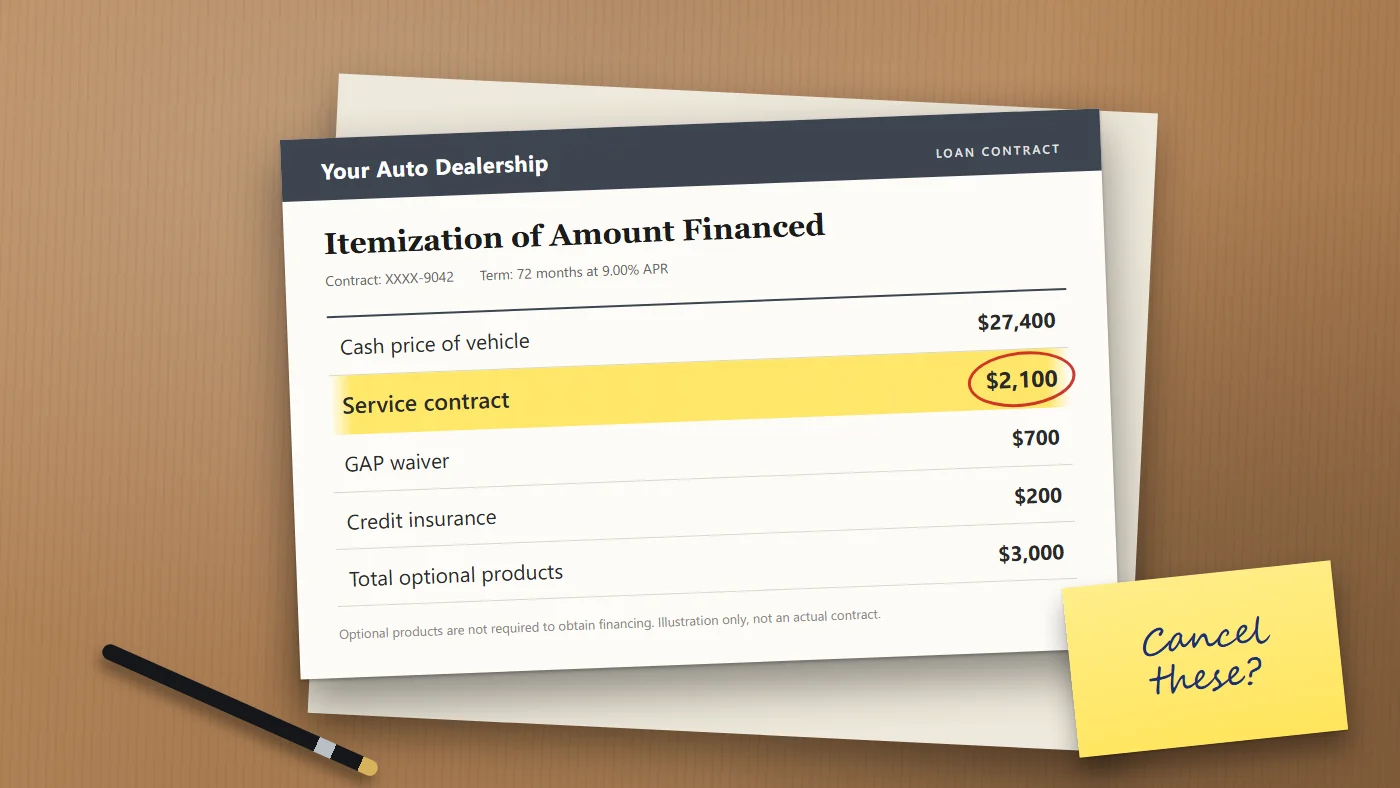
Doing nothing costs more than the sticker on the products, because you're paying interest on them. Say $3,000 of add-ons got rolled into a 72-month loan at 9% APR. That's about $54 added to every monthly payment. Over six years you pay $3,894 for them, and $894 of that is interest.
$894. The interest on $3,000 of add-ons financed for 72 months at 9% APR, in this example. The products cost $3,000. Financing them brings the total to $3,894.
Where do you find the add-ons?
In the retail installment contract. It's the long form with the federal truth-in-lending boxes across the top: APR, finance charge, amount financed. Below them sits a section called "Itemization of Amount Financed." Look for lines described as amounts paid to others on your behalf. That's where the add-ons live, each with a price and the name of the company that got paid.
Most of the money usually sits in three kinds of charges.
A service contract is often sold as an "extended warranty," but it isn't a warranty. It's a separate contract promising to pay for certain repairs, and you can say no to it.
GAP, or guaranteed asset protection, covers the difference between what you owe and what your insurer pays if the car's totaled or stolen. The CFPB calls it "an optional product." If a dealer told you it was required to get the loan, ask to see that in writing: under federal disclosure rules, if a lender requires GAP, its cost has to be included in the finance charge and the disclosed APR.
Credit insurance, meaning credit life and credit disability policies, makes loan payments if you die or become disabled. The FTC says credit insurance "is not required by federal law," and that it's illegal for a lender to slip it into your loan without your knowledge or permission.
Other lines may show up: tire-and-wheel protection, key replacement, prepaid maintenance, paint and fabric protection, window etching, theft-deterrent products. Whether those can be cancelled depends on what they are.
| Charge on the contract | Can it usually be cancelled? | What you typically get back |
|---|
| Service contract ("extended warranty") | Yes | Full refund in an early window in some states; after that, prorated by time or miles, less any fee and sometimes less claims paid |
| GAP waiver or GAP insurance | Yes | Prorated for the remaining loan term; often the full unused amount if the loan is paid off early |
| Credit life or disability insurance | Yes | The unearned premium |
| Tire-and-wheel, key replacement, prepaid maintenance | Usually | Prorated, according to the contract |
| Paint sealant, fabric protection, window etching already applied | Often not | These are products already delivered; read the contract, but expect little |
A general picture only. The real terms sit in each product's contract and your state's law.
Where the money goes
If you still owe on the loan, the refund almost always goes to the lender, not to you. The lender's usually listed as lienholder on the product contract, and the product was bought with the lender's money.
The lender applies the refund to principal. Your payment normally stays put. What changes is the balance: you owe less, pay less interest from then on and finish sooner, a real gain even if the monthly bill looks exactly the way it did before you made a single phone call. In the $3,000 example, about $2,600 of the add-on money is still owed after 12 payments. A refund of roughly $2,280, like the one worked out below, would wipe out most of it.
That's how it works while the loan's open. Once it's closed, the refund takes a different path, and that's the one people miss most.