Medicare

Cataract Surgery Costs With Medicare: What's Covered and What the Premium Lens Adds

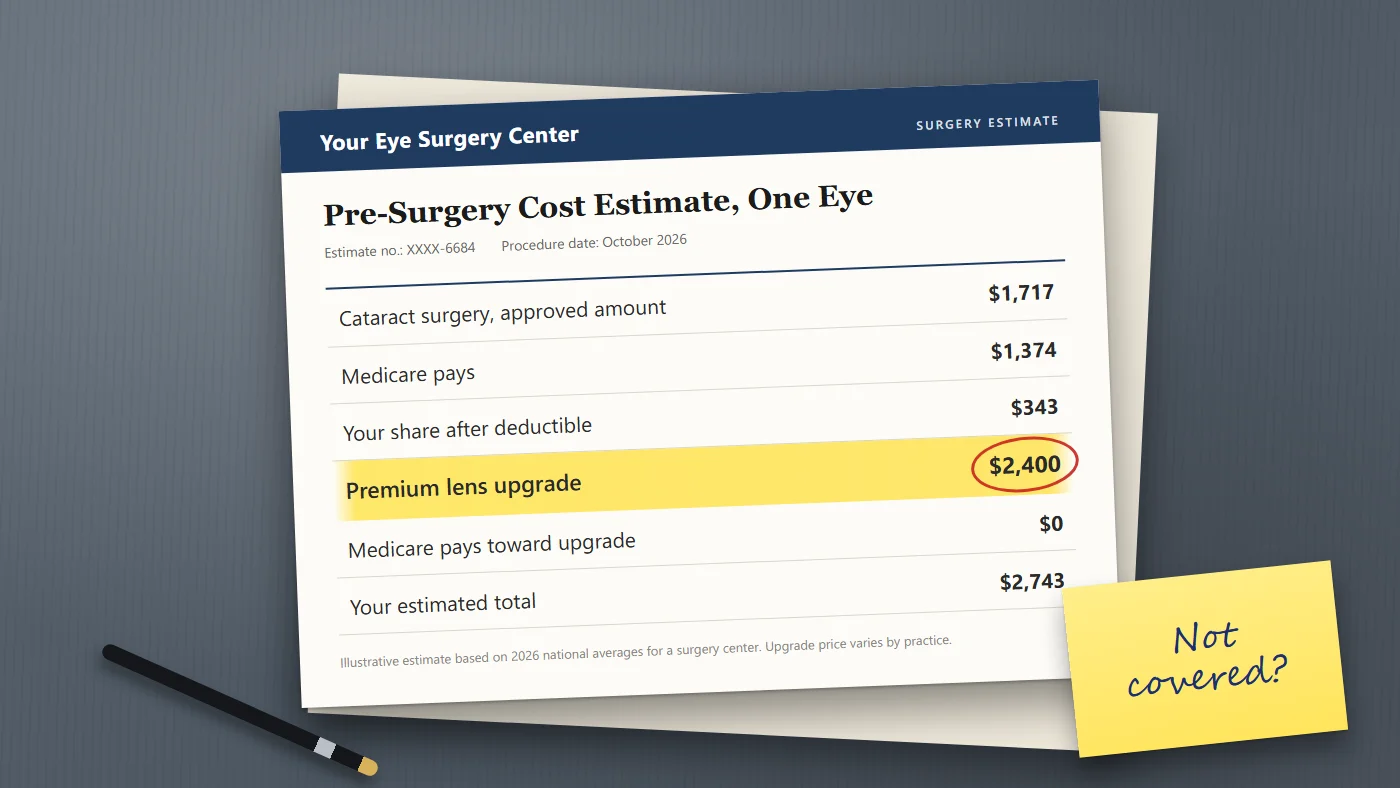
Medicare's own 2026 estimate puts your share of cataract surgery at $343 per eye at a surgery center. The lens upgrade offered at the consult is a separate, uncovered charge that can run $1,500 to $3,000 an eye.

Illustrated surgical cost estimate on a slate desk showing Medicare's covered share of $343 and a premium lens upgrade of $2,400 per eye circled, with a sticky note reading "Not covered?
Illustration

Few operations come with a price Medicare will show you ahead of time. Cataract surgery does. Look it up in Medicare's Procedure Price Lookup and you'll find a 2026 national average for your share: $343 per eye at an ambulatory surgical center. At a hospital outpatient department, it's $563. Both figures cover the surgeon and the facility, and both assume you've already met the Part B deductible.

Then comes a conversation plenty of people don't see coming. Somewhere between the exam and the surgery date, the office explains that Medicare covers a "conventional" lens, and it offers an upgrade: multifocal, extended-depth, toric, "premium." Medicare won't pay for that part. So what does it cost you? Roughly $1,500 to $3,000 per eye, going by the price guides clinics have published for 2026, and some quotes run higher. Do both eyes and it can turn into a $6,000 decision, stacked on top of a surgery you were told was covered.

Covered or not? Both, which is what makes it confusing. The surgery is covered. The extra cost of a premium lens isn't, and your surgeon is allowed to bill you for the difference. That permission goes back to two CMS rulings, one from 2005 and one from 2007.

How many people run into this? A lot. Past age 80, more than half of Americans either have cataracts or have already had surgery to remove them, according to the National Eye Institute.

This article is about the money: what Medicare pays, what the upgrade adds, how the facility changes your share and what to ask before you sign. Whether a particular lens suits your eyes is a question for you and your surgeon. Nothing here answers it.

What Medicare covers, and what it doesn't

The benefit fits in one sentence on Medicare.gov: Part B covers cataract surgery that implants "conventional intraocular lenses." Your share is 20% of the Medicare-approved amount, owed to the facility and to the doctor once you've met the Part B deductible ($283 in 2026).

There's a second covered item most people never hear about. After each cataract surgery that implants a lens, Part B covers one pair of eyeglasses with standard frames or one set of contact lenses. You pay 20% of the approved amount, plus the full cost of any upgraded frames, and you've got to buy from a supplier enrolled in Medicare. Ask the surgeon's office for the paperwork before you head to the optical shop.

Medicare stops at the lens that does more than a conventional one, such as correcting presbyopia or astigmatism. It pays what it would've paid for a conventional lens and the covered surgery. Your provider can charge you for the rest, as long as you're told first. That arrangement started with presbyopia-correcting lenses, in CMS Ruling 05-01 (May 2005). CMS Ruling 1536-R extended it to astigmatism-correcting lenses in 2007.

The number to remember: $343 per eye, Medicare's 2026 national average for your share of standard cataract surgery at a surgery center. A premium lens upgrade is billed separately and isn't covered. Published 2026 price guides put it at about $1,500 to $3,000 per eye.

Where you have it changes your share

One procedure, code 66984, carries two different price tags in Medicare's tool. Why? The facility fee.

2026 national averages, one eyeAmbulatory surgical centerHospital outpatient department
Doctor fee$462$462
Facility fee$1,255$2,357
Total cost$1,717$2,819
Medicare pays$1,374$2,256
You pay (average)$343$563

Source: Medicare.gov Procedure Price Lookup, based on 2026 payments and copayments. Amounts vary by location, and the tool notes that treatment may include more than one procedure.

Two things follow. Because most surgeons operate at only one or two places, the facility is often settled the moment you pick the surgeon, well before anyone mentions a price, so it's a question for the very first visit. And a Medigap policy may pay some or all of the 20%, which is why many people with a supplement see a bill near zero for the covered part. A Medicare Advantage plan sets its own copays for outpatient surgery, listed in its Evidence of Coverage.

None of that touches the upgrade. With Medigap, with Advantage or with Original Medicare alone, the premium lens difference is a non-covered charge. It comes out of your pocket. All of it.

What should the "premium" quote contain?

"Premium" covers several different products and services, and the quote should say which ones you're paying for.

There are two big families: a presbyopia-correcting lens, designed to reduce reliance on reading glasses, and an astigmatism-correcting (toric) lens, designed to correct astigmatism. Some do both. Each carries its own price, and the surgeon's fee for placing one may run higher than for a conventional lens, too.

Some offices fold laser-assisted steps or extra measurements into the upgrade package. Under CMS guidance, the extra charge is allowed for the part tied to the vision correction you chose, not for the cataract removal Medicare already pays for. A clean quote shows which is which.

Say you're getting both eyes done. The covered surgery leaves you $343 per eye, $686 for the pair, before any supplement. Then the office quotes a premium lens package at $2,400 per eye. Add it up and you're at $5,486 out of pocket. And the upgrade's slice of that? $4,800. Even if a Medigap plan picks up the $686, you still owe the $4,800.

Those numbers are made up. The split isn't: the two parts are billed and covered differently, and you should see them on separate lines before you decide anything.
Continued

Before you pick a date: eight questions

  1. Ask for a written estimate that separates the covered surgery from the upgrade. One line for the surgeon's fee and one for the facility fee on the covered part, then the lens upgrade, any laser step and any extra testing on lines of their own. If the upgrade is one lump sum, ask what's inside it.
  2. Ask which facility and what type it is. "Is this an ambulatory surgical center or a hospital outpatient department?" Medicare's averages differ by $220 per eye, and your Medigap or Advantage plan may treat the two settings differently.
  3. Check that the surgeon and facility accept Medicare assignment. A doctor who accepts assignment agrees to Medicare's approved amount. One who doesn't can bill up to 15% more on covered services in most states. Medicare.gov's provider search shows this.
  4. Read the notice about the non-covered charge before you sign it. The office has to tell you about the upgrade cost in advance. Take the form home. It should state the dollar amount, and that Medicare won't pay it.
  5. Call your supplement or Advantage plan. Ask what you'll owe for outpatient cataract surgery at that facility, and confirm the plan pays nothing toward the lens upgrade. Write down the date and the name of the person you spoke with.
  6. Ask about the eyeglasses benefit. One pair of standard-frame glasses or one set of contacts after each surgery is covered at 80% by Part B. Ask if the practice's optical shop is enrolled with Medicare, and get the prescription in writing so you can buy elsewhere if it isn't.
  7. Ask about the second eye. Surgeries are usually weeks apart. If they land in different calendar years, the Part B deductible applies twice. That's a timing question for you and the office, not a reason to rush.
  8. Get a second estimate if the upgrade is large. Asking a second surgeon to price the same lens type is a normal request. Medicare sets the covered part, so most of any difference between quotes is in the upgrade.

Paying for the upgrade, if you choose it

The uncovered part is a medical expense, so the usual tools apply. HSA or FSA money can pay it with pre-tax dollars. If you itemize, eye surgery counts as a medical expense under IRS Publication 502, though you can deduct only the part of the year's medical costs above 7.5% of adjusted gross income. Two eyes done in the same calendar year, on top of the premiums, prescriptions and dental bills many retirees already pay out of pocket, can push a household past that line even when one surgery alone wouldn't.

Go slow with financing offered at the front desk. On medical credit cards, the typical deferred-interest rate was 26.99% (that's from a May 2023 report by the Consumer Financial Protection Bureau). Deferred interest means the interest gets charged back to the purchase date if the balance isn't cleared before the promotion ends. Ask whether the office has an in-house plan with no interest. Then price a regular card or a personal loan before you sign anything.

In a Medicare Advantage plan? Many plans require prior authorization for outpatient surgery. Confirm the approval is in place for the covered procedure before the date, and ask the office if the upgrade changes any codes on the claim.

Mistakes that cost money

  • Assuming "covered" means the whole bill, then finding the upgrade on the invoice afterward.
  • Signing the non-covered notice without a dollar figure on it.
  • Not knowing the facility type, and paying the hospital rate when the surgeon also operates at a surgery center.
  • Buying glasses at full price after surgery without using the Part B benefit.
  • Putting the upgrade on a deferred-interest medical card and paying only the minimum.
  • Scheduling the two eyes across a year-end without checking how the deductible resets.

If you want to shop or compare

Related searches

Once you've got a written estimate with the covered and uncovered parts split out, comparing is simple. Give it an hour.

People at this stage tend to look up a few things. They search cataract surgery cost in their state and hold it against Medicare's national averages. They look for the best cataract surgeon near me and check which facility each one uses and whether it takes assignment. If they're weighing the upgrade, they search premium lens cataract pricing to see what other practices charge for the same lens type. And people expecting ongoing eye care bills compare vision insurance for seniors and the vision benefits in Medicare Advantage plans, which mostly cover exams and glasses, not surgery.

Thinking about a Medigap plan? Open Enrollment for Advantage and drug plans runs October 15 through December 7, but Medigap follows different rules that depend on your state and on when you first enrolled. Switching isn't automatic. Check your own situation before you count on it.

Two numbers to bring to the consult

Bring $343 and $563, Medicare's 2026 averages for your share per eye at a surgery center and at a hospital outpatient department. If the covered part of your estimate is far off from those, ask why. Sometimes there's a good reason, like a second procedure billed the same day. Sometimes there isn't.

Then look at the upgrade line by itself. At roughly $1,500 to $3,000 an eye in published guides, it's usually the biggest number on the page, and it's the only one Medicare leaves entirely to you. If I were comparing two practices, that's the line I'd ask each of them to price first.

This article is general information, not financial, legal, tax or medical advice.

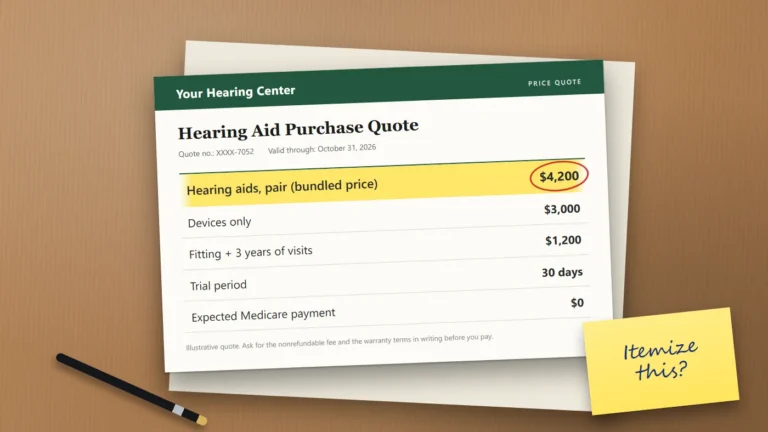
Illustrated hearing aid purchase quote on a wooden desk with the $4,200 bundled price circled and a sticky note reading "Itemize this? Read nextHearing Aids in 2026: Prescription vs. Over-the-Counter, Real Prices and Who Pays Illustrated pharmacy price summary on a dark desk showing four prices for one prescription, with the $14 discount price circled and a sticky note reading "Ask first Read nextWhy the Same Prescription Costs So Much More at One Pharmacy Than Another, and When Cash Beats Your Copay

About the author

Margaret Linwood

Margaret Linwood covers Medicare, Social Security and what health care actually costs after 60. She builds every piece around the number a reader will face on a bill or a notice, and shows where that number comes from.

Sources

Updated Sep 22, 2026 · Reviewed against Medicare.gov, CMS Rulings 05-01 and 1536-R, NEI, CFPB, IRS

Related searches