In August 2025, the government's price index for motor vehicle repair stood 15% higher than a year earlier. More than a third of that increase landed in a single month, when the index jumped 5% between July and August. The Bureau of Labor Statistics tracks this inside the Consumer Price Index, the same report used to measure inflation.
The pace has cooled since then. Prices haven't fallen. By August 2026 the repair index was another 2.6% higher, the broader category of maintenance and repair was up 5.2% over the year, and overall inflation ran 3.4%. Against August 2021, the repair index is up by more than half.
Part of it is the cars themselves. A bumper or a side mirror now holds radar units and cameras, so a repair that once meant a piece of plastic and an hour of labor now means electronics and calibration. In a 2023 study, AAA found that replacing a single front radar sensor ran $500 to $1,300 and a windshield camera $900 to $1,200, over and above the normal body work after a crash.
Meanwhile, the cars on the road keep getting older. S&P Global Mobility put the average age of U.S. cars and light trucks at a record 12.8 years in 2025, far beyond the typical factory coverage. So the question comes up in nearly every household with a car: should you pay for an extended warranty to cover the bills the factory no longer will?
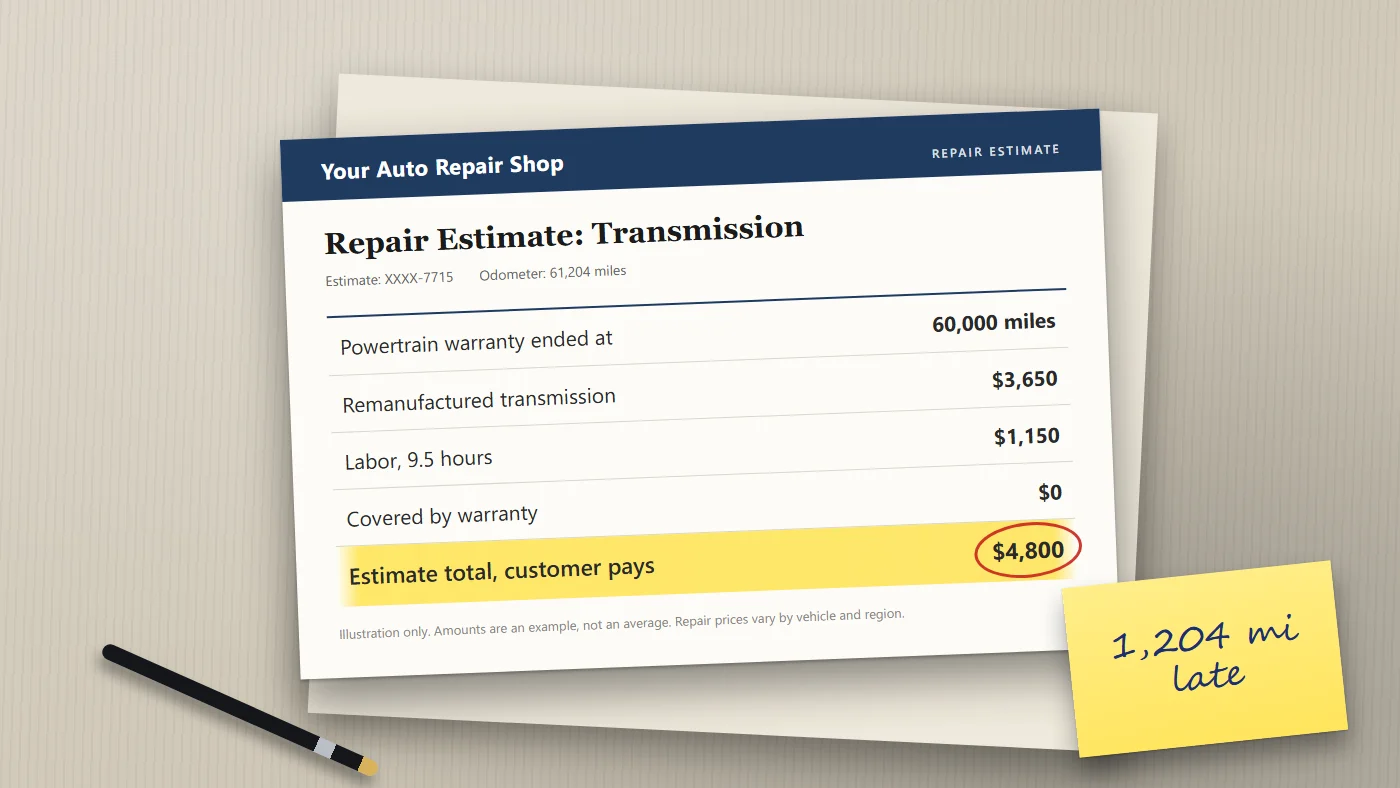
Picture an owner whose powertrain warranty ended at 60,000 miles and whose transmission fails at 61,000. The shop quotes $4,800.
The factory pays nothing.
Whether that bill means a bad week or a real emergency depends on what the owner set up beforehand.
For a lot of owners, the honest answer is no. For some it's yes. The contract and your own finances decide it more than the car does.
What you're actually buying
The Federal Trade Commission makes a point that tends to get lost in the sales pitch. An "extended warranty" isn't a warranty. A warranty comes with the car, from the manufacturer, included in the price. What you're offered later is a vehicle service contract, a separate product sold for a separate price by a dealer, an automaker or an independent company.
Why does the label matter? Because a service contract covers only what its text says it covers. The word "warranty" makes people expect that a broken car simply gets fixed, while a contract may name only certain parts and set conditions on every claim.
The same FTC page warns about the "final notice" letters and calls telling you your warranty's about to expire. They often misrepresent a connection to your dealer or manufacturer. More on those below.
The Consumer Financial Protection Bureau adds two facts dealers rarely volunteer. These products are optional, even when they show up pre-printed on the paperwork, and if one was added to your financing, you can cancel it and cut what you owe, something to remember the next time a finance manager slides a form across the desk.
The BLS motor vehicle repair index rose 15% in the 12 months through August 2025, including a 5% jump in a single month. A year later it was up a further 2.6%.
Why most owners come out behind
A service contract is priced so the company selling it takes in more than it pays out, which is how any insurance-type product works, and it means the average buyer pays more for the contract than they'll ever get back in repairs. No surprise there.
Consumer Reports found as much in past member surveys: owners typically paid more for the coverage than they got back in direct benefits. Its current guidance, updated in October 2025, still says that from a pure numbers standpoint the smart money skips the protection, buys a model with better-than-average predicted reliability, and maintains it.
Financing makes it worse. Roll a $3,200 contract into a 72-month car loan at 7%, and it adds about $55 to the payment and roughly $730 in interest. The real price becomes about $3,930, and you start paying for it years before most of the coverage could even be used.
Now put that same $55 a month into a savings account set aside for the car. After four years you'd have about $2,600, plus interest. If the car never needs a major repair, the money's still yours. AAA made a version of this suggestion back in 2017, when it put a typical repair bill at $500 to $600 and advised drivers to save at least $50 a month for unexpected expenses.
Who sets the price, anyway? It isn't fixed. Consumer Reports notes that the price of a service contract can be negotiated, just like the price of the car. The first figure a finance office quotes is an opening offer, so two buyers can pay very different amounts for the same plan on the same model, and most never find out because few people ask a second dealer.
The savings route assumes you'll actually save the money and leave it alone. It also assumes a $3,000 bill in year two, before the fund has grown, wouldn't sink you. If either assumption fails for you, a contract starts to make more sense.