Home & Mortgage
HELOC vs. Home Equity Loan in 2026: Rates, Risks and the Math
Both loans turn home equity into cash at a rate far below a credit card, and both are secured by the house you live in.
 Ray Castellano
Updated Sep 22, 2026 · 11 min read
If you've owned your home for a while, a big share of your net worth is probably tied up in it. Cotality, a property data firm, put the average equity of a U.S. homeowner with a mortgage at $310,500 in the first quarter of 2026. Across all mortgaged homes, that's $17.9 trillion.
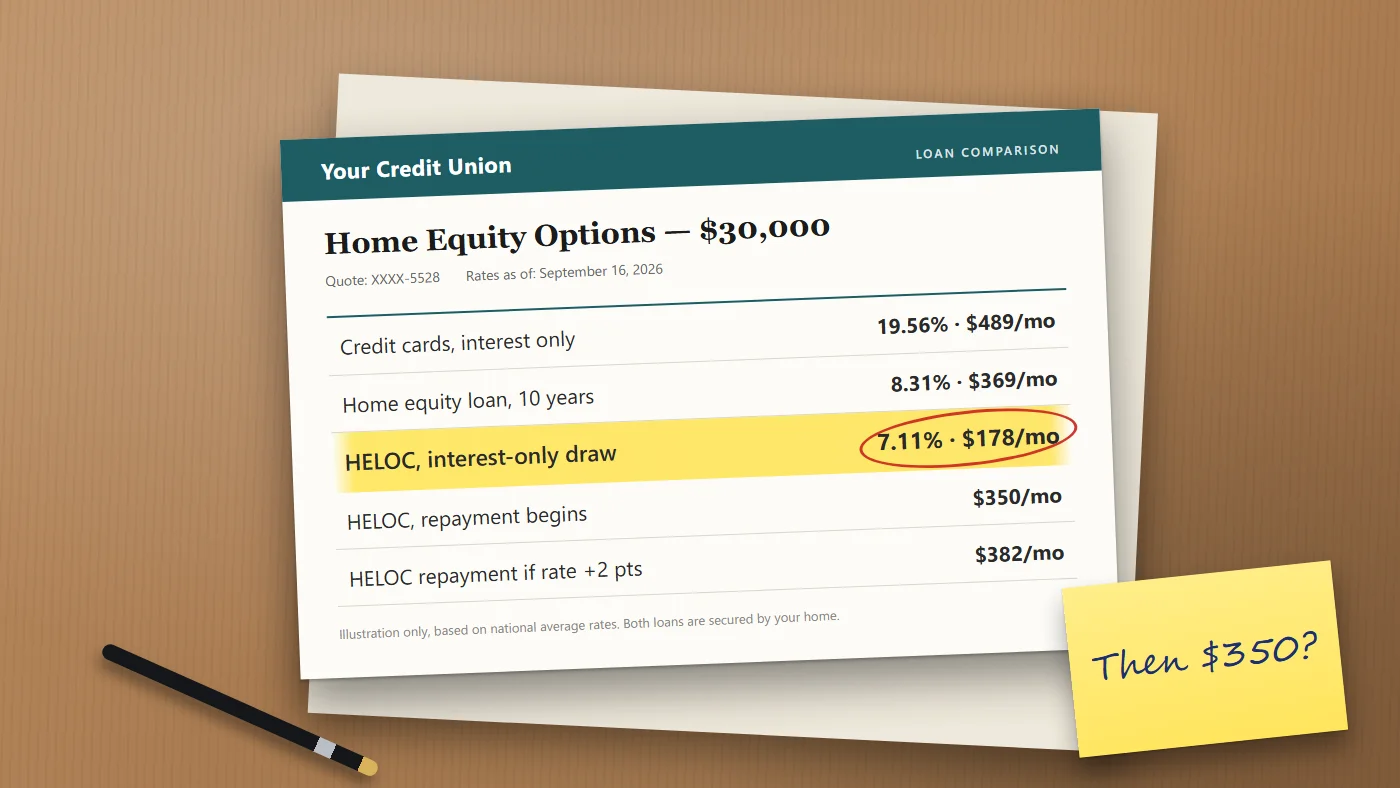
Meanwhile the average credit card charges 19.56 percent, according to Bankrate's survey for September 16, 2026. Carry $30,000 on cards at that rate and you're paying about $489 a month in interest before a dime touches the balance.
That gap is why home equity borrowing keeps coming up at kitchen tables. There are two main ways to do it without disturbing your first mortgage: a home equity loan and a home equity line of credit, or HELOC. The names are close. The products aren't. One gives you a fixed payment from the first month, and the other starts cheap and can change on you twice.
7.11 percent versus 19.56 percent. Those were Bankrate's national averages for a HELOC and a credit card on September 16, 2026. The gap of more than 12 points is real. So is the trade: card debt is unsecured, and a HELOC is secured by your house.
Hold on to that last sentence. A card issuer that isn't paid can wreck your credit and sue you. A home equity lender that isn't paid can foreclose, and the Federal Trade Commission says so plainly in its guidance on these loans: your home is the collateral, and you can lose it if you don't pay.
So which one is cheaper matters less than you'd think. What matters more is which one you could still repay in a bad year, with a payment you can see coming.
How each one works
A home equity loan is a second mortgage. You borrow one lump sum at a fixed rate and make equal payments for a set term, commonly 5 to 20 years. Think car loan. You know the date of the last payment on the day you sign.
A HELOC is a revolving line, closer to a credit card with your house standing behind it. The lender approves a limit. During the draw period, often 10 years, you borrow what you need, pay it down and borrow again, and many lines let you pay interest only while the draw lasts. Then the line closes and repayment begins, often over 10 to 20 years, and now you're paying principal and interest on whatever's left.
Nearly every HELOC has a variable rate tied to the prime rate, and prime follows the Federal Reserve. On September 16, 2026, the Fed raised its target range by a quarter point, to 3.75 to 4 percent. Its first increase since 2023. Oddly, Bankrate's HELOC average actually dipped that same week, which tells you averages and your own line don't move in lockstep. Still, a HELOC opened today won't necessarily stay at today's rate.
| Home equity loan | HELOC | Cash-out refinance |
|---|
| How you get the money | One lump sum | Draw as needed up to a limit | Lump sum from a new, larger first mortgage |
| Rate | Fixed | Variable, tied to prime | Fixed or adjustable |
| Average rate, mid-September 2026 | About 8.2 to 8.3 percent | About 7.1 percent | Near 7 percent for a 30-year loan |
| Payment | Same every month | Interest-only at first on many lines, then higher | Same every month |
| Your existing mortgage | Untouched | Untouched | Replaced at today's rate |
| Best fit | One known cost | Costs spread over time | Rarely, if your current rate is low |
The averages come from Bankrate (home equity, September 16, 2026) and Freddie Mac (6.95 percent on a 30-year mortgage, September 17, 2026). Your own offer depends on your credit score, your income and how much equity you leave in the house.
How much can you borrow?
Lenders look at combined loan-to-value: your first mortgage plus the new loan, divided by what the home is worth. Many cap it somewhere around 80 to 85 percent, and each lender sets its own limit.
Take a $400,000 house with $180,000 left on the mortgage. At an 80 percent cap, total debt can reach $320,000, so the most you could borrow is $140,000. At 85 percent it's $160,000.
Lenders also check your credit, compare your total debt payments with your income, and either order an appraisal or pull an automated valuation of the house, and if that value comes in lower than you hoped, your borrowing limit shrinks right along with it.
You don't have to take the max. The 15 or 20 percent left over isn't spare money, either; it's what protects you if prices slide and you need to sell.
The payment on a real loan looks different from the averages, and on a HELOC it changes twice. That math is next, with the fees lenders don't lead with.