Insurance
Home Insurance Claim Denied? The Appeal Steps Insurers Don't Advertise
A denial letter is the insurer's reading of your policy, and your policy and your state give you several ways to challenge it.
 Ray Castellano
Updated Sep 22, 2026 · 10 min read
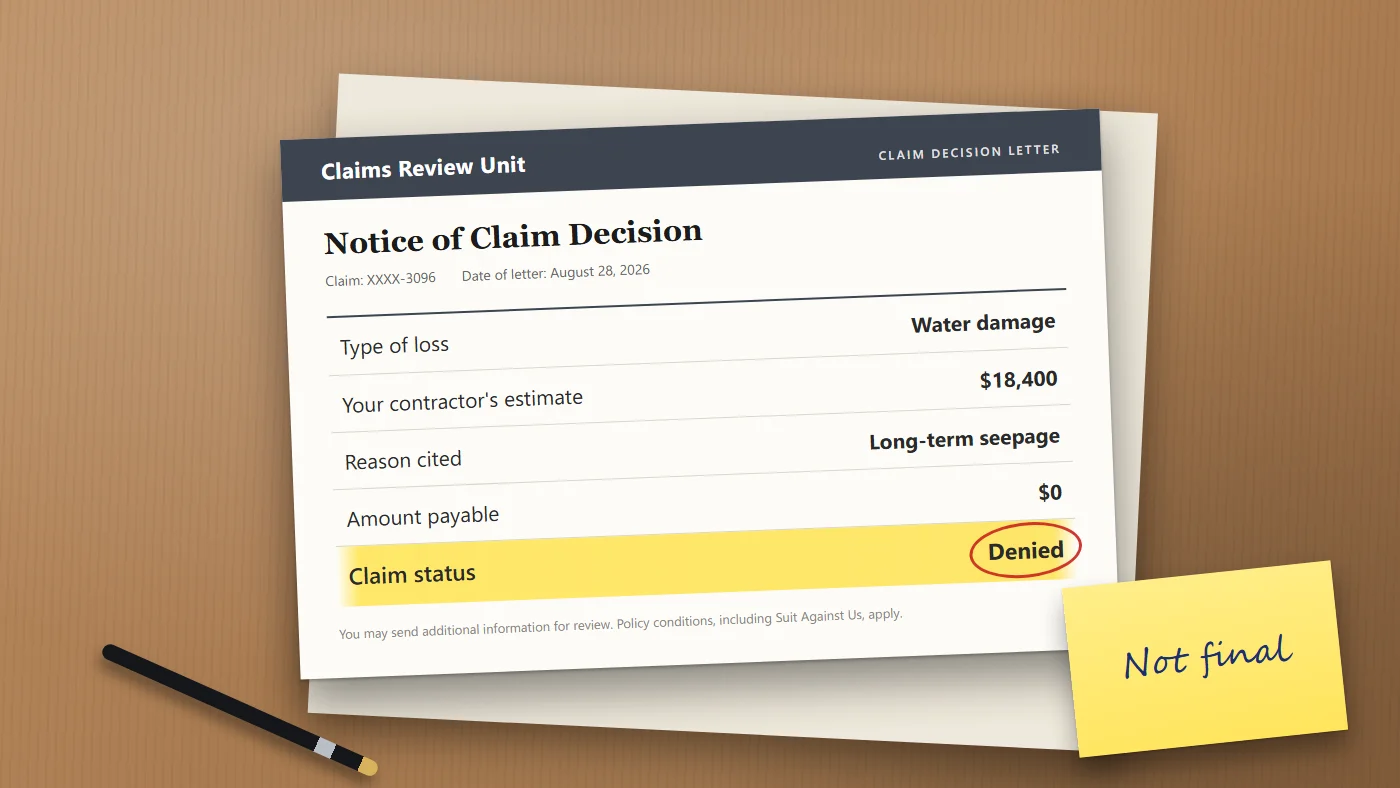
The letter is usually one page. It thanks you for your patience, quotes a paragraph from your policy, and says the company is unable to make a payment for this loss. Most people read it twice, drop it in a folder and start working out how to pay for the repair themselves.
That letter is the insurer's reading of a contract. It isn't a ruling. Your policy and your state's insurance laws give you several ways to push back: a written request for reconsideration, a reinspection, a formal appraisal process that's already written into most policies, a complaint to your state regulator and, if it comes to that, a lawsuit. The denial letter rarely lays any of these out in useful detail.
Why does this matter to so many households? About one insured home in 18 has a claim in a given year, according to the Insurance Information Institute, and the average claim between 2019 and 2023 came to $17,059. More of those claims are ending with no check at all. Weiss Ratings, which went through the annual statements insurers file with regulators, found that 42% of the 6.8 million homeowner claims received and closed in 2024 were closed without any payment, up from 39% in 2023 and 25.7% back in 2004.
42% of homeowner claims closed in 2024 ended with no payment, up from 25.7% twenty years earlier, according to Weiss Ratings' analysis of insurer filings.
That number needs a fair reading. The Insurance Information Institute points out that "closed without payment" isn't the same as "denied." It also covers damage that came in under the deductible, duplicate filings, losses that belong to a flood policy and claims the owner withdrew.
Still, somewhere inside that 42% are claims that should've been paid: a sudden pipe burst labeled long-term seepage, storm damage written off as old wear, a repair estimate that missed half the job. Those deserve a second round. The second round has rules.
Denied, underpaid or closed: which one did you get?
Your next move depends on what kind of "no" you received.
A denial means the insurer says the policy doesn't cover this loss at all. The fight is over coverage: what caused the damage and what the policy language means.
An underpayment means the insurer agrees the loss is covered but puts a lower price on it than your contractor does. Now the fight is over the amount.
A claim closed under the deductible is a version of the second kind. The insurer's estimate came in below your deductible, so nothing got paid, and if that estimate is too low, so is the closure.
Why split hairs? Because one of the strongest tools in your policy, the appraisal clause, settles disputes about amounts only. It can't overturn a coverage denial.
The reasons insurers give, and which ones can be argued
Most denial letters lean on one of a handful of reasons.
Wear, tear and lack of maintenance. Home policies cover sudden, accidental damage, not a roof or a pipe that simply wore out, and the Insurance Information Institute is blunt that damage from poor maintenance is on the owner. But whether a specific leak was sudden or gradual is a question of fact, and a licensed plumber's or roofer's written opinion can change the answer.
Long-term seepage. Water claims often get denied on the theory that the leak ran for weeks. Same point. Cause and timing can be documented.
Flood or groundwater. Standard home policies exclude it. If water came in from outside at ground level, the claim belongs with a flood policy, if you have one.
Late notice or missing paperwork. Policies require prompt notice and, when the insurer asks, a signed proof of loss, commonly within 60 days of the request. Missing paperwork can sometimes be fixed after the fact. Ask in writing exactly what's missing.
Misstatements on the application, or a vacant house. These are harder to fight. Talk to an attorney early.
The clock you can't see
Nearly every policy has a clause headed "Suit Against Us." United Policyholders, a nonprofit that helps people with insurance claims, says the typical version gives you one year from the date of loss to file a lawsuit. State law overrides that in some places with a longer period, and many states pause the clock while the claim is being adjusted, so your year may run from the denial rather than from the storm. It differs by state. Don't guess.
You may never sue. But once that deadline passes, you lose most of your leverage in every other step, which is why the very first thing I'd do with a denial letter is find that date. Send the insurer a short letter asking it to state in writing which deadline it believes applies to your claim, and put that date on the calendar before you start the appeal itself.