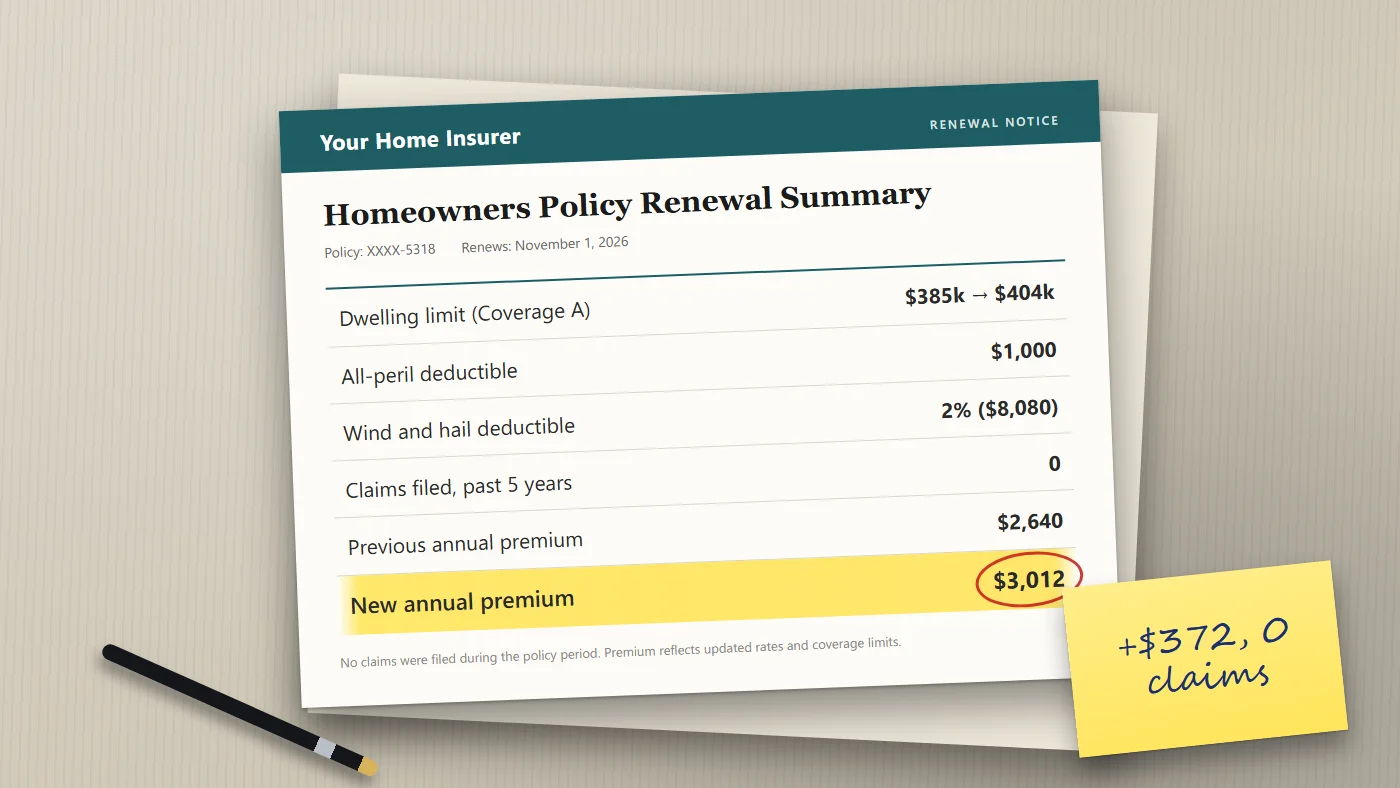
The renewal notice usually lands about a month before your policy ends. You open it, and the premium is a few hundred dollars higher than last year. You didn't file a claim. Nothing changed at the house. It looks like a billing mistake.
It almost never is. Over 2025 the average U.S. home policy went up 12%, which left it at $2,948 a year (Insurify's figure, drawn from insurer rate filings). And this year hasn't let up. By Insurify's mid-year check, published in September, the national average had reached $3,012. That's another 2.2% in six months, with a forecast of $3,057 by the end of 2026.
Why didn't your spotless record protect you? Because you were never paying just for your own claims. Your premium is your share of what the insurer expects to pay out across everyone in your rating territory. On top of that goes whatever it now costs to rebuild a house after a fire or a storm, and then what the insurer itself pays for the backup coverage it buys to survive a bad year. A clean record keeps you out of the pricier tiers. It doesn't shield you from the pool.
Still, every renewal price has two layers. Where you live sets the first, and you can't argue with it. The second comes from your own policy, and most homeowners never look at it.
46% is how much the average home premium has climbed since 2021, per Insurify. General inflation over the same stretch was 16%, so insurance rose about three times as fast. On a typical policy that's roughly $900 more a year for the same house.
So who am I actually paying for?
Start with the weather, because insurers do. Last year the country got hit by 23 separate disasters that each did at least a billion dollars in damage. Only 2023 and 2024 had more, so 2025 ranks third on record (Insurify again). Then there were the severe thunderstorms: hail, tornadoes, straight-line wind. Those alone produced about $52 billion in insured losses.
And they landed in places that never thought of themselves as high risk. The steepest 2025 increases, 20% or more, hit Minnesota, Colorado, Iowa, Nebraska, Oklahoma and South Carolina.
Then there's the repair bill. Over two years, building material prices rose only about 7%. Then, Insurify found, they jumped roughly 15% in a single year. When a roof or a kitchen costs more to replace, every claim in your ZIP code costs more too, and that feeds straight into next year's rates.
Regulators see it too. In August 2026 the National Association of Insurance Commissioners put out its first national study of the homeowners market. It covers seven years, 2018 through 2024, and splits the results by region. Adjusted for inflation, premiums rose anywhere from 18.3% to 43.3%, depending on the region. Claims got more frequent and more expensive over that stretch, especially from 2021 on.
A different group, the Consumer Federation of America, came at it by ZIP code. Between 2021 and 2024, premiums went up in 95% of them.
The honest answer, then: your neighbors' roofs, last spring's hailstorm two counties over, and the price of lumber.
The part of the increase that's about you
Not all of it is the pool. Several things in your own file can move the price without a claim.
Your dwelling limit went up. Most policies carry an inflation guard that raises Coverage A, the amount to rebuild the house, every year. Higher limit, higher premium. Fair enough, but the figure is only an estimate, and it can be wrong in either direction.
Your roof had a birthday. Many insurers re-rate a home once the roof passes 10, 15 or 20 years. Some also change how they'd pay a roof claim, which can matter more than the price.
Your credit-based insurance score moved. It's built from your credit report, and in most states home insurers are allowed to use it. Not in California, Maryland or Massachusetts, where it's barred for home insurance. Lawmakers in several other states debated limits in 2026. Why the fuss? Homeowners with weak scores were paying noticeably more than strong scorers for the same coverage, in research CNBC reported on in April.
A discount fell off. New-home, new-roof and claims-free credits expire. A bundle discount vanishes the day you move your car insurance somewhere else.
Your claims file has something you didn't put there. Insurers check CLUE, a LexisNexis database that can hold up to seven years of claims tied to you and to the address. A prior owner's water claim can sit there. So can a phone call to your agent that got logged as a claim.
You stayed put. About a decade ago, regulators worried that loyalty could cost you. The practice they went after, "price optimization," sets your price partly on how likely you are to shop around, not on risk alone. The NAIC wrote a white paper on it in November 2015. More than a dozen state insurance departments then issued bulletins against it. Loyalty can cut the other way, too. Some insurers knock 5% off after three to five years, and 10% after six or more (those are the Insurance Information Institute's numbers). You won't know which side you're on until you see another company's price for the same coverage.
None of this means your insurer did anything wrong. The renewal figure is an opening position, and you're allowed to check every input that's about you. Order matters, too. A few of these checks take five minutes, and one can take a month.