The envelope from the hospital holds a balance, a due date and a tear-off payment slip. It looks like you've got two choices. Pay it now, or call and sign up for a payment plan that could run for years.
There's a third one, and the hospital is required to tell you about it. Under section 501(r) of the federal tax code, every nonprofit hospital has to keep a written financial assistance policy, which most people call charity care, and that policy has to spell out who gets free or discounted care and how to apply for it. Nonprofits make up about 58% of community hospitals in the U.S., according to KFF. Odds are decent that yours is one of them.
The notice is usually right there on the bill. Federal rules require a conspicuous written notice about financial assistance on billing statements, with a phone number and a web address. In practice it's often one sentence in small type near the bottom of the page, or on the back.
Plenty of people never see it. When KFF went through nonprofit hospitals' tax filings, it found that about $2.7 billion of the bad debt they reported for 2019 came from patients who were likely eligible for charity care and didn't get it.
$2.7 billion. That's the bad debt nonprofit hospitals reported for 2019 that likely came from patients who qualified for charity care and never received it, according to KFF's review of hospital tax filings.
What the law requires, and what it leaves to the hospital
Start with what federal law doesn't do. It doesn't set an income limit. It doesn't force any hospital to wipe out a bill for people under a certain income. What it does require is a written policy, made public, that covers all emergency and medically necessary care at that hospital, and the policy has to say who's eligible, whether the help is free care or a discount, how the discount is figured, and how to apply.
The hospital must post the policy, the application and a plain-language summary on its website. It also has to hand out free paper copies, including in the emergency room and at admissions.
There's a price rule, too. If you qualify, the hospital can't charge you more than the "amounts generally billed" to insured patients for the same care.
Where the income lines usually fall
Each hospital draws its own lines, and they're all over the map. Researchers writing in the journal Health Affairs in 2024 reviewed the policies of 2,989 nonprofit hospitals and found free-care income limits ranging from 41% of the federal poverty level to 600%.
Two numbers still come up again and again, in hospital policies and in state laws. One is 200% of the poverty level, a common cutoff for free care. The other is 400%, a common ceiling for discounts. In dollars, using the 2026 poverty guidelines from the Department of Health and Human Services for the 48 contiguous states and Washington, D.C., they look like this.
| Household size | 2026 poverty guideline | 200% (a common free-care line) | 400% (a common discount ceiling) |
|---|
| 1 | $15,960 | $31,920 | $63,840 |
| 2 | $21,640 | $43,280 | $86,560 |
| 3 | $27,320 | $54,640 | $109,280 |
| 4 | $33,000 | $66,000 | $132,000 |
Alaska and Hawaii use higher figures. Your hospital may use different percentages, so read the table as a first check. It isn't a verdict.
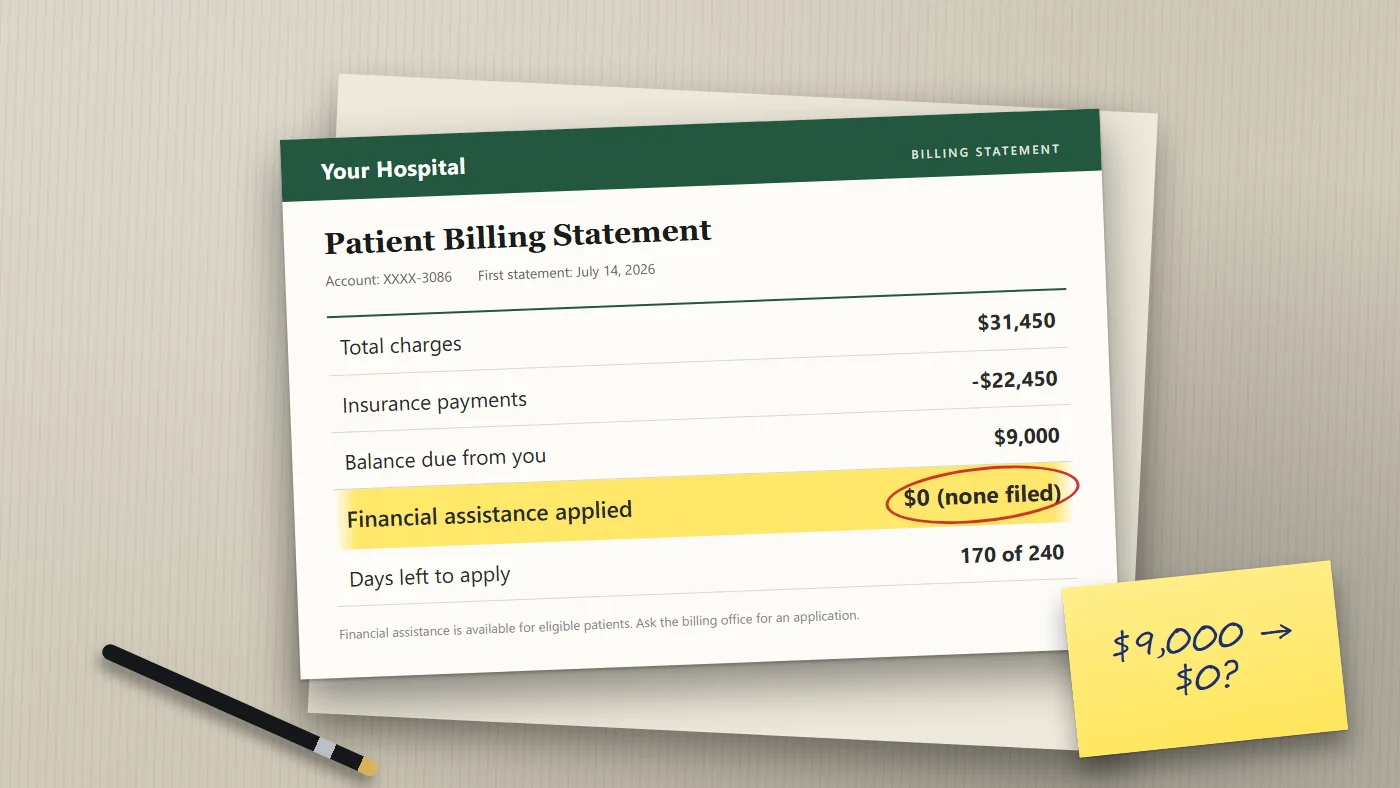
Say a retired couple has $41,000 of household income and owes $9,000 after a three-day stay. That's under $43,280, the 200% line for two people. At a hospital that gives free care up to 200%, an approved application would take the $9,000 to zero, while a stingier policy might knock off only part of it. Same form either way. Filing it costs nothing.
Having insurance doesn't rule you out. Many policies cover what's left after your plan pays, including the deductible and coinsurance, though some hospitals limit help to people with no coverage at all. You won't know which kind you're dealing with until you read the eligibility page.
You have more time than the bill suggests
The due date on the statement is what the hospital would like. The legal clock is longer.
Under the IRS rules, a nonprofit hospital must accept a financial assistance application for at least 240 days after it sends the first bill following your discharge. That's about eight months.
For the first 120 days, the hospital can't start what the rules call extraordinary collection actions. Those include selling the debt, reporting it to credit bureaus, suing you, placing a lien, garnishing wages, or refusing later care because of the old bill. Before it takes any of those steps, it owes you a written notice at least 30 days ahead saying financial assistance is available.
File a complete application inside the 240 days and the hospital has to pause those actions and make a decision. Approved? Then it must reverse steps it already took. It also has to refund anything you paid above what you now owe, unless the difference is under $5.
Knowing the rule is the easy half. Getting an application through a billing office is where people stall, and the order you do things in matters more than you'd think.