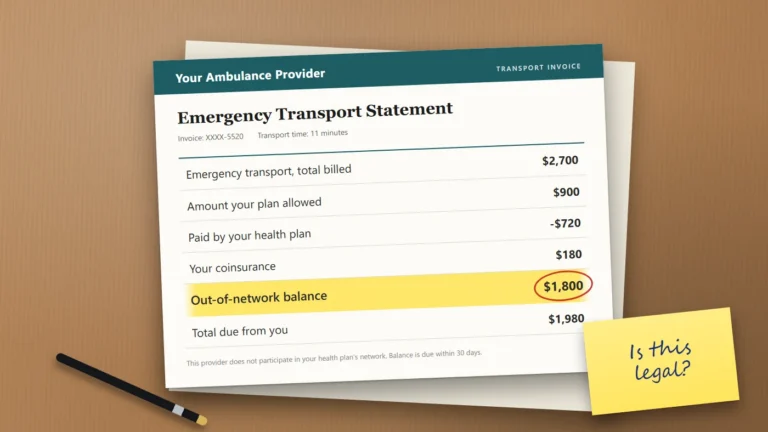
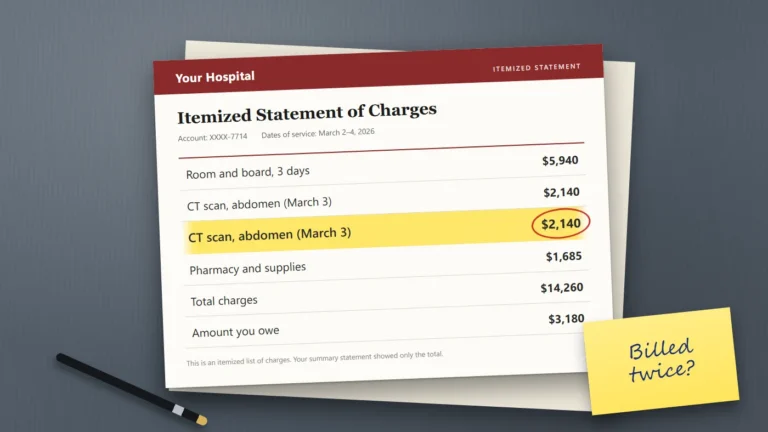
The envelope from the hospital holds a balance, a due date and a tear-off payment slip. It looks like you've got two choices. Pay it now, or call and sign up for a payment plan that could run for years.
There's a third one, and the hospital is required to tell you about it. Under section 501(r) of the federal tax code, every nonprofit hospital has to keep a written financial assistance policy, which most people call charity care, and that policy has to spell out who gets free or discounted care and how to apply for it. Nonprofits make up about 58% of community hospitals in the U.S., according to KFF. Odds are decent that yours is one of them.
The notice is usually right there on the bill. Federal rules require a conspicuous written notice about financial assistance on billing statements, with a phone number and a web address. In practice it's often one sentence in small type near the bottom of the page, or on the back.
Plenty of people never see it. When KFF went through nonprofit hospitals' tax filings, it found that about $2.7 billion of the bad debt they reported for 2019 came from patients who were likely eligible for charity care and didn't get it.
$2.7 billion. That's the bad debt nonprofit hospitals reported for 2019 that likely came from patients who qualified for charity care and never received it, according to KFF's review of hospital tax filings.
What the law requires, and what it leaves to the hospital
Start with what federal law doesn't do. It doesn't set an income limit. It doesn't force any hospital to wipe out a bill for people under a certain income. What it does require is a written policy, made public, that covers all emergency and medically necessary care at that hospital, and the policy has to say who's eligible, whether the help is free care or a discount, how the discount is figured, and how to apply.
The hospital must post the policy, the application and a plain-language summary on its website. It also has to hand out free paper copies, including in the emergency room and at admissions.
There's a price rule, too. If you qualify, the hospital can't charge you more than the "amounts generally billed" to insured patients for the same care.
Where the income lines usually fall
Each hospital draws its own lines, and they're all over the map. Researchers writing in the journal Health Affairs in 2024 reviewed the policies of 2,989 nonprofit hospitals and found free-care income limits ranging from 41% of the federal poverty level to 600%.
Two numbers still come up again and again, in hospital policies and in state laws. One is 200% of the poverty level, a common cutoff for free care. The other is 400%, a common ceiling for discounts. In dollars, using the 2026 poverty guidelines from the Department of Health and Human Services for the 48 contiguous states and Washington, D.C., they look like this.
| Household size | 2026 poverty guideline | 200% (a common free-care line) | 400% (a common discount ceiling) |
|---|
| 1 | $15,960 | $31,920 | $63,840 |
| 2 | $21,640 | $43,280 | $86,560 |
| 3 | $27,320 | $54,640 | $109,280 |
| 4 | $33,000 | $66,000 | $132,000 |
Alaska and Hawaii use higher figures. Your hospital may use different percentages, so read the table as a first check. It isn't a verdict.
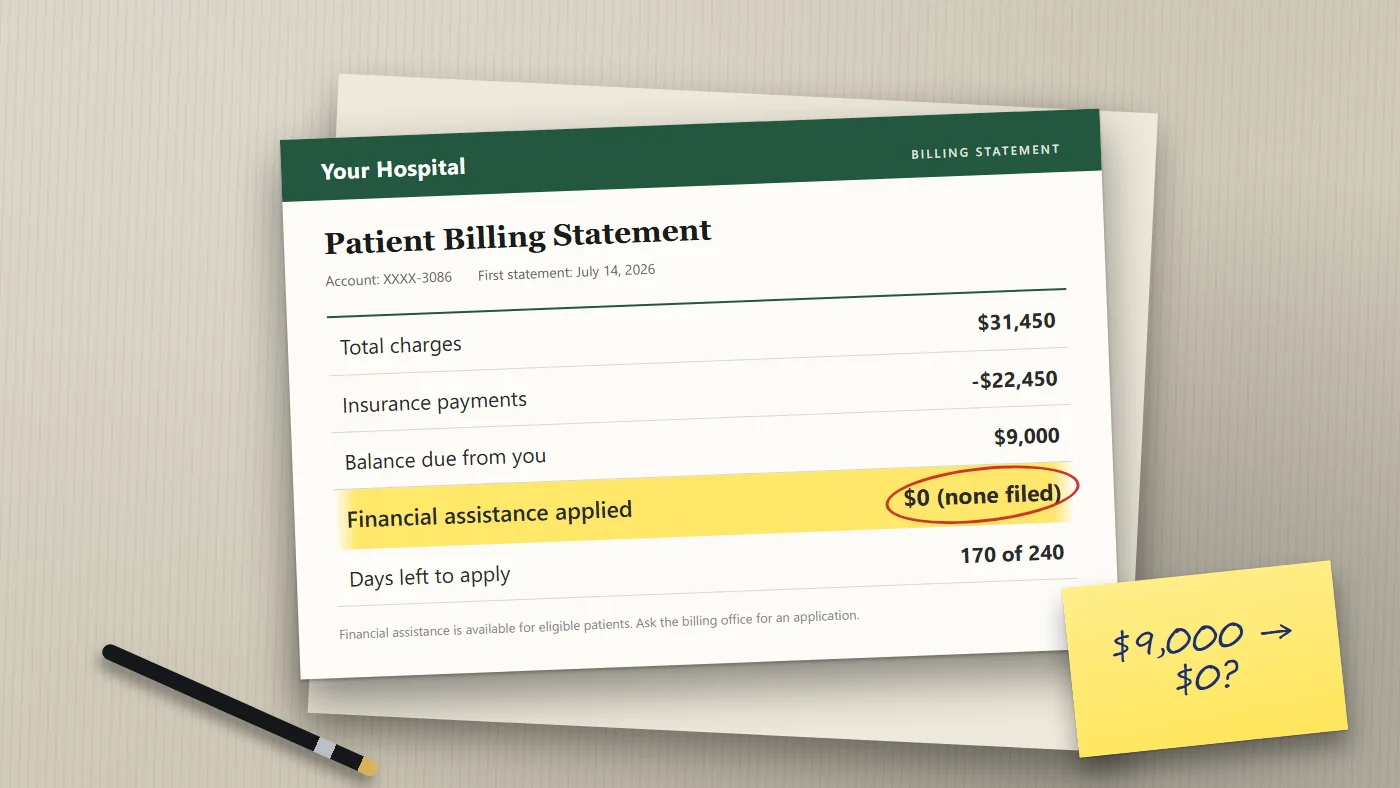
Say a retired couple has $41,000 of household income and owes $9,000 after a three-day stay. That's under $43,280, the 200% line for two people. At a hospital that gives free care up to 200%, an approved application would take the $9,000 to zero, while a stingier policy might knock off only part of it. Same form either way. Filing it costs nothing.
Having insurance doesn't rule you out. Many policies cover what's left after your plan pays, including the deductible and coinsurance, though some hospitals limit help to people with no coverage at all. You won't know which kind you're dealing with until you read the eligibility page.
You have more time than the bill suggests
The due date on the statement is what the hospital would like. The legal clock is longer.
Under the IRS rules, a nonprofit hospital must accept a financial assistance application for at least 240 days after it sends the first bill following your discharge. That's about eight months.
For the first 120 days, the hospital can't start what the rules call extraordinary collection actions. Those include selling the debt, reporting it to credit bureaus, suing you, placing a lien, garnishing wages, or refusing later care because of the old bill. Before it takes any of those steps, it owes you a written notice at least 30 days ahead saying financial assistance is available.
File a complete application inside the 240 days and the hospital has to pause those actions and make a decision. Approved? Then it must reverse steps it already took. It also has to refund anything you paid above what you now owe, unless the difference is under $5.
Knowing the rule is the easy half. Getting an application through a billing office is where people stall, and the order you do things in matters more than you'd think.
How to apply, step by step
The form isn't hard. What trips people up is the order.
- Start with the statement you already have. The financial assistance notice is usually at the bottom or on the back, and a search of the hospital's website for "financial assistance" should turn up the policy, the application and the plain-language summary, free to download. Nothing turns up? Call the billing number and ask for the financial assistance application by that name.
- Every hospital writes its own rules, so read the eligibility page before you fill in a single line. Look for the income percentages, whether assets count, whether you have to live in the state or in the hospital's service area, and whether the deadline is shorter than you'd assume. A sizable minority of hospitals have residency rules.
- Gather proof of income. Most applications want your latest federal tax return and recent pay stubs; a retiree would send a Social Security award letter or pension statements. Some want bank statements too. No income to document? Many will accept a signed letter explaining how you cover your living costs.
- Tell the billing office in writing that you're applying, ask it to hold the account while the application is pending, and then send the application itself in a way you can prove later. Send copies, never originals, by certified mail, a patient portal upload, or hand delivery with a date-stamped receipt. If a collection agency already has the account, the Consumer Financial Protection Bureau suggests telling the collector you're seeking financial assistance and asking it to pause. Note the date and the name of anyone you talk to.
- Watch the mail. If something's missing, the hospital has to tell you in writing what it needs and how to reach the office handling your file. Answer fast. An incomplete file that sits unanswered is the most common way an application dies.
- Get the decision on paper. With an approval, ask for a new statement showing the adjusted balance, and ask about refunds for anything you've already paid. With a denial, ask which rule you failed and whether there's an appeal.
Doctors who treated you in the hospital often bill on their own, and the policy has to include a list of which providers it covers and which it doesn't. Check that list before you assume the surgeon's or the radiologist's bill is part of the deal.
Does your state go further?
Some states set the income lines themselves, and some extend the rules to for-profit hospitals. KFF counted 26 states plus Washington, D.C., that require at least some hospitals to offer charity care to certain groups of patients. That count is from 2022, though, and several states have changed their laws since, so look up your own. A few examples from state sources:
Washington writes the discounts straight into state law. At a large hospital, or one in a bigger system, a household at or below 300% of the poverty level owes nothing. Those hospitals hold about 80% of the state's beds, by the Attorney General's estimate. From 301% to 350% of the poverty level the bill drops by 75%, and from 351% to 400% it's cut in half. Smaller hospitals use lower lines. And the Attorney General says charity care applies to people with private insurance, public coverage or none.
In New York, the deadline pressure mostly goes away. There's no deadline to apply, according to the Attorney General's office. Once your application is complete, the hospital has to decide within 30 days, and it can't send the bill to a collector for at least six months after the first statement. Who qualifies? In most cases, households at or below 400% of the poverty level.
California adds two protections that don't depend on income. A hospital can't sue over the bill until 180 days after the first billing, the state's financial protection agency says. And a separate 2024 law, SB 1061, now bars medical debt from California credit reports. Uninsured patients and patients with high medical costs can apply for a hospital's charity care or discount program if they're at or below 400% of the poverty level.
Maryland is the short one. KFF notes that hospitals there must give free care to insured and uninsured patients at or below 200% of the poverty level, with discounts for people with higher incomes.
What if your hospital is for-profit or government-run? Then the federal 501(r) rules don't reach it. Ask anyway. The CFPB points out that many of these hospitals keep their own assistance policies, and some state laws cover them.
Mistakes that cost people the discount
The costliest one looks like the responsible thing to do: putting the bill on a credit card. Once the hospital's been paid, your balance there is zero, and the debt now belongs to a card issuer with no charity care policy. The CFPB also warns that medical credit cards can carry steep interest after a promotional period ends.
A payment plan signed before you apply has a similar flaw: it's built on the full balance, so it locks in the wrong number. Apply first, and set up a plan for whatever's left.
"I earn too much" is wrong more often than you'd think. New York and California both use 400% of the poverty level as the ceiling for help, which for a household of two in 2026 is $86,560, and plenty of retirees living on a pension and Social Security come in under it. "It's too late" is the other one. The 240 days run from the first bill after discharge, not from the date of care, so even an account that's already with a collector may still be inside the window.
And don't wait for a billing dispute to be settled. You can question the charges and apply for assistance at the same time. Neither one cancels the other.
If the hospital says no, or the balance is still too big
A denial isn't the end of the file. Get the reason in writing and appeal if the policy allows it. If you think a nonprofit hospital ignored its own policy, your state attorney general takes complaints. The CFPB takes medical debt collection complaints at (855) 411-2372.
Some people bring in help here. A medical billing advocate reviews the charges, deals with the billing office and negotiates on your behalf. Fees vary: some bill by the hour, others take a share of what they save you, so get the terms in writing and compare more than one before you sign. Many states also fund consumer assistance programs that do similar work for free.
If a balance survives every discount, compare the ways to pay it. A hospital payment plan is often interest-free. A personal loan or a debt consolidation loan isn't, and moving a hospital bill onto a loan turns medical debt into ordinary debt, which gives up protections that apply only to medical bills. I'd treat that as a last resort.
Then look at how the bill got this big. A large balance after insurance usually traces back to a high deductible or an out-of-network provider. Medicare's fall enrollment period opens October 15, and Marketplace open enrollment for 2027 plans starts November 1. When you compare health insurance plans, weigh the deductible and the out-of-pocket maximum, not only the monthly premium.
None of that has to happen today. This does. Pull out the statement, find the words "financial assistance" in the fine print, and count the days since the first bill after discharge. Under 240, at a nonprofit hospital? The application's still open. Download it, clip your income documents to it and mail it with proof of delivery.
If you only make one phone call about this bill, make it to the financial assistance office.
This article is general information, not financial, legal, tax or medical advice.