Medicare
IRMAA Explained: Why Your Medicare Premium Is Higher Than Your Neighbor's — and How to Appeal
Medicare sets your premium from a tax return that's two years old. If your income has dropped since then, there's a form for that, and a short list of reasons it accepts.
 Margaret Linwood
Updated Sep 22, 2026 · 10 min read
Most people on Medicare pay $202.90 a month for Part B in 2026. About 8% pay more, and some pay a lot more. At the top of the scale it's $689.90 a month, for the same card, the same doctors and the same coverage your neighbor gets.
That extra charge is the Income-Related Monthly Adjustment Amount, usually shortened to IRMAA. It's added to your Part B premium and, as a separate charge, to your Part D drug coverage. It's based on your income, though probably not the income you're thinking of.
Social Security doesn't look at what you earn now. It uses the most recent tax return the IRS can hand over, which is usually two years old. Your 2026 premium comes from your 2024 return. Your 2027 premium will come from your 2025 return.
So someone who retired last year can be billed as if the paycheck never stopped. Worse, someone who sold a house or pulled a big chunk out of an IRA back in 2024 can watch the premium jump in 2026, long after that money was spent, reinvested or handed to a contractor, because the system has no idea what happened in between and doesn't ask. The letter usually shows up late in the year. Often it's the first time anyone in the house has seen the word IRMAA.
The number to know: up to $578 a month. That's the top 2026 surcharge per person: $487.00 added to Part B plus $91.00 added to Part D. If both spouses have Medicare, each one pays it.
The 2026 brackets, and what's expected for 2027
IRMAA runs on your modified adjusted gross income, or MAGI. For this purpose it's the adjusted gross income on your tax return plus any tax-exempt interest. Wages, pensions, IRA and 401(k) withdrawals, Roth conversions, capital gains, rental income and the taxable part of your Social Security all count.
| 2024 MAGI, single filer | 2024 MAGI, joint return | Part B premium in 2026 | Added to Part D premium |
|---|
| $109,000 or less | $218,000 or less | $202.90 | $0 |
| Above $109,000 to $137,000 | Above $218,000 to $274,000 | $284.10 | $14.50 |
| Above $137,000 to $171,000 | Above $274,000 to $342,000 | $405.80 | $37.50 |
| Above $171,000 to $205,000 | Above $342,000 to $410,000 | $527.50 | $60.40 |
| Above $205,000, below $500,000 | Above $410,000, below $750,000 | $649.20 | $83.30 |
| $500,000 or more | $750,000 or more | $689.90 | $91.00 |
Married and filing separately, and lived with your spouse at any point in the year? Your table is harsher. Anything above $109,000 goes straight to a $649.20 Part B premium, and $391,000 or more puts you at $689.90.
Two features of this table cost people real money.
The brackets are cliffs, not ramps. One dollar over $109,000 triggers the whole first-tier surcharge: $95.70 a month for Part B and Part D together, or about $1,148 a year. There's no partial charge for being a little over. And the charge is per person, so a couple with $220,000 of joint income, just $2,000 past the joint line, pays it twice, which works out to roughly $2,297 for the year on a sliver of extra income. That stings.
The official 2027 numbers aren't out yet. CMS usually announces them in October or November. The 2026 Medicare Trustees Report projects a standard Part B premium of $209.50 for 2027, though some private forecasters expect a few dollars more. Estimates built on inflation data put the first 2027 IRMAA threshold at about $112,000 for single filers and $224,000 for joint filers. Treat all of that as forecast.
How one sale turns into a year of higher premiums
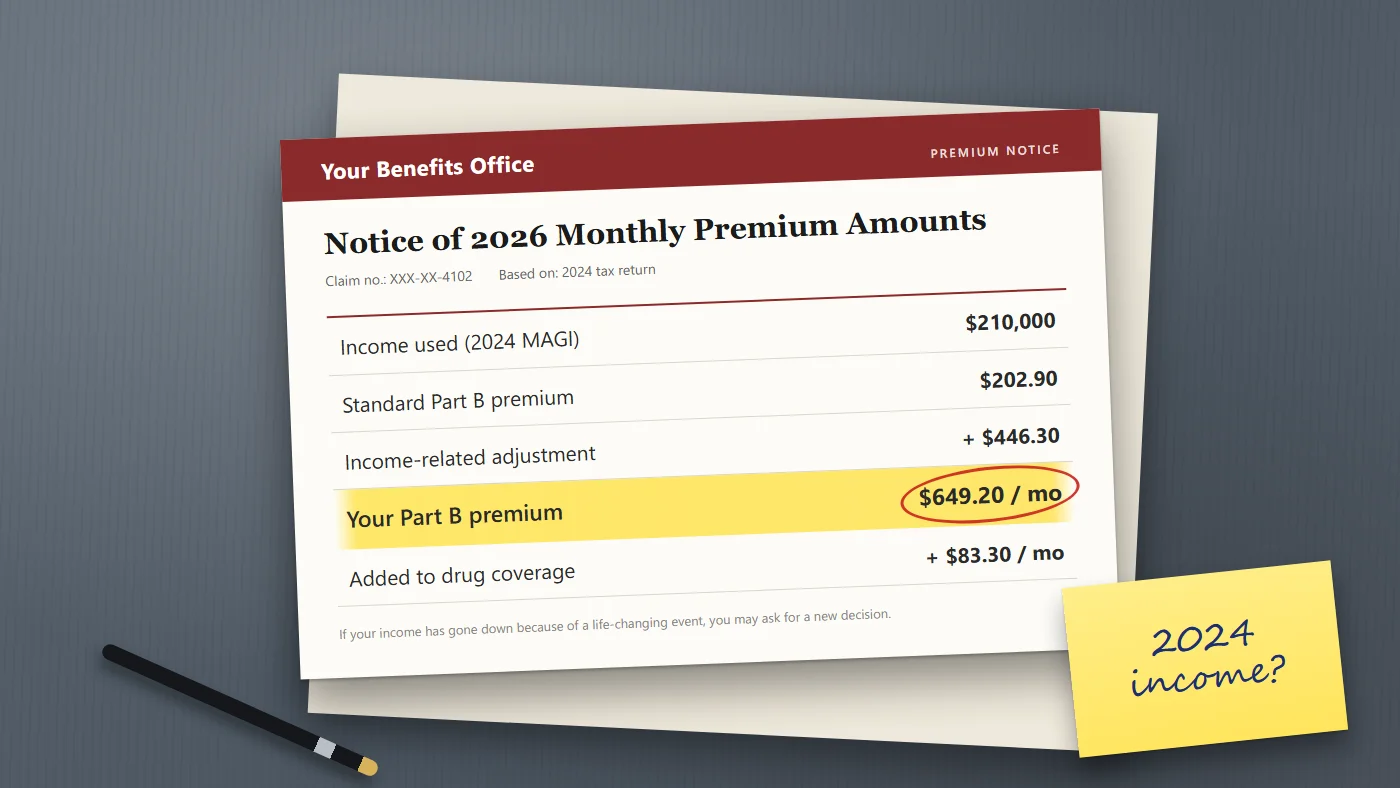
Say a single homeowner, 68, has $60,000 of regular income. In 2024 she sells the house she's owned for 30 years, with a $400,000 gain. The tax code lets her exclude $250,000 of it. The other $150,000 is a taxable capital gain, and it lands in her MAGI.
Now her 2024 MAGI is $210,000. In 2026 that puts her in the fifth bracket: $649.20 for Part B instead of $202.90, plus $83.30 on her drug coverage. Over twelve months, that's about $6,355 she wouldn't otherwise have paid. She's made up, but the math works the same way for anyone.
Big traditional IRA withdrawals do the same thing. So do Roth conversions, the sale of a business or rental property, and cashing out company stock. The income shows up on one tax return, and two years later it shows up in the Medicare bill.
There's a limit to the damage, at least. IRMAA is recalculated every year. If her income drops back to $60,000 in 2025, her premium returns to the standard amount in 2027. One spike, one year.
What Social Security won't do is lower the surcharge just because the income was a one-off. A home sale or an IRA withdrawal isn't on its list of accepted reasons. Some other changes are, and a lot of people who qualify for them never ask.