Most people on Medicare pay $202.90 a month for Part B in 2026. About 8% pay more, and some pay a lot more. At the top of the scale it's $689.90 a month, for the same card, the same doctors and the same coverage your neighbor gets.
That extra charge is the Income-Related Monthly Adjustment Amount, usually shortened to IRMAA. It's added to your Part B premium and, as a separate charge, to your Part D drug coverage. It's based on your income, though probably not the income you're thinking of.
Social Security doesn't look at what you earn now. It uses the most recent tax return the IRS can hand over, which is usually two years old. Your 2026 premium comes from your 2024 return. Your 2027 premium will come from your 2025 return.
So someone who retired last year can be billed as if the paycheck never stopped. Worse, someone who sold a house or pulled a big chunk out of an IRA back in 2024 can watch the premium jump in 2026, long after that money was spent, reinvested or handed to a contractor, because the system has no idea what happened in between and doesn't ask. The letter usually shows up late in the year. Often it's the first time anyone in the house has seen the word IRMAA.
The number to know: up to $578 a month. That's the top 2026 surcharge per person: $487.00 added to Part B plus $91.00 added to Part D. If both spouses have Medicare, each one pays it.
The 2026 brackets, and what's expected for 2027
IRMAA runs on your modified adjusted gross income, or MAGI. For this purpose it's the adjusted gross income on your tax return plus any tax-exempt interest. Wages, pensions, IRA and 401(k) withdrawals, Roth conversions, capital gains, rental income and the taxable part of your Social Security all count.
| 2024 MAGI, single filer | 2024 MAGI, joint return | Part B premium in 2026 | Added to Part D premium |
|---|
| $109,000 or less | $218,000 or less | $202.90 | $0 |
| Above $109,000 to $137,000 | Above $218,000 to $274,000 | $284.10 | $14.50 |
| Above $137,000 to $171,000 | Above $274,000 to $342,000 | $405.80 | $37.50 |
| Above $171,000 to $205,000 | Above $342,000 to $410,000 | $527.50 | $60.40 |
| Above $205,000, below $500,000 | Above $410,000, below $750,000 | $649.20 | $83.30 |
| $500,000 or more | $750,000 or more | $689.90 | $91.00 |
Married and filing separately, and lived with your spouse at any point in the year? Your table is harsher. Anything above $109,000 goes straight to a $649.20 Part B premium, and $391,000 or more puts you at $689.90.
Two features of this table cost people real money.
The brackets are cliffs, not ramps. One dollar over $109,000 triggers the whole first-tier surcharge: $95.70 a month for Part B and Part D together, or about $1,148 a year. There's no partial charge for being a little over. And the charge is per person, so a couple with $220,000 of joint income, just $2,000 past the joint line, pays it twice, which works out to roughly $2,297 for the year on a sliver of extra income. That stings.
The official 2027 numbers aren't out yet. CMS usually announces them in October or November. The 2026 Medicare Trustees Report projects a standard Part B premium of $209.50 for 2027, though some private forecasters expect a few dollars more. Estimates built on inflation data put the first 2027 IRMAA threshold at about $112,000 for single filers and $224,000 for joint filers. Treat all of that as forecast.
How one sale turns into a year of higher premiums
Say a single homeowner, 68, has $60,000 of regular income. In 2024 she sells the house she's owned for 30 years, with a $400,000 gain. The tax code lets her exclude $250,000 of it. The other $150,000 is a taxable capital gain, and it lands in her MAGI.
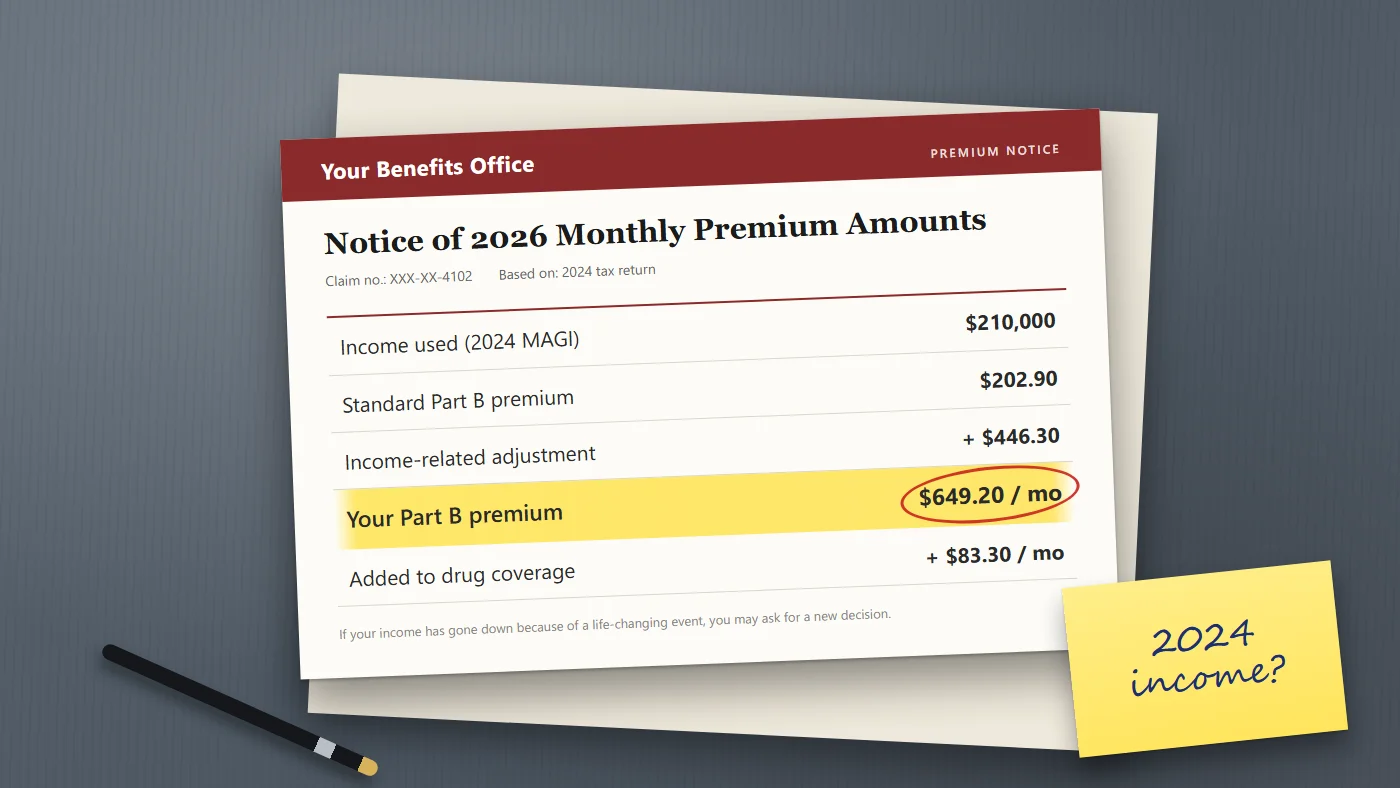
Now her 2024 MAGI is $210,000. In 2026 that puts her in the fifth bracket: $649.20 for Part B instead of $202.90, plus $83.30 on her drug coverage. Over twelve months, that's about $6,355 she wouldn't otherwise have paid. She's made up, but the math works the same way for anyone.
Big traditional IRA withdrawals do the same thing. So do Roth conversions, the sale of a business or rental property, and cashing out company stock. The income shows up on one tax return, and two years later it shows up in the Medicare bill.
There's a limit to the damage, at least. IRMAA is recalculated every year. If her income drops back to $60,000 in 2025, her premium returns to the standard amount in 2027. One spike, one year.
What Social Security won't do is lower the surcharge just because the income was a one-off. A home sale or an IRA withdrawal isn't on its list of accepted reasons. Some other changes are, and a lot of people who qualify for them never ask.
Which life changes let you ask for a lower premium?
Social Security will make a new decision, using a more recent year's income, if your income went down because of what it calls a life-changing event. The list is short:
- You married, divorced, or your spouse died.
- You or your spouse stopped working or cut back your hours.
- You or your spouse lost income-producing property through a disaster or another event outside your control.
- An employer pension plan ended or was reorganized, and you lost pension income.
- You or your spouse received a settlement from an employer because of its closure, bankruptcy or reorganization.
Retirement comes up most. Say you earned $160,000 in 2024 and retired in 2025. Your 2026 premium is built on a salary you don't have anymore. That's a work stoppage, and you can ask Social Security to use your lower income for 2025 or your expected income for 2026 instead.
A spouse's death is another. The survivor usually moves from a joint return to a single one, where every threshold is half the size. If household income also fell, the event qualifies.
What doesn't count: selling a home or investments, a large retirement account withdrawal, a Roth conversion, an inheritance, a good year in the market. Those are your own transactions, not listed events. For them, the surcharge runs its course and drops off the following year.
Filing Form SSA-44, step by step
The form's full name is "Medicare Income-Related Monthly Adjustment Amount – Life-Changing Event." It's free. You don't need a lawyer or a paid service.
- Pull out your determination letter. It shows which tax year Social Security used, the MAGI it got from the IRS and the premium it set. Check that the year and the income match your own return.
- Get the form. Download SSA-44 from ssa.gov, or sign in through the agency's IRMAA page and fill it out and submit it online.
- Pick the event and its date. Step 1 of the form asks what happened and when. Choose one. If two apply, say retirement followed by a spouse's death, use the one that best explains the drop.
- Report the lower income. Step 2 asks for the tax year your income went down, your adjusted gross income, tax-exempt interest and filing status for that year. If the year isn't over yet, you give an estimate.
- Add next year if it'll be lower still. Step 3 covers a further drop expected the following year. People who retire mid-year often need it, since the first full year of retirement is the lower one.
- Attach proof of the event. An employer letter showing your last day of work, a death certificate, a divorce decree, a letter from the pension administrator. Some documents have to be originals or certified copies, so ask before you mail anything you can't replace.
- Send it. Submit online, fax or mail it to your local Social Security office, or call 1-800-772-1213 and say you want to report a life-changing event for IRMAA.
If Social Security agrees, it resets your premium and generally credits or refunds the extra already collected for that year. Used an estimate? Expect it to be checked against your actual tax return later. If the real number comes in higher, the premium gets corrected upward and you owe the difference.
When the number itself is wrong
Sometimes nothing in your life changed. The data did. Each version has its own fix.
An older return was used. If the IRS could only supply a return from three years back and your newer one shows lower income, call or visit Social Security with a copy and ask for an update.
You amended your return. If an amended return lowers your MAGI, Social Security needs a copy of it plus the IRS acknowledgment. Start with a call to 1-800-772-1213.
The IRS figure is wrong. Then you'll be told to fix it with the IRS first.
If none of that fits and you still think the decision is wrong, you can appeal. The formal route is a Request for Reconsideration, Form SSA-561-U2, which can also be filed online, and you generally have 60 days from when you receive the letter. You don't need that formal appeal to report a life-changing event or to show the data was wrong, though. Those count as requests for a new decision and tend to move faster.
Planning the income Medicare will see in two years
An appeal only helps after the fact, and only for listed events. The bigger savings usually come earlier, from deciding how much income lands on each tax return and in which year, because the return you file for 2026 quietly sets the Part B and Part D premiums you'll pay in 2028, whether or not anyone mentions it at tax time. Plan backward.
This is where retirement tax planning stops being abstract. The questions people bring to a financial advisor or a CPA tend to sound like these:
- How big should a Roth conversion be? Converting $80,000 in one year might push you over a cliff, while $40,000 in each of two years might not. It depends on where your other income sits against the brackets.
- When should I sell? A home, a rental or a block of stock can sometimes be sold before Medicare starts. The lookback is two years, so income at 63 can show up in your premium at 65.
- Which account should withdrawals come from? Traditional IRA and 401(k) money counts toward MAGI. Qualified Roth withdrawals don't. Mixing the two can keep you under a threshold.
- Do you give to charity? After age 70½, a qualified charitable distribution sends IRA money straight to a charity and keeps it out of your adjusted gross income.
None of these is right for everyone. Dodging a $1,148 surcharge is a bad reason to make a bad investment move, and a Roth conversion that triggers one year of IRMAA can still come out well ahead over 20 years. I'd want a flat-fee or hourly advisor, or a CPA who works with retirees, to run those numbers before I committed. When you talk to one, ask how they're paid and whether their tax projections include Medicare premiums.
Mistakes that keep the surcharge in place
- Ignoring the letter. It arrives in late fall, and people who retired the year before often qualify for a reduction and never ask.
- Filing SSA-44 for a home sale. It'll be denied. Plan for the one-year surcharge instead.
- Forgetting your spouse. Each spouse on Medicare gets a separate surcharge, and each one needs the reduction applied.
- Lowballing the estimate. Social Security compares it with your real return and bills the difference.
- Dropping Part B to dodge IRMAA. Signing up again later can mean a lifetime late penalty and a gap in coverage, which usually costs more than the surcharge.
- Landing just over a cliff. Within a few thousand dollars of a threshold in December? Check your year-to-date income before taking another withdrawal.
If your 2024 return no longer describes your life, find the determination letter, pick the one event on the SSA-44 list that fits, and gather the paper that proves the date. If the return still fits, the one you can shape is the 2026 return you'll file next spring.
This article is general information, not financial, legal, tax or medical advice.