Most people who skip life insurance after 50 do it for the same reason: they assume it's out of reach. Often they're wrong, and by a lot. Three out of four adults guessed high on the price in the 2025 Insurance Barometer Study (it's run every year by the industry research group LIMRA and the nonprofit Life Happens).
That bad guess costs people. Ask the ones who say they need coverage but don't have it why not, and nearly half, 46%, will name the price. Plenty of them never got a quote. In the same study, only 51% of adults owned any life insurance at all.
So is 50 too late? Usually not. Say you're a healthy woman of 50 and you want $500,000 that lasts 20 years. You'd likely pay somewhere between $53 and $102 a month. Where you land depends on how the insurer grades your health. A man the same age? Figure $68 to $137. Those ranges come from published 2026 surveys, not from an ad.
Two other things have probably changed since you last looked. Plenty of insurers now approve term policies without a nurse visit or a blood draw, using records they can pull in minutes. And for people with serious health problems, there are small policies that can't turn anyone down. Each route has its own price, and the gaps between them are bigger than most shoppers expect.
Real prices at 50, 55, 60 and 65
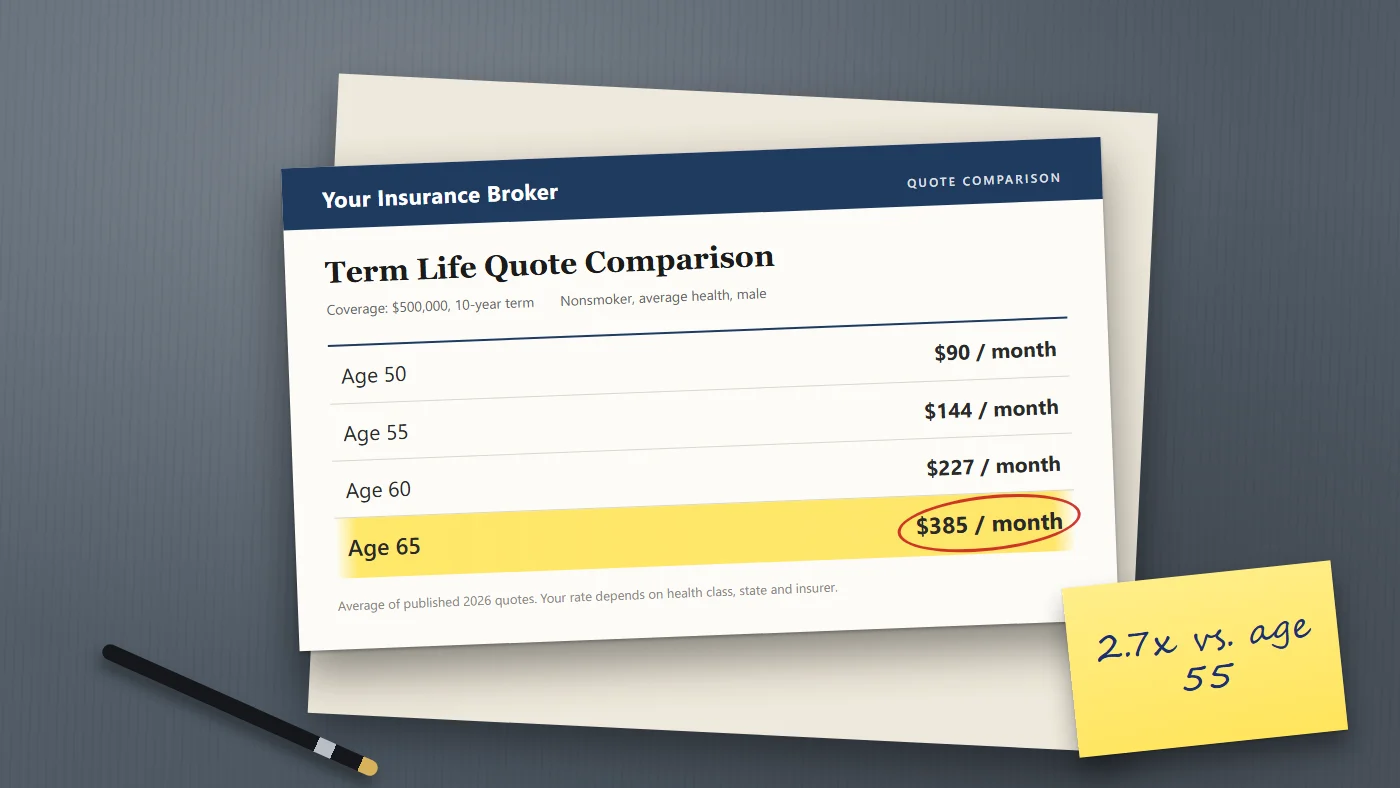
Start with the middle of the market: nonsmokers in average health buying a $500,000 term policy. The table shows their average monthly premiums. (The numbers are MoneyGeek's, drawn from quotes by more than 30 insurers and updated September 10, 2026.)
| Age at purchase | 10-year term, woman | 10-year term, man | 20-year term, woman | 20-year term, man |
|---|
| 50 | $70 | $90 | $102 | $137 |
| 55 | $104 | $144 | $168 | $231 |
| 60 | $158 | $227 | $286 | $395 |
| 65 | $262 | $385 | $415 | $591 |
Healthier than average? Then you'd likely pay a good deal less. A separate survey looked at the preferred class, using data as of August 1, 2026. There, a 50-year-old woman paid about $53 a month for a $500,000, 20-year policy, and a man paid about $68. Ten years older, those prices had climbed to roughly $137 and $194. Your own quote will probably land somewhere between the two sets.
Why such a spread? Because an insurer isn't pricing "a 50-year-old woman." It's pricing you. Your blood pressure, cholesterol, weight, family history and tobacco use all get weighed, and they decide which of four or so rate classes you're placed in, usually with names like preferred plus, preferred, standard plus and standard. Taking a common medication won't knock you out of a good class if the condition is under control. Put the two surveys side by side and the class you're assigned can move your price by a third or more. Same age, same policy, very different quote.
Most people don't need $500,000 at this point anyway. If the goal is to clear, say, a $180,000 mortgage balance and give a surviving spouse a few years of cushion while the household adjusts to one Social Security check, a policy in the $250,000 range may cover it. Premiums shrink as the coverage amount does, though not quite in proportion, so a $250,000 policy usually costs somewhat more than half the $500,000 price.
Wait from 55 to 65 and the same $500,000, 10-year term policy more than doubles in price. For a woman, the average goes from $104 a month to $262. For a man, it goes from $144 to $385.
Same policy, ten more birthdays.
Smoke, and all of this goes out the window. Take a 50-year-old man. As a nonsmoker he'd pay $810 a year for that policy in the August survey, and as a smoker, about $3,495.
Want coverage that lasts for life? That's a different product at a very different price. At 50, a $500,000 whole life policy ran roughly $4,300 to $5,000 a year in the same survey. By 60 it was $7,300 to $8,300. If the job is protecting a spouse or paying off a mortgage, term is what most families can actually afford.
Three things sold as "no medical exam"
They share a label and very little else.
Accelerated underwriting is the one healthy applicants hope to get. From your side it looks like applying for an ordinary term policy. Behind the scenes, the insurer pulls your prescription history, your file with MIB (the industry's shared underwriting database), your driving record and sometimes electronic health records. Clean data can mean approval at regular rates, with no exam, often within days. If something needs a closer look, you're sent for the traditional exam. You don't pick this path. The insurer's system does.
With simplified issue, you'll answer health questions, but nobody ever sends a nurse. Approval comes fast. Since the insurer knows less about you, it offers smaller amounts at higher prices.
Guaranteed issue doesn't ask about your health at all. If you're inside the company's age band, you're accepted. That band starts around 45 or 50 and tops out at 80 or 85, depending on the company. The policies are small, typically $2,000 to $25,000, and you'll wait a while before the full benefit applies.
Which of these you end up in matters more than which company you pick. You also have more say in it than you'd think.