Most people who skip life insurance after 50 do it for the same reason: they assume it's out of reach. Often they're wrong, and by a lot. Three out of four adults guessed high on the price in the 2025 Insurance Barometer Study (it's run every year by the industry research group LIMRA and the nonprofit Life Happens).
That bad guess costs people. Ask the ones who say they need coverage but don't have it why not, and nearly half, 46%, will name the price. Plenty of them never got a quote. In the same study, only 51% of adults owned any life insurance at all.
So is 50 too late? Usually not. Say you're a healthy woman of 50 and you want $500,000 that lasts 20 years. You'd likely pay somewhere between $53 and $102 a month. Where you land depends on how the insurer grades your health. A man the same age? Figure $68 to $137. Those ranges come from published 2026 surveys, not from an ad.
Two other things have probably changed since you last looked. Plenty of insurers now approve term policies without a nurse visit or a blood draw, using records they can pull in minutes. And for people with serious health problems, there are small policies that can't turn anyone down. Each route has its own price, and the gaps between them are bigger than most shoppers expect.
Real prices at 50, 55, 60 and 65
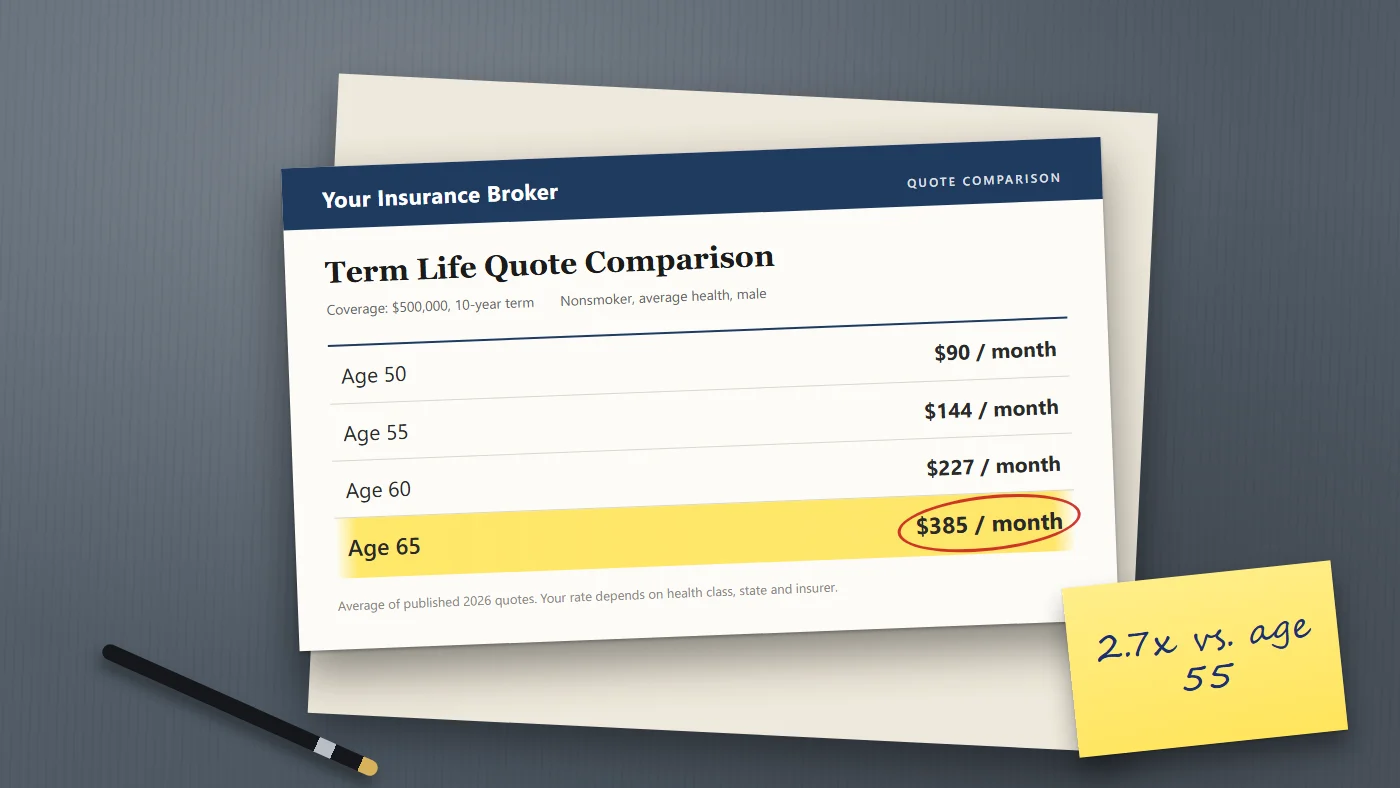
Start with the middle of the market: nonsmokers in average health buying a $500,000 term policy. The table shows their average monthly premiums. (The numbers are MoneyGeek's, drawn from quotes by more than 30 insurers and updated September 10, 2026.)
| Age at purchase | 10-year term, woman | 10-year term, man | 20-year term, woman | 20-year term, man |
|---|
| 50 | $70 | $90 | $102 | $137 |
| 55 | $104 | $144 | $168 | $231 |
| 60 | $158 | $227 | $286 | $395 |
| 65 | $262 | $385 | $415 | $591 |
Healthier than average? Then you'd likely pay a good deal less. A separate survey looked at the preferred class, using data as of August 1, 2026. There, a 50-year-old woman paid about $53 a month for a $500,000, 20-year policy, and a man paid about $68. Ten years older, those prices had climbed to roughly $137 and $194. Your own quote will probably land somewhere between the two sets.
Why such a spread? Because an insurer isn't pricing "a 50-year-old woman." It's pricing you. Your blood pressure, cholesterol, weight, family history and tobacco use all get weighed, and they decide which of four or so rate classes you're placed in, usually with names like preferred plus, preferred, standard plus and standard. Taking a common medication won't knock you out of a good class if the condition is under control. Put the two surveys side by side and the class you're assigned can move your price by a third or more. Same age, same policy, very different quote.
Most people don't need $500,000 at this point anyway. If the goal is to clear, say, a $180,000 mortgage balance and give a surviving spouse a few years of cushion while the household adjusts to one Social Security check, a policy in the $250,000 range may cover it. Premiums shrink as the coverage amount does, though not quite in proportion, so a $250,000 policy usually costs somewhat more than half the $500,000 price.
Wait from 55 to 65 and the same $500,000, 10-year term policy more than doubles in price. For a woman, the average goes from $104 a month to $262. For a man, it goes from $144 to $385.
Same policy, ten more birthdays.
Smoke, and all of this goes out the window. Take a 50-year-old man. As a nonsmoker he'd pay $810 a year for that policy in the August survey, and as a smoker, about $3,495.
Want coverage that lasts for life? That's a different product at a very different price. At 50, a $500,000 whole life policy ran roughly $4,300 to $5,000 a year in the same survey. By 60 it was $7,300 to $8,300. If the job is protecting a spouse or paying off a mortgage, term is what most families can actually afford.
Three things sold as "no medical exam"
They share a label and very little else.
Accelerated underwriting is the one healthy applicants hope to get. From your side it looks like applying for an ordinary term policy. Behind the scenes, the insurer pulls your prescription history, your file with MIB (the industry's shared underwriting database), your driving record and sometimes electronic health records. Clean data can mean approval at regular rates, with no exam, often within days. If something needs a closer look, you're sent for the traditional exam. You don't pick this path. The insurer's system does.
With simplified issue, you'll answer health questions, but nobody ever sends a nurse. Approval comes fast. Since the insurer knows less about you, it offers smaller amounts at higher prices.
Guaranteed issue doesn't ask about your health at all. If you're inside the company's age band, you're accepted. That band starts around 45 or 50 and tops out at 80 or 85, depending on the company. The policies are small, typically $2,000 to $25,000, and you'll wait a while before the full benefit applies.
Which of these you end up in matters more than which company you pick. You also have more say in it than you'd think.
What skipping the exam costs
The less an insurer knows about your health, the more it charges and the less coverage it offers. That isn't a sales pitch. It's the basic point of the NAIC's life insurance buyer's guide.
So how much more? MoneyGeek's September analysis put no-exam coverage at 10% to 20% above fully underwritten coverage for the same death benefit.
That's an average. Real quotes wander. Picture a 50-year-old nonsmoker who wants a $500,000, 20-year no-exam term policy. In the August survey, the yearly premium ran from about $640 at the low end to about $1,499 at the high end, depending on sex and health class.
Guaranteed issue costs the most per dollar of coverage, by a wide margin. MoneyGeek priced just $15,000 of it for 2026, and a 50-year-old woman averaged $54 a month. A man that age paid $70.
At 60 the averages were $75 and $94. By 70 they'd reached $113 for a woman and $145 for a man.
Now set that 60-year-old man next to the term table. His $94 a month buys $15,000 of guaranteed coverage, while about $227 a month would buy him $500,000 of 10-year term. More than 30 times the protection, for under 2.5 times the price. If he can pass underwriting at all, it isn't much of a contest.
Most guaranteed policies also carry a graded benefit, and it's the part of the fine print people tend to miss. Die of natural causes in the first two years and your family usually gets back the premiums you paid, sometimes with a little interest, instead of the face amount they were counting on. For someone who's been declined everywhere and wants a funeral covered, that's still useful. For nearly everyone else it's poor value.
Turned down before?
A past denial isn't a life sentence, though it does follow you. Insurers report application information to MIB, so a new company will likely see that you applied somewhere else. Be accurate about it. Then keep going.
Why try again at all? Because underwriting rules differ from one insurer to the next more than most people realize. Well-controlled type 2 diabetes, a cancer several years behind you, sleep apnea, a heart stent, a history of depression: any one of them can get you declined at one company and a standard rate at another.
Time helps. Many conditions get rated more kindly once you're a few years past treatment with stable test results.
An independent agent or broker earns the commission here. They can ask underwriters at several companies for an informal read on your file before you formally apply anywhere, so declines don't stack up.
Six steps to a real price
- Start by deciding what the money is for. After 50 it's usually a mortgage, a spouse who'd lose income, a dependent adult child, or debts you don't want to pass on. Count Social Security in that math, because when one spouse dies the household generally keeps only the larger of the two checks. Then put a dollar figure and an end date on each need.
- Match the term to that end date. Say the mortgage has 12 years left and you retire in 10. A 10-year or 15-year policy may do, not a 20-year one, and the table shows what the shorter term saves.
- Insurers check prescription records, so leaving something out only slows the decision or puts a claim at risk later. Before you apply, list your medications and doses, diagnoses with dates, height and weight, and your doctors' names.
- Get quotes from several insurers for the same amount and term, each stating the health class it assumes. A "preferred plus" quote means little if you take blood pressure medication.
- If you're in decent health and the exam is offered, take it. It's free, usually takes about half an hour, is often done at your kitchen table, and it's how you get the lowest rate class.
- Use the free-look period. Once the policy's delivered you'll generally have at least 10 days, longer in some states, to return it for a full refund. Don't cancel existing coverage until the new policy is in force.
Mistakes that cost the most
The big one is buying the first policy you see advertised. Mail and TV offers aimed at people over 50 are usually guaranteed issue or simplified issue, which means that if you're reasonably healthy you'd be paying, month after month, a price built for people who aren't, and getting less coverage for it than a term policy would give you.
Close behind it: waiting for a better year. It rarely comes. Rates rise with every birthday, and a single new diagnosis can drop you two rate classes. If you need coverage, today's usually the cheapest day you'll get.
Then there's counting on the policy from work. It usually ends when the job does, often right when replacing it costs the most.
Shading the truth on the application? Riskier than it looks. During the first two years, the insurer can investigate a claim and deny it over a material misstatement, and your family would typically get the premiums back and nothing more.
Last, whole life bought to fix a term problem. If the need ends when the mortgage does, a policy costing five or six times as much is hard to justify.
How do I compare quotes?
Can you haggle? In most states, no. Each insurer files its rates and agents can't discount them, so the same policy from the same company costs the same wherever you buy it. The savings come from finding the insurer whose underwriting treats your health history best, and that matters a lot more at 58 than it did at 30.
You can shop through an independent broker, an online marketplace that lines up several insurers side by side, or the companies directly. Whichever door you use, ask the same questions every time:
- Is this term, simplified issue or guaranteed issue?
- What health class does the quote assume?
- Is there a waiting period before the full benefit is paid?
- Can the term policy be converted to permanent coverage later without new health questions, and until what age?
- What's the insurer's financial strength rating?
With a serious condition, ask for simplified issue and guaranteed issue quotes at the same time and compare the price per $1,000 of coverage. Healthy, but you hate needles? Ask which insurers are most likely to approve you through accelerated underwriting at your age and coverage amount. That path narrows as you get older, and the limits vary by company.
Before you sign, look up the agent and the company on your state insurance department's website. It has a license lookup, and it takes complaints.
Then, this week, write down what the coverage is for and when that need ends, and get three quotes for that amount and term, each with the health class spelled out. I'd start with the 10-year and 15-year prices, since that's where people over 50 are most often surprised on the low side.
This article is general information, not financial, legal, tax or medical advice.