Insurance
Selling a Life Insurance Policy: How Life Settlements Work and What They Pay
If you're over 65 and about to drop a policy you can no longer afford, there's a regulated way to sell it, and the gap between the sale price and the surrender value can be large.
 Margaret Linwood
Updated Sep 22, 2026 · 10 min read
When a life insurance policy lapses, the owner gets nothing. Every premium paid over 20 or 30 years is gone, and the insurer is off the hook for the death benefit. If the policy has cash value, surrendering it gets you that amount, minus any surrender charge, and lets the insurer off the hook the same way.
There's a third way out that most policy owners have never heard of. In 43 states and Puerto Rico, a life insurance policy is treated as property you can sell to a licensed buyer. The buyer pays you a lump sum, takes over the premiums and collects the death benefit when you die. It's called a life settlement.
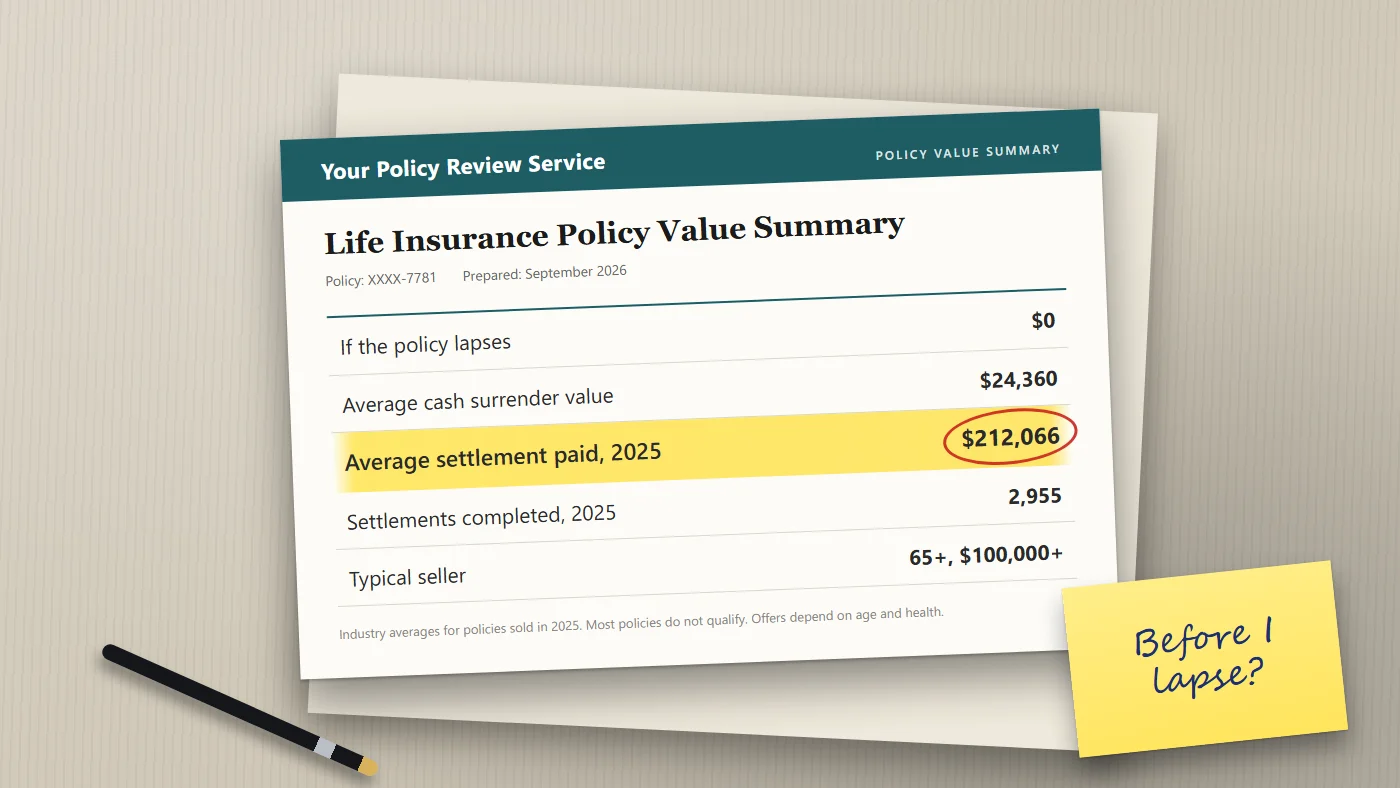
The numbers can be striking. The Life Insurance Settlement Association, the industry's trade group, reports that its members completed 2,955 of these deals in 2025 and paid policy owners $626.6 million. The average payout was $212,066. The average cash surrender value of those same policies? $24,360. Sellers got almost nine times what their insurers would have paid.
Hold that number loosely. It comes from the buyers' own association, and it describes the policies buyers wanted: big ones, on older people, often in poor health. Most policies won't qualify. By the association's count, more than 9 million policies are surrendered or lapse every year, and fewer than 3,000 get sold. But if yours might qualify, you'll want to know before you stop paying, because a lapse can't be undone.
Who can sell, and who can't
Buyers are investors. They're estimating how long they'll pay premiums before they collect, and that shapes who gets an offer.
Going by the settlement association's guidance for policy owners, buyers most often want an insured who's 65 or older and a death benefit of $100,000 or more. Younger people with a serious illness may qualify too. Universal life, whole life and even term policies can be sold, though buyers usually want a term policy that can still be converted to permanent coverage.
Your state also sets a waiting period after the policy's issued: two years in 30 states, five years in 11 and four years in Minnesota. Most states make exceptions for events like terminal or chronic illness, divorce or retirement.
In practice, the strongest candidates tend to be in their 70s or 80s, with health that's declined since the policy was issued and premiums high enough to hurt. A healthy 66-year-old with a $150,000 whole life policy may get no offer at all, or one below the cash value.
What do settlements actually pay?
There's no price list. Each offer is built from your life expectancy, which the buyer estimates from your medical records, plus the premiums needed to keep the policy in force and the return the buyer wants.
So why would a stranger pay more than your own insurer? The insurer's surrender value comes from a formula in the contract that ignores your health entirely. A buyer looks at the same policy and sees a $500,000 check at some point in the future, minus all the premiums it'll have to pay until then, and if your health has gotten worse, that check is closer and the policy is worth more. It works the other way too. Likely to live another 20 years? The premiums eat the value, and the offer shrinks or disappears.
Aggregate data gives a rough sense of scale. In 2023, the association's members bought policies with $4.67 billion in death benefits and paid owners $842 million, or about 18 cents per dollar of face value. That's an average across very different policies, though: the older and sicker the insured, the bigger the share of face value a buyer can afford to pay, and for a healthy person in their late 60s the number can be close to nothing.
In 2025, policy owners who sold through settlement association members received an average of $212,066. The average surrender value of those policies was $24,360. A lapsed policy pays $0.
Say you're 78, with a $500,000 universal life policy. The cash surrender value is $30,000, and keeping the policy going takes $18,000 a year in premiums. Your choices, if a buyer offered that 18% figure:
| What you do | What you get now | What your heirs get | What you keep paying |
|---|
| Stop paying and let it lapse | $0 | $0 | $0 |
| Surrender to the insurer | $30,000 | $0 | $0 |
| Sell at 18% of face value | $90,000, before taxes | $0 | $0 |
| Keep the policy | $0 | $500,000 | $18,000 a year |
Don't skip the last row. If you can afford the premiums, or your kids can, keeping the policy is often the best financial outcome for the family, since an investor offering $90,000 expects to come out well ahead. A settlement makes sense when keeping the policy truly isn't possible.
Before you get there, your insurer may have in-between options it won't mention unless you ask. And there's a tax bill that catches a lot of sellers off guard.