Medicare's own fact sheet gets to the point fast: in most situations, Medicare won't pay for health care or supplies you get outside the U.S. That goes for Part A and Part B. It applies in a hospital in Lisbon, at a clinic in a Mexican port town, and on a cruise ship once it's more than six hours from a U.S. port.
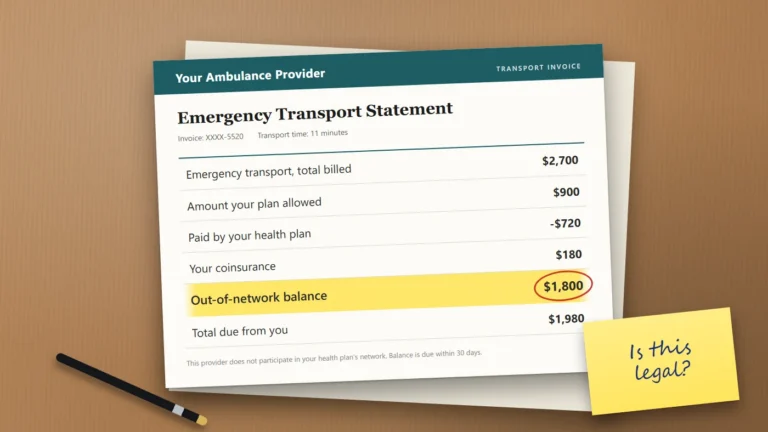
It's a bigger gap than it sounds. The Centers for Disease Control and Prevention, in its guidance for travelers, says a medical evacuation from a remote area to a high-quality hospital "could otherwise cost more than $100,000." That's the flight. Not the treatment. And many hospitals abroad expect payment before they treat or release a patient, by card or in cash.
None of this is a reason to stay home. It just means the Medicare card in your wallet is a domestic document, and you need something else in the bag for the days you're away. The choices are few and well understood: a Medigap plan with a foreign travel benefit, a Medicare Advantage plan that adds travel coverage, or a travel medical policy bought for the trip. Plenty of travelers end up combining the first and the third.
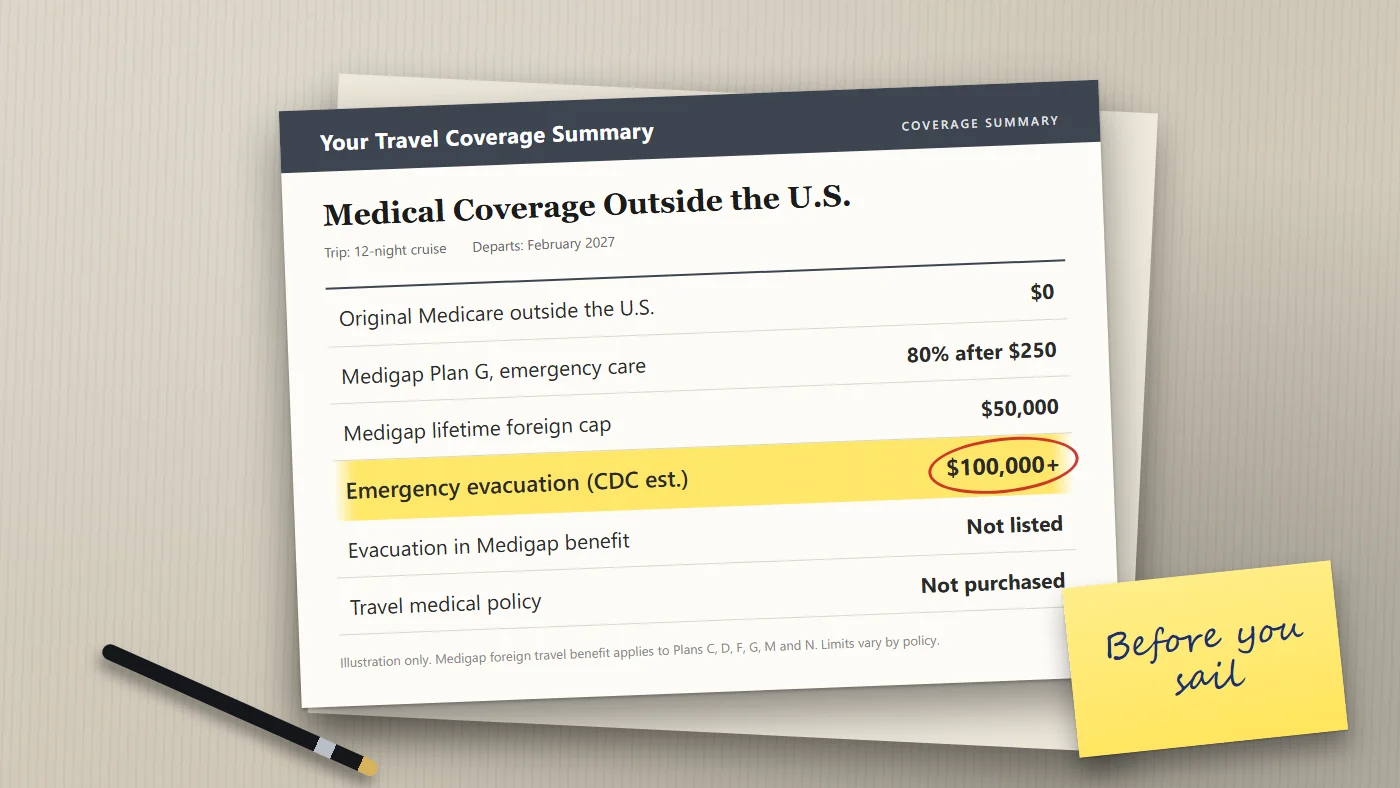
The gap in one number: more than $100,000. That's what the CDC says an emergency medical evacuation can cost. Original Medicare's share of that flight, and of the foreign hospital bill that usually comes first, is generally zero.
Where does "the U.S." end for Medicare?
For Medicare, the U.S. means the 50 states, the District of Columbia, Puerto Rico, the U.S. Virgin Islands, Guam, American Samoa and the Northern Mariana Islands. A hospital in San Juan is covered like a hospital in Ohio. A hospital in Cozumel isn't.
Medicare lists three situations in which it may pay for care in a foreign hospital. Few vacationers fit any of them. You're in the U.S. when a medical emergency hits and the foreign hospital is closer than the nearest U.S. hospital that can treat you. You're driving through Canada, without unreasonable delay and by the most direct route, between Alaska and another state when an emergency happens, and the Canadian hospital is the closest one. Or you live in the U.S. and a foreign hospital is closer to your home than the nearest U.S. hospital that can treat you, emergency or not.
Even then, Medicare pays only its usual share, and you still owe the deductibles and coinsurance. It won't pay for an ambulance ride home afterward.
Cruise ships get their own rule. Medicare may cover medically necessary care you get on board if the doctor is legally allowed to treat you there and the ship is in a U.S. port or no more than six hours away from one. Past six hours, you're on your own.
Prescriptions are simpler. Medicare drug plans can't cover drugs you buy outside the U.S., so if you take daily medication, pack enough for the whole trip plus a few extra days, in the original containers.
What Medigap pays abroad
If you have Original Medicare plus a Medigap policy, look at the letter of your plan. Medicare's 2026 Medigap guide shows a foreign travel emergency benefit in Plans C, D, F, G, M and N. Plans A, B, K and L don't have it. Older Plans E, H, I and J, no longer sold, include it too.
It's a standardized benefit, and it's narrower than the word "covered" suggests.
| Feature | What the Medigap foreign travel benefit does |
|---|
| What it covers | Emergency care that begins during the first 60 days of a trip outside the U.S., when Medicare doesn't otherwise cover it |
| What it pays | 80% of the billed charges for certain medically necessary emergency care |
| What you pay first | A separate $250 deductible each year |
| Lifetime cap | $50,000 in total, over your lifetime |
| What it leaves out | Evacuation isn't a listed benefit, and care that starts after day 60 or runs past the cap is on you |
Read that last row twice.
Say you hold Plan G and break a hip on day 4 of a Mediterranean cruise, then run up a $40,000 hospital bill in Italy. After the $250 deductible, Medigap pays 80% of the remaining $39,750, which comes to $31,800. You owe $8,200, plus whatever it costs to get home. And $31,800 of your $50,000 lifetime cap is gone for good.
So why do so many Medigap holders still buy a trip policy? Because Medigap is a decent backstop for a short emergency, but it isn't built for the two most expensive parts of a bad trip: the air ambulance and the long hospital stay.
And if you're on Medicare Advantage?
Medicare Advantage plans have to follow Medicare's rules on care outside the U.S., but some add their own coverage for emergency and urgently needed care while you travel. Does yours? Call and ask. Ask what the benefit covers, whether there's a dollar limit, whether it includes evacuation, and how a foreign claim gets filed. Then check it against the plan's Evidence of Coverage.
If your plan has no travel benefit, or a thin one, you're in the same spot as someone with Original Medicare alone.
That's the coverage side. The rest is the buying side, which is where the fine print does its damage: what a travel medical policy actually includes, the questions that separate a good one from a cheap one, and the paper trail that gets a foreign bill paid.
What a travel medical policy adds
A travel medical policy is short-term health coverage for the days you're outside the U.S. Don't confuse it with "trip cancellation" coverage. That reimburses lost deposits, and while many packages bundle the two, they're different promises with different limits, sold under names that sound almost identical on a checkout page. You can usually buy the medical piece on its own.
For a traveler on Medicare, these are the parts that matter:
- Emergency medical coverage. Hospital, doctor, ambulance and prescription costs abroad, up to a limit. Limits vary widely, from tens of thousands of dollars into the hundreds of thousands. For a cruise or a trip well outside major cities, the higher end often costs only a little more.
- Emergency medical evacuation and repatriation. Transport to the nearest adequate facility, and then home if it's medically necessary. With the CDC's figure running past $100,000, I'd want an evacuation limit well above that number. Some policies also pay for a family member to travel to your bedside, and for return of remains.
- Pre-existing condition waiver. Many policies exclude conditions that were treated or changed during a look-back period before you bought the policy. Some will waive that exclusion if you buy within a short window after your first trip deposit, often a couple of weeks. If you're over 65 with a heart condition, diabetes or a recent surgery, this is the line in the policy to read first.
- Primary or secondary payment. A primary policy pays first. A secondary one pays after your other insurance, and since Original Medicare pays nothing abroad in most cases, it ends up paying first anyway, just with more paperwork.
- 24-hour assistance line. The number you call from the ship's infirmary or a foreign emergency room. The assistance company arranges an evacuation and can guarantee payment to the hospital. Without it, you're booking an air ambulance yourself, with a credit card.
Cruise lines sell their own protection plans when you book. Read those the same way. Some are generous on cancellation and thin on medical, and the medical limit can sit well below what a serious evacuation costs.
Three cruise details that surprise people
The ship's medical center isn't a U.S. hospital. Its doctors typically bill passengers directly, often to the onboard account, at private rates. Medicare's six-hour rule can cover some of that care near a U.S. port, but on most itineraries the ship spends days farther out than that. Treat the infirmary bill as a foreign bill, and keep the itemized receipt.
Port days count as abroad. Slip on a cobblestone street in Nassau, or get chest pain in a taxi in Cozumel, and a local hospital handles it under local rules. The ship may sail without you. Your travel policy's assistance line is what arranges a transfer to a better facility and, later, the flight home.
Cancellation and medical are different products. Very different. A "cancel for any reason" upgrade protects the money you paid for the cruise and does nothing for a hospital bill. If the budget only stretches to one, the medical and evacuation coverage is the one that guards against a six-figure loss.
Questions to ask before you pay
Premiums climb with age and with trip length. Still, the premium isn't where policies really differ. The fine print is. Putting two or three quotes side by side takes an evening, before every trip, or once a year if you go with an annual multi-trip policy. Then put these to each insurer:
- What's the medical limit, and what's the evacuation limit? Are they separate?
- Is there a pre-existing condition waiver, and what's the deadline to qualify?
- Is there an age cap? Some policies cut limits after 70 or 80.
- Does it cover what you'll actually do on the trip, such as shore excursions, hiking or scuba?
- Who decides whether an evacuation is "medically necessary," the doctor on site or the insurer?
- Does it pay the hospital directly, or reimburse you after you've paid?
- Is it primary or secondary?
If you carry a Medigap plan with the foreign travel benefit, tell the travel insurer. Some policies coordinate with it. Either way, you want both documents to agree on who pays first.
The paperwork that gets a foreign bill paid
Part of it happens before anything goes wrong. Before you leave, photograph your Medicare card, your Medigap or Advantage card and the travel policy's assistance number, and store the images somewhere a travel companion can reach them. If you're the one in the hospital bed, your companion is the one making the calls.
When something does happen, the first call goes to the assistance line, ideally before you agree to anything expensive. They can often steer you to a hospital they already pay directly.
At the hospital, ask for itemized bills, in English if possible, and a discharge summary. Pay by card if you have to. Keep every receipt.
Nobody files the Medigap claim for you. Why not the hospital? Foreign hospitals aren't required to bill Medicare, and they generally don't bill your Medigap insurer either. So the itemized bill and your proof of payment go from you to the Medigap company, which applies the $250 deductible and pays its 80%. In the uncommon case where one of Medicare's own exceptions applies, the claim to Medicare goes on Form CMS-1490S.
The travel policy is a separate claim with its own deadline, spelled out in the policy. Send the discharge summary with it, and for an evacuation, the assistance company's case number too.
Afterward, hold on to copies of everything for at least a year. A second invoice from a foreign hospital months later isn't unheard of, and your payment records are your defense.
Before you book
Start with an index card. Pull out your Medigap policy, or call your Advantage plan, and write down in one line what your coverage pays outside the U.S. For most people the honest version reads "80% after $250, up to $50,000 for life, no evacuation." For some it's just "nothing." That card goes in your passport.
The quotes come next, two or three travel medical policies, each with an evacuation limit comfortably above the CDC's six-figure figure. Mind the calendar when you buy. For many policies the pre-existing-condition window opens the day you put down your first deposit, so the day you book the cruise is a good day to shop.
This article is general information, not financial, legal, tax or medical advice.