Medicare
Why the Same Prescription Costs So Much More at One Pharmacy Than Another, and When Cash Beats Your Copay
Pharmacy prices for one drug can differ by hundreds of dollars in the same town, and sometimes the price without insurance is lower than the copay. Pharmacists are allowed to tell you. They aren't required to bring it up.
 Margaret Linwood
Updated Sep 22, 2026 · 10 min read
Here's something that surprises people. Carry the same prescription into two pharmacies in the same town and the prices can differ by hundreds of dollars. Same pill, same strength, same count. Consumer Reports caught this back in 2018, when it sent secret shoppers to more than 100 pharmacies across the country.
It gets odder. Now and then, paying cash beats using your insurance. Researchers at the USC Schaeffer Center dug into pharmacy claims from 2013 and found that in 23% of them, the copay was bigger than what the pharmacy actually got paid for the drug by the insurer's pharmacy benefit manager. People overpaid by $7.69 a claim on average. With generics, it happened 28% of the time.
For years, a lot of pharmacists couldn't tell you. Their contracts with benefit managers had "gag clauses," which kept them quiet about any cheaper way to pay. Even the head of Medicare called that "completely unacceptable," in May 2018. Two federal laws ended the clauses that October. One covers private insurance (the Patient Right to Know Drug Prices Act). The other, the Know the Lowest Price Act, covers Medicare drug plans starting with the 2020 plan year. Both are dated October 10, 2018.
Those laws left a gap, though. Your plan can no longer stop the pharmacist from mentioning a lower price, but nothing makes the pharmacist bring it up. At a busy counter, the question usually has to come from you.
Most households have a reason to ask it. About half of Americans had used at least one prescription drug in the past 30 days (49.9%, in CDC survey data from 2017 to March 2020). Below: why prices differ, when paying cash can make sense, and when it can cost you more over a year. It's about what you pay, not about which medicine you should take.
Why does one drug have so many prices?
A prescription doesn't have one price. It has at least four, and different players set each one.
Walk up with no insurance and no coupon, and you'll be charged the cash price, also called the usual and customary price. The pharmacy sets it. Every chain and independent store picks its own number, which is how two stores across the street from each other end up far apart.
Behind the counter sits a second number, the negotiated price, written into a contract between the pharmacy and your plan's benefit manager. You never see it unless you're in your deductible. Then you pay all of it.
Your copay comes from your plan, often as a flat amount per tier: one price for preferred generics, a higher one for other generics, and on up. That flat amount doesn't budge when the drug itself gets cheaper.
Then there's the discount price, from a pharmacy's own savings program or a third-party discount card. It's a separate negotiated rate, and it skips your insurance entirely.
Generics make the gaps widest. Once five generic makers compete, prices drop by nearly 85% compared with the brand, according to the FDA. Now picture your plan's flat copay for that tier sitting at, say, $15. The drug got cheap. The copay didn't, and it can end up above the store's own cash price.
The number to remember: 23% of prescriptions in USC's study of 2013 pharmacy claims came with a copay higher than the drug's full cost to the plan. Average overpayment: $7.69. On generic claims it happened 28% of the time.
When cash can beat the copay, and when it backfires
Cash or a discount price is most likely to win in a few spots: a low-cost generic on a flat copay tier, the deductible phase of your plan, when you're paying the full negotiated price anyway, and a drug your plan doesn't cover at all.
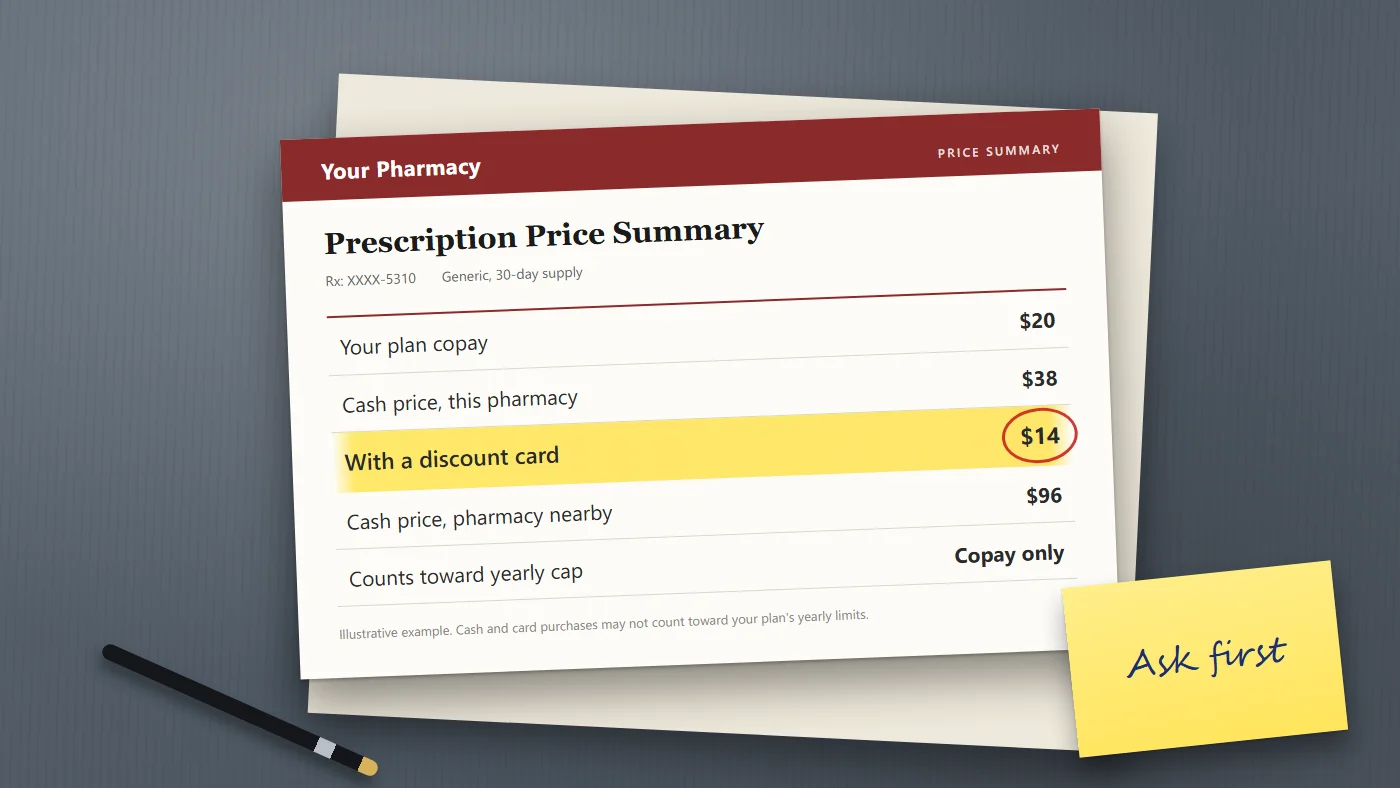
Say you fill a 30-day generic. Your plan's copay is $20, and the same pharmacy's cash price is $38, so insurance wins there. But a discount card brings it to $14 at that store, and another pharmacy nearby charges $96 cash for the identical bottle. One drug, four prices. In this made-up case the cheapest one isn't the one that gets rung up by default.
Now the downside. When you pay cash or use a discount card, the purchase generally runs outside your insurance. It doesn't automatically count toward your deductible or your yearly out-of-pocket limit.
On Medicare, that limit matters a lot. Part D puts a ceiling on your out-of-pocket spending for covered drugs: $2,100 in 2026. Reach it and you pay nothing more for covered drugs that year. The deductible has a ceiling too, $615 this year. Both rise in 2027, to a $2,400 cap and a $700 maximum deductible (Medicare.gov already lists them). So who should care? If you take an expensive drug and expect to reach the cap, saving $6 a month on a generic by going outside the plan changes little. If every drug you take is a cheap generic and you never get near the cap, the lower price is simply lower.
So the real comparison isn't one receipt against another. It's your whole year. That takes a few minutes of checking.