Here's something that surprises people. Carry the same prescription into two pharmacies in the same town and the prices can differ by hundreds of dollars. Same pill, same strength, same count. Consumer Reports caught this back in 2018, when it sent secret shoppers to more than 100 pharmacies across the country.
It gets odder. Now and then, paying cash beats using your insurance. Researchers at the USC Schaeffer Center dug into pharmacy claims from 2013 and found that in 23% of them, the copay was bigger than what the pharmacy actually got paid for the drug by the insurer's pharmacy benefit manager. People overpaid by $7.69 a claim on average. With generics, it happened 28% of the time.
For years, a lot of pharmacists couldn't tell you. Their contracts with benefit managers had "gag clauses," which kept them quiet about any cheaper way to pay. Even the head of Medicare called that "completely unacceptable," in May 2018. Two federal laws ended the clauses that October. One covers private insurance (the Patient Right to Know Drug Prices Act). The other, the Know the Lowest Price Act, covers Medicare drug plans starting with the 2020 plan year. Both are dated October 10, 2018.
Those laws left a gap, though. Your plan can no longer stop the pharmacist from mentioning a lower price, but nothing makes the pharmacist bring it up. At a busy counter, the question usually has to come from you.
Most households have a reason to ask it. About half of Americans had used at least one prescription drug in the past 30 days (49.9%, in CDC survey data from 2017 to March 2020). Below: why prices differ, when paying cash can make sense, and when it can cost you more over a year. It's about what you pay, not about which medicine you should take.
Why does one drug have so many prices?
A prescription doesn't have one price. It has at least four, and different players set each one.
Walk up with no insurance and no coupon, and you'll be charged the cash price, also called the usual and customary price. The pharmacy sets it. Every chain and independent store picks its own number, which is how two stores across the street from each other end up far apart.
Behind the counter sits a second number, the negotiated price, written into a contract between the pharmacy and your plan's benefit manager. You never see it unless you're in your deductible. Then you pay all of it.
Your copay comes from your plan, often as a flat amount per tier: one price for preferred generics, a higher one for other generics, and on up. That flat amount doesn't budge when the drug itself gets cheaper.
Then there's the discount price, from a pharmacy's own savings program or a third-party discount card. It's a separate negotiated rate, and it skips your insurance entirely.
Generics make the gaps widest. Once five generic makers compete, prices drop by nearly 85% compared with the brand, according to the FDA. Now picture your plan's flat copay for that tier sitting at, say, $15. The drug got cheap. The copay didn't, and it can end up above the store's own cash price.
The number to remember: 23% of prescriptions in USC's study of 2013 pharmacy claims came with a copay higher than the drug's full cost to the plan. Average overpayment: $7.69. On generic claims it happened 28% of the time.
When cash can beat the copay, and when it backfires
Cash or a discount price is most likely to win in a few spots: a low-cost generic on a flat copay tier, the deductible phase of your plan, when you're paying the full negotiated price anyway, and a drug your plan doesn't cover at all.
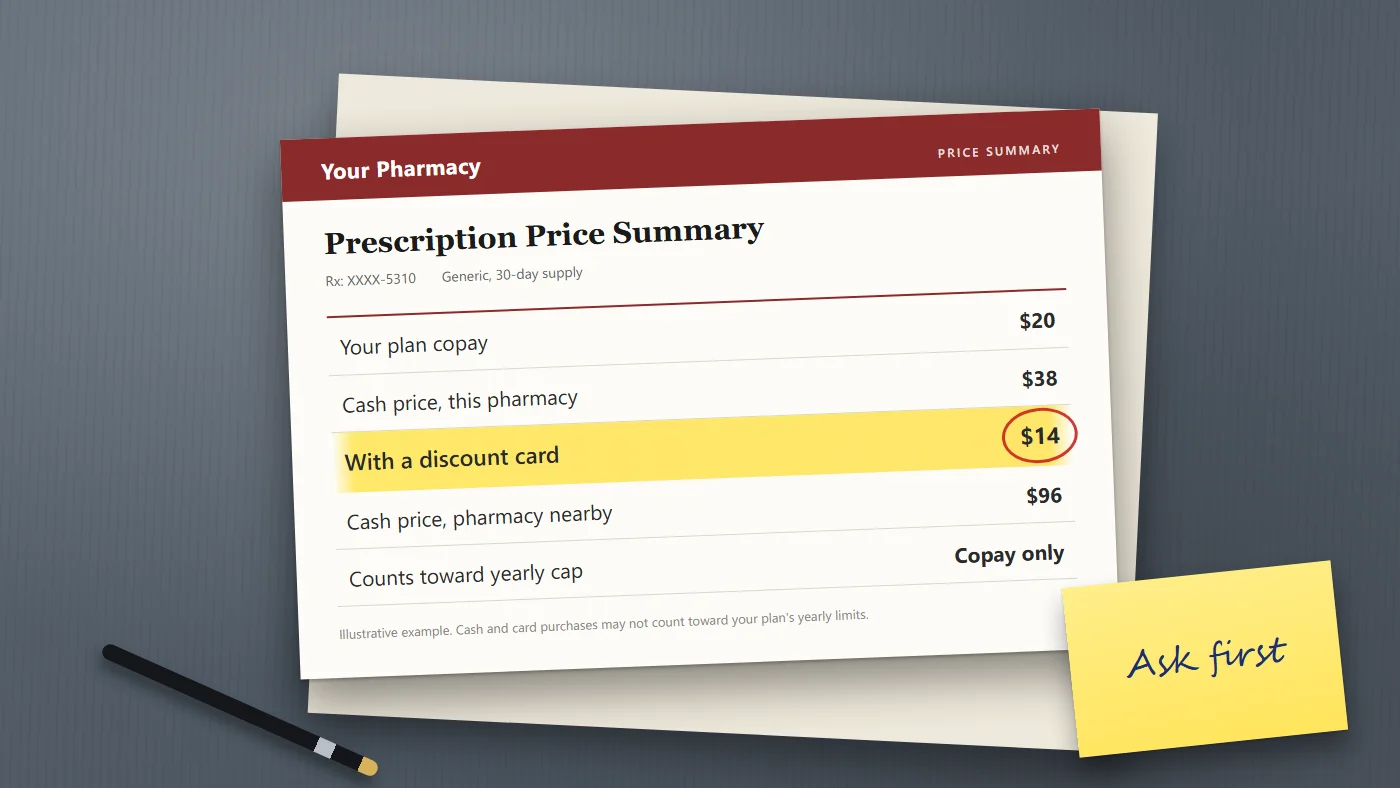
Say you fill a 30-day generic. Your plan's copay is $20, and the same pharmacy's cash price is $38, so insurance wins there. But a discount card brings it to $14 at that store, and another pharmacy nearby charges $96 cash for the identical bottle. One drug, four prices. In this made-up case the cheapest one isn't the one that gets rung up by default.
Now the downside. When you pay cash or use a discount card, the purchase generally runs outside your insurance. It doesn't automatically count toward your deductible or your yearly out-of-pocket limit.
On Medicare, that limit matters a lot. Part D puts a ceiling on your out-of-pocket spending for covered drugs: $2,100 in 2026. Reach it and you pay nothing more for covered drugs that year. The deductible has a ceiling too, $615 this year. Both rise in 2027, to a $2,400 cap and a $700 maximum deductible (Medicare.gov already lists them). So who should care? If you take an expensive drug and expect to reach the cap, saving $6 a month on a generic by going outside the plan changes little. If every drug you take is a cheap generic and you never get near the cap, the lower price is simply lower.
So the real comparison isn't one receipt against another. It's your whole year. That takes a few minutes of checking.
What to ask at the counter, step by step
- Ask the question directly. "What's the cash price for this, and is it lower than my copay?" Federal law protects the pharmacist's right to answer. Ask each time a prescription is new or the price changes.
- Ask about the store's own program. Many chains and grocery pharmacies run a generic savings list or a membership program with flat prices for 30-day and 90-day supplies. Some charge a yearly fee. Ask for the printed list.
- Look up a discount price before you go. Discount cards and apps are free and show a price by pharmacy and ZIP code. You can't combine one with insurance on the same fill. It's one or the other.
- Call two more pharmacies. Include an independent store and a big-box or warehouse pharmacy. Give the exact drug name, strength, form and quantity from your label, because a tablet and a capsule of the same drug can be priced differently.
- Ask about a 90-day supply. Many plans and pharmacies price three months below three single months, in the store or by mail. Your prescriber has to write it that way, so ask at your next visit or through the office's message line.
- Check your plan's formulary. Your plan's drug list shows which tier each drug is on. If yours sits on a high tier, ask your prescriber if the plan lists something on a lower one. Whether a change is appropriate is entirely your prescriber's call. Your part is knowing what each option would cost.
- Keep the receipt when you pay outside the plan. Ask your plan if it accepts receipts for cash purchases at network pharmacies and how to send one in. Rules differ, and member services can walk you through its process.
The ways to pay, side by side
| Way to pay | Who sets the price | Counts toward your deductible and yearly cap? | What to check |
|---|
| Insurance copay | Your plan | Yes | Tier, preferred pharmacy, deductible status |
| Pharmacy cash price | The pharmacy | Not automatically | Differs store to store; ask each time |
| Discount card or app | Card's negotiated rate | Not automatically | Privacy policy; can't combine with insurance |
| Pharmacy membership program | The pharmacy | Not automatically | Yearly fee; which drugs are on the list |
| Mail-order through your plan | Your plan | Yes | 90-day pricing; shipping time; auto-refill terms |
| Extra Help (Medicare) | Set by Medicare | Yes | Income and resource limits |
Discount cards and online pharmacies: read the fine print first
Discount cards cost you nothing because they earn a fee each time one's used. What you may be paying with is your data. One large prescription discount company shared users' prescription and health information with advertising platforms without telling them, and in February 2023 that earned it a $1.5 million civil penalty from the Federal Trade Commission. Before you sign up for any card or app, read what it says about sharing data, and give it only what it needs.
Online and mail-order pharmacies can be the low-price option, especially for 90-day supplies. They're also where counterfeit sellers set up shop.
What does a legitimate online pharmacy look like? The FDA's BeSafeRx campaign spells it out. It always requires a prescription, lists a physical U.S. address and phone number, has a licensed pharmacist available to answer questions, and is licensed by a state board of pharmacy. Red flags, per the FDA, include no prescription requirement and "prices that seem too good to be true." You can look up any pharmacy's license through your state board, and I'd do it before the first order, not after.
On Medicare? Two bigger levers
Counter tactics save dollars per fill. Two other moves can change the whole year.
Extra Help. This federal program is for people whose income and savings are limited, and plenty of them never check because they assume they're over the line. It lowers Part D premiums, deductibles and copays. So where is the line? For one person in 2026, it's $23,940 in income. Savings and other resources count separately, and the single limit there is $18,090. Married couples get more room: $32,460 in income, $36,100 in resources.
What does qualifying get you? You pay no plan deductible at all. And in 2027, copays run no higher than $5.80 for a generic, or $14.40 for a brand-name drug. (Every figure here is Medicare.gov's.) The application goes through Social Security, and if the form looks like a chore, your State Health Insurance Assistance Program will help you with it for free.
Open Enrollment. Pick an evening between October 15 and December 7, gather every bottle from the medicine cabinet, and sit down at Medicare.gov. That window is when you can switch Part D or Medicare Advantage plans for the coming year. Why bother if your plan has been fine? Because plans rewrite their drug lists, tiers and preferred pharmacies every year, and the plan that suited you this year was built on this year's list. In the Plan Finder, type in each drug the way it reads on the label, then add the pharmacies you actually use. What comes back is an estimated yearly cost for every plan. Don't sort by premium and stop there. A plan that charges a little more each month can still cost less over the year if it puts your drugs on a lower tier.
The Medicare Prescription Payment Plan is a different animal, a timing tool rather than a price cut. It spreads your out-of-pocket drug costs across the calendar year, so you aren't paying big amounts at the counter. Medicare is blunt about the limits: "it doesn't save you money or lower your drug costs." It only smooths the bills.
Where a price search fits in
The slow part is the list. Once every drug is written down with its exact strength and quantity, comparing goes quickly, whether it's the fall plan review or a month when a refill suddenly costs more.
What people search for tends to follow the problem in front of them. Someone holding a copay receipt looks for a prescription discount card to see if its price comes in lower. For the one or two drugs that cost real money, it's the cheapest pharmacy prices in their ZIP code. Come fall, they compare Medicare Part D plans with their actual drug list instead of a guess. And anyone on a long-term prescription might price a mail order pharmacy for 90-day supplies, after checking its license.
None of it takes special knowledge. You need the drug's name exactly as printed on the label, plus three numbers: your copay, the cash or discount price, and how close you are to your plan's yearly cap.
Far from the cap, the lower price at the counter usually wins. Close to it, staying inside the plan usually does. Next time you hand a prescription across the counter, ask for the cash price before it's rung up. The pharmacist's allowed to answer.
This article is general information, not financial, legal, tax or medical advice.