The average new-car payment hit $777 a month in the second quarter of 2026, according to Edmunds. For a lot of households that's one of the biggest bills after housing. And unlike the mortgage, it was probably signed in a small office at the back of a dealership, at the end of a long afternoon.
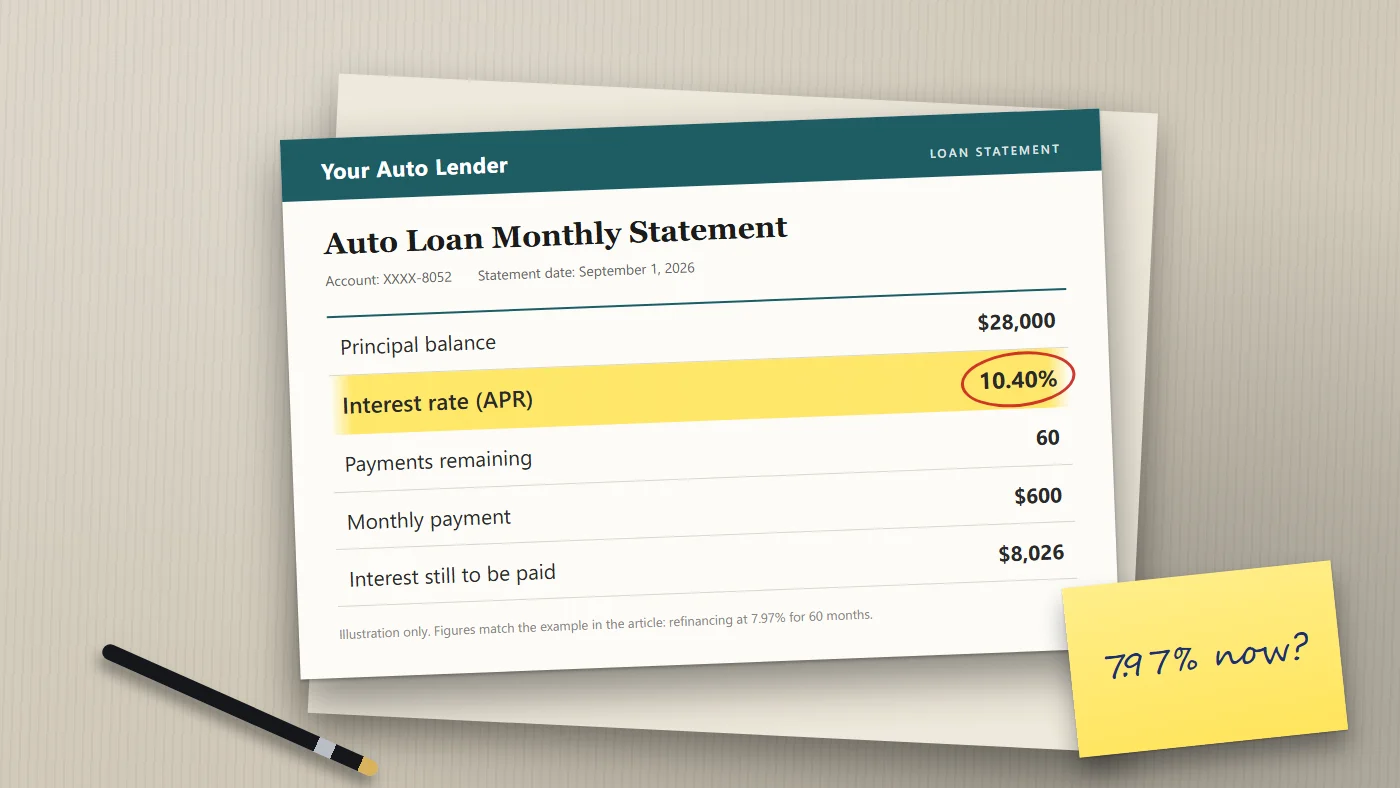
You aren't stuck with it. A car loan can be replaced by a new one from a different lender, at a different rate, without trading in the car. Experian, which tracks auto lending nationwide, reported that owners who refinanced in the second quarter of 2026 went from an average rate of 10.40% to an average of 7.97%. Their payments dropped by $83 a month on average.
Averages hide two very different stories, though. Some of those owners cut their rate and paid less for the car in the end. Others got the smaller payment mostly by adding months, and they'll pay more overall. From the outside the two look identical: a smaller monthly bill. Telling them apart is what the rest of this article is for.
Start with where your original rate came from. It explains why there's often room to improve it.
Why a dealership loan often has room in it
Many car loans are arranged by the dealer rather than by a bank the buyer picked. The Consumer Financial Protection Bureau lays out how that works. The dealer sends your application to one or more lenders, and a lender answers with a "buy rate," the rate it's willing to give you. The rate on your contract can be higher, to compensate the dealer for arranging the loan.
Nobody's obliged to hand you the best deal, either. In the CFPB's words, dealers and lenders aren't required to offer the best rates available. Many lenders cap how much a dealer can add, but you won't see the buy rate on your contract. Only the final number.
What few buyers hear is that the rate is negotiable, just like the price of the car. The CFPB says so directly. Almost nobody tries. After two hours of paperwork, most people sign what's put in front of them.
So if your loan came through a dealership and you never compared it with an outside offer, a bank or credit union might have beaten it that same day. Refinancing is how you go back and check.
In the second quarter of 2026, owners who refinanced through a credit union lowered their payment by an average of $102 a month. Through banks the average was $65, and through finance companies $38, according to Experian.
What's changed since you signed?
Three things can make a new loan cheaper than the old one.
Rates came down a little. Experian puts the average new-car loan rate at 6.35% in the second quarter of 2026, down from 6.79% a year earlier. Used-car loans averaged 11.19%, down from 11.57%. If you borrowed in 2023 or 2024, you probably did it near the peak.
Your credit may have moved. A year or two of on-time payments, a paid-off card or an old late payment aging off your report can push you into a better pricing tier, and the tiers are far apart. LendingTree's marketplace data for the second quarter of 2026 shows refinance rates averaging 5.84% for scores of 800 and up, 7.14% for scores from 670 to 739, and 12.50% for scores under 580.
You've got time to shop. At the dealership you had one offer and a salesperson waiting. At home, you can collect five.
None of that helps if the new loan is built the wrong way. Refinance ads rarely mention this part.
The payment can fall while the cost rises
Say you owe $28,000 with 60 months to go at 10.40%. Your payment's about $600. A lender offers you the Experian average of 7.97%, and there are two ways to take it.
| Keep current loan | Refinance, same 60 months | Refinance, stretch to 72 months |
|---|
| Rate | 10.40% | 7.97% | 7.97% |
| Monthly payment | $600 | $567 | $491 |
| Interest still to pay | $8,026 | $6,040 | $7,317 |
| Change in total cost | | saves $1,986 | saves $709 |
The same-term refinance cuts the payment by only $33, yet it saves nearly $2,000. The 72-month version feels far better every month, $109 lower, and hands back almost two-thirds of that saving in extra interest. Stretch it further, or refinance at a rate barely below your current one, and you can end up paying more than if you'd done nothing at all.
The CFPB puts it in one line: a longer term may mean lower monthly payments but more interest over the life of the loan.
Is a longer term always a mistake? No. If the alternative is missed payments, a smaller bill can be worth paying extra for. The Federal Reserve Bank of New York reported that auto loans moved into serious delinquency at an annualized rate of 3.00% in the second quarter of 2026, up from 2.93% a year earlier, with household auto debt at $1.71 trillion. Plenty of people are under real pressure right now, and if that's you, pick the longer term on purpose, knowing what it costs, rather than finding out later.