Home & Mortgage
How to Remove PMI From Your Mortgage in 2026
Private mortgage insurance protects your lender, and there are four ways to stop paying for it, only two of which happen on their own.
 Ray Castellano
Updated Sep 22, 2026 · 11 min read
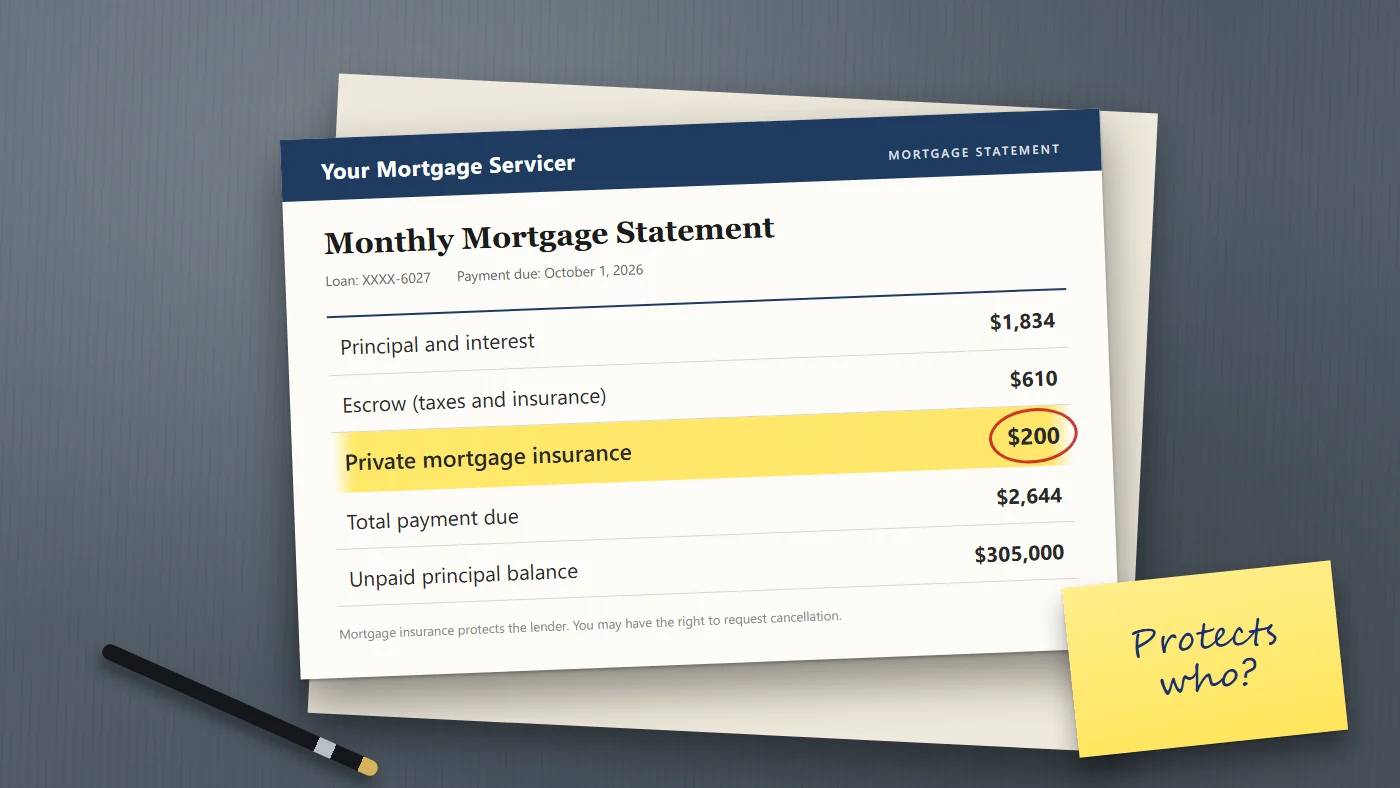
Pull up your monthly mortgage statement and find the line labeled "PMI" or "mortgage insurance." On a $300,000 loan it typically runs somewhere between $115 and $375 a month, based on Urban Institute pricing data cited by Bankrate. The yearly cost ranges from about 0.46% to 1.50% of the original loan amount, and your credit score and down payment decided where in that range you landed.
That payment doesn't protect you. The Consumer Financial Protection Bureau is plain about it: mortgage insurance protects the lender, not you, if you fall behind. It was the price of buying with less than 20% down. It was never meant to last for the life of the loan.
A federal law, the Homeowners Protection Act of 1998, spells out when private mortgage insurance has to end, and it gives you three exits. Fannie Mae and Freddie Mac, which own a big share of U.S. mortgages, add a fourth based on what your home is worth today. After several years of rising prices, that fourth exit is the one plenty of owners already qualify for without knowing it.
Only the two slowest exits are automatic. The faster ones require you to ask, in writing, and to meet a short list of conditions.
80% is the number to remember. When your loan balance reaches 80% of your home's original value, federal law gives you the right to ask your servicer in writing to cancel PMI. Automatic removal doesn't kick in until 78%.
The four exits
| Route | Loan-to-value needed | Measured against | Who starts it |
|---|
| Borrower request | 80% | Original value | You, in writing |
| Automatic termination | 78%, on the scheduled date | Original value | Your servicer |
| Final termination | Midpoint of the loan term | Calendar, not balance | Your servicer |
| Current-value request (Fannie Mae loans) | 75% after 2 to 5 years, 80% after 5 years | Today's value | You, in writing |
Request at 80%. According to the CFPB, you can ask for cancellation on the date your principal balance is scheduled to hit 80% of the original value, or sooner if extra payments got you there first. Under the law the servicer has to agree if you ask in writing, you're current with a good payment history, and you certify there's no second mortgage or other junior lien on the house. The lender can also ask for evidence that the home's value hasn't dropped below the original value.
Automatic at 78%. The servicer must end PMI on the date your balance is scheduled to reach 78% of original value, as long as you're current. That date comes from the original payment schedule. Extra payments you've made don't move it.
The midpoint. If PMI is somehow still on the bill, it has to end the month after you pass the halfway point of the loan term. On a 30-year mortgage, that's year 15.
All three rights apply to loans on a single-family primary residence that closed on or after July 29, 1999. FHA and VA loans follow different rules, covered below. So does lender-paid mortgage insurance, where the cost is baked into your interest rate.
What does "original value" mean, and why does it slow you down?
For a purchase, original value is the lower of the sales price and the appraisal at closing. If you've refinanced, it's the appraised value at the refinance. Either way, it never changes afterward. That's the weak spot of the first three exits: they ignore every dollar your home has gained since you bought it.
Take a buyer who paid $340,000 with 5% down, so the loan started at $323,000. The 80% mark is a balance of $272,000, and the 78% mark is $265,200. On a 30-year loan, scheduled payments alone take about 7 years to reach 80% at a 3% rate and about 11 years at 7%, with roughly one more year to hit 78%. At $200 a month in PMI, ten years of waiting is $24,000.
You can speed things up with extra principal payments, since the 80% request can be based on your actual balance. For most people who bought in the last several years, though, the bigger lever is the house itself. If it's worth noticeably more than you paid, you may already be past the line under the fourth route. That one works on today's value.
The current-value route
Fannie Mae's Servicing Guide lets a borrower ask for cancellation based on the property's current value. The thresholds for a one-unit primary residence or second home are specific:
- If the loan is between two and five years old, the balance must be 75% or less of the current value.
- If it's more than five years old, the balance must be 80% or less.
- If you made substantial improvements, such as a kitchen or bath renovation or added square footage, the servicer can waive the two-year wait, but the balance still has to be 80% or less of current value.
- For investment properties and two- to four-unit homes, the mark is 70%, and the loan has to be more than two years old.
Freddie Mac has its own current-value option. Get the exact terms from your servicer.
Go back to the $340,000 buyer. Say the loan is four years old at a 5.5% rate, so the balance is now about $305,000, and similar homes on the street are selling for $415,000. Loan-to-value on current value is about 73.5%. That clears the 75% bar. Years before the balance would reach 80% of the original price.
Qualifying on paper is the easy part. Whether the servicer says yes comes down to two conditions and to how you file the request.