Insurance
Your Term Life Policy Is Ending: Convert, Renew or Walk Away?
Your coverage usually doesn't stop on the last day of the term, but the price you locked in does, and the cheapest way out may expire before the term does.
 Margaret Linwood
Updated Sep 22, 2026 · 11 min read
If you bought a 20-year term life policy in 2006 or 2007, or a 30-year policy in the late 1990s, your level-premium period is ending now or soon. Most people assume that means the coverage simply stops. In most policies, it doesn't. What stops is the price.
A lot of level term policies sold in the U.S. are renewable. After the last level year, you can keep the policy going one year at a time, with no health questions, up to an age limit written into the contract. But the premium resets to a rate based on your current age, and then it climbs every year after that.
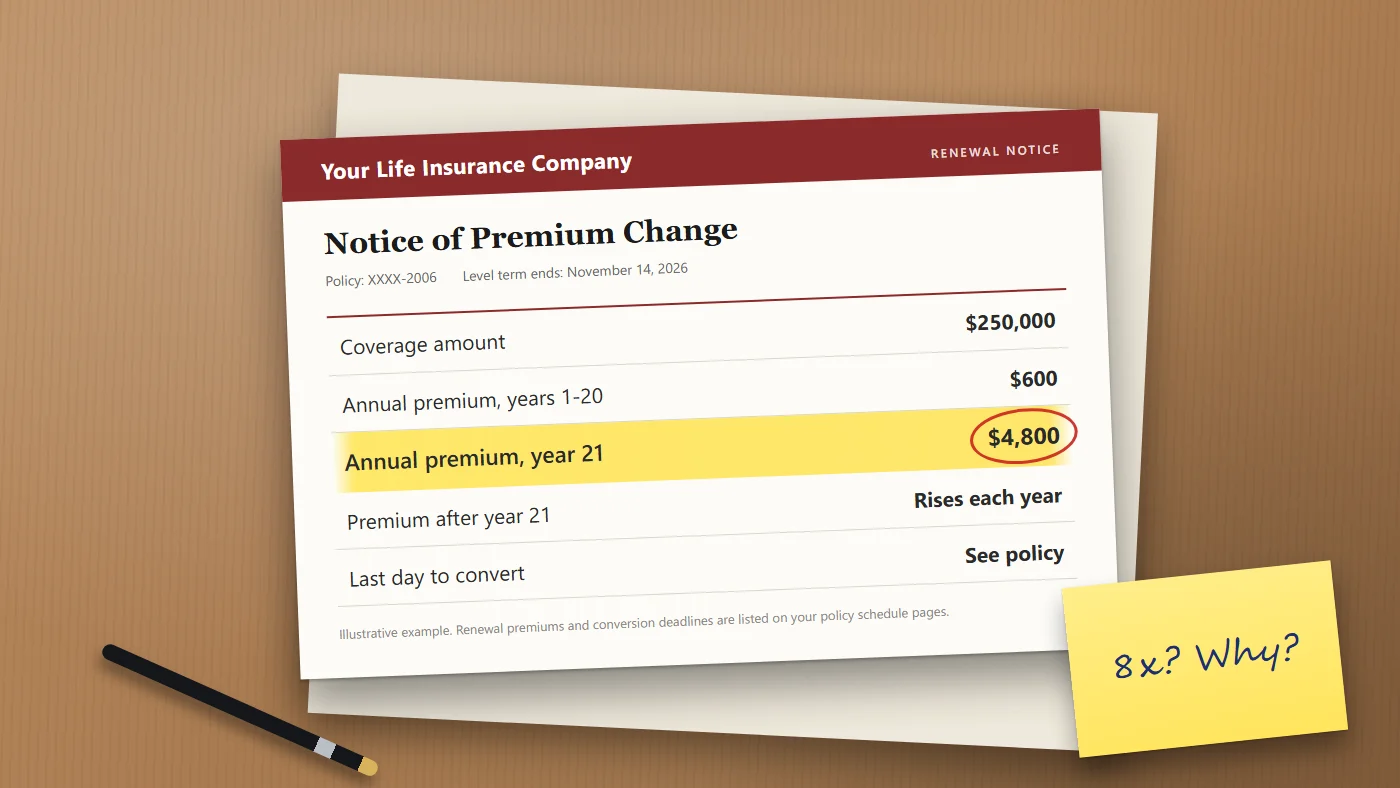
It's not a small reset. The Society of Actuaries, working with the reinsurer RGA, studied what happened to term policies at the end of their level period between 2000 and 2012. For 10-year policies that jumped straight to yearly increasing rates, the first post-level premium averaged 7.4 times the old one. For 15-year policies the average jump was 8.8 times. Put that in dollars with a made-up but typical example: a policy that cost $600 a year for two decades could come with a renewal notice asking for about $4,800.
Owners reacted about how you'd expect. In the same study, roughly 70% of those policies were dropped in the year the level period ended. Some of those people no longer needed the coverage. Others still did, had health problems that made new insurance hard to get, and never found out their old policy offered a way to keep coverage without a medical exam. That option has its own deadline. It often comes before the term ends.
Why is the renewal price so high?
During the level period you overpaid a little in the early years and underpaid in the later ones, because the insurer averaged your risk across 20 or 30 years. When the term ends, so does the averaging.
There's a second reason, and it's less comfortable. Insurers know who renews at eight times the price: mostly people who can't pass a medical exam anymore. Healthy owners leave for a new policy somewhere else, the people who stay are sicker on average, and renewal rates are set with exactly that group in mind, which is why they look so far out of line with what a brand-new policy costs.
You don't have to guess at your number. The policy has a table of guaranteed renewal premiums for every year after the level term, usually on the schedule pages near the front. Your insurer will also send a notice before the change, but it may arrive only a month or two ahead. That's late to start shopping.
And the first renewal bill isn't the last increase. On a yearly renewable schedule the premium goes up at every policy anniversary. In the made-up example, the owner paid $12,000 over the 20-year level term. The third renewal payment would push the post-term total past that, with each year costing more than the one before.
In the Society of Actuaries study, premiums on 10-year term policies jumped an average of 7.4 times in the first year after the level period, and 69.9% of those policies lapsed that year. For 15-year policies, the jump averaged 8.8 times and 72% lapsed.
Newer policies sometimes phase the increase in over several years instead of all at once. A 2021 SOA update, the first to include 20-year policies, found that the bigger the jump, the more people walked away, with first-year lapses ranging from 27% to 96% depending on how steep the increase was. Your own policy's schedule is the only number that counts.
Two dates you need
Every term policy has an end to the level premium, and most owners know roughly when that is. Fewer know about the second date.
The end of the level term is the policy anniversary when your premium resets. Check the schedule page for the exact day, not just the year.
The conversion deadline is the other one. Most term policies are convertible, meaning you can exchange the policy for a permanent one from the same insurer with no health questions and no exam. That right doesn't last forever, though. Depending on the insurer and the policy, the conversion window runs a set number of years from the start date, often somewhere between 5 and 20, or ends at a certain age, commonly between 65 and 75. On a 20-year policy it may have closed in year 10, or it may stay open until the final anniversary.
If your health has changed since you bought the policy, the conversion deadline matters more. Once it passes, the only coverage you can keep without underwriting is year-by-year renewal at the rates above.
Both dates are in the contract. A short call to customer service can confirm them, and it's worth asking the rep to put both in a letter or an email so there's no confusion later between the end of the level term and the end of the conversion period.