If you bought a 20-year term life policy in 2006 or 2007, or a 30-year policy in the late 1990s, your level-premium period is ending now or soon. Most people assume that means the coverage simply stops. In most policies, it doesn't. What stops is the price.
A lot of level term policies sold in the U.S. are renewable. After the last level year, you can keep the policy going one year at a time, with no health questions, up to an age limit written into the contract. But the premium resets to a rate based on your current age, and then it climbs every year after that.
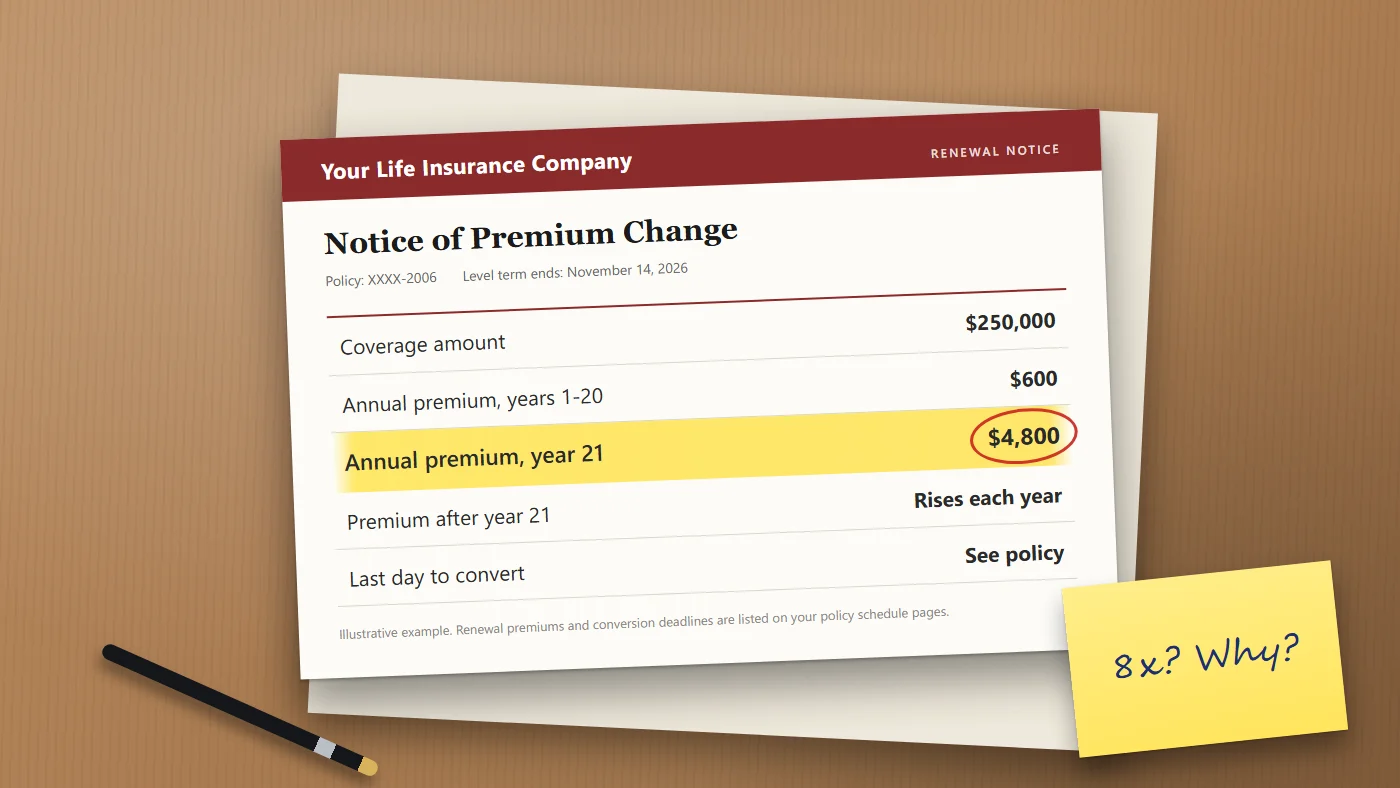
It's not a small reset. The Society of Actuaries, working with the reinsurer RGA, studied what happened to term policies at the end of their level period between 2000 and 2012. For 10-year policies that jumped straight to yearly increasing rates, the first post-level premium averaged 7.4 times the old one. For 15-year policies the average jump was 8.8 times. Put that in dollars with a made-up but typical example: a policy that cost $600 a year for two decades could come with a renewal notice asking for about $4,800.
Owners reacted about how you'd expect. In the same study, roughly 70% of those policies were dropped in the year the level period ended. Some of those people no longer needed the coverage. Others still did, had health problems that made new insurance hard to get, and never found out their old policy offered a way to keep coverage without a medical exam. That option has its own deadline. It often comes before the term ends.
Why is the renewal price so high?
During the level period you overpaid a little in the early years and underpaid in the later ones, because the insurer averaged your risk across 20 or 30 years. When the term ends, so does the averaging.
There's a second reason, and it's less comfortable. Insurers know who renews at eight times the price: mostly people who can't pass a medical exam anymore. Healthy owners leave for a new policy somewhere else, the people who stay are sicker on average, and renewal rates are set with exactly that group in mind, which is why they look so far out of line with what a brand-new policy costs.
You don't have to guess at your number. The policy has a table of guaranteed renewal premiums for every year after the level term, usually on the schedule pages near the front. Your insurer will also send a notice before the change, but it may arrive only a month or two ahead. That's late to start shopping.
And the first renewal bill isn't the last increase. On a yearly renewable schedule the premium goes up at every policy anniversary. In the made-up example, the owner paid $12,000 over the 20-year level term. The third renewal payment would push the post-term total past that, with each year costing more than the one before.
In the Society of Actuaries study, premiums on 10-year term policies jumped an average of 7.4 times in the first year after the level period, and 69.9% of those policies lapsed that year. For 15-year policies, the jump averaged 8.8 times and 72% lapsed.
Newer policies sometimes phase the increase in over several years instead of all at once. A 2021 SOA update, the first to include 20-year policies, found that the bigger the jump, the more people walked away, with first-year lapses ranging from 27% to 96% depending on how steep the increase was. Your own policy's schedule is the only number that counts.
Two dates you need
Every term policy has an end to the level premium, and most owners know roughly when that is. Fewer know about the second date.
The end of the level term is the policy anniversary when your premium resets. Check the schedule page for the exact day, not just the year.
The conversion deadline is the other one. Most term policies are convertible, meaning you can exchange the policy for a permanent one from the same insurer with no health questions and no exam. That right doesn't last forever, though. Depending on the insurer and the policy, the conversion window runs a set number of years from the start date, often somewhere between 5 and 20, or ends at a certain age, commonly between 65 and 75. On a 20-year policy it may have closed in year 10, or it may stay open until the final anniversary.
If your health has changed since you bought the policy, the conversion deadline matters more. Once it passes, the only coverage you can keep without underwriting is year-by-year renewal at the rates above.
Both dates are in the contract. A short call to customer service can confirm them, and it's worth asking the rep to put both in a letter or an email so there's no confusion later between the end of the level term and the end of the conversion period.
Your five options, side by side
| Option | Health questions? | What it costs | Fits best when |
|---|
| Let the policy end | No | Nothing | The mortgage is paid, the kids are independent and your spouse would be fine on savings and Social Security |
| Buy a new term policy | Yes, full underwriting | Priced at your current age and health | You're in decent health and need 10 to 15 more years of coverage |
| Convert to permanent coverage | No | Several times the old term premium, fixed for life | Your health has declined and you want coverage that can't expire |
| Convert part, drop the rest | No | Proportional to the amount you convert | You need a smaller amount for life, like final expenses or a survivor's cushion |
| Renew year by year | No | The highest price per dollar, rising annually | You need a short bridge, or you have a serious diagnosis |
Some numbers for the second row. In MoneyGeek's September 2026 analysis of quotes from more than 30 insurers, a new $500,000, 10-year term policy for a nonsmoker in average health averaged $158 a month for a 60-year-old woman and $227 for a man. At 65 it averaged $262 and $385. That's a lot more than you paid at 40, but for a reasonably healthy person in their early 60s it's usually well below what the old policy's renewal schedule would charge for the same $500,000, and it stays level for the whole term instead of climbing every year.
Conversion is priced differently, and it's the part people miss. The new permanent policy is issued at your current age but at the health class you got when you first bought the term policy. Qualified as preferred at 42 and had a heart procedure since? You convert as preferred, which no new applicant with your history could get. It's still expensive. Whole life can cost 5 to 15 times as much as term for the same death benefit, by one 2026 industry estimate. So most insurers let you convert only part of it, say $100,000 of a $500,000 policy, and let the rest go.
Some insurers also give a conversion credit, often tied to the last year of term premium you paid, which knocks down the first-year cost of the new policy. It's rarely advertised. Ask.
Step by step, starting six to twelve months out
- Find the policy and read the schedule pages. Write down the level term end date, the renewal premium table and the conversion provision. Can't find the policy? Call the insurer and ask for a duplicate and an in-force summary.
- Call the insurer with four questions. What's my conversion deadline? Which permanent products can I convert to? Can I convert part of the face amount? Is there a conversion credit? Get the answers in writing.
- Decide whether you still need coverage, how much and for how long. Look at the mortgage balance and the years until retirement. Think about what your spouse would lose in pension and Social Security income if you died; a household generally keeps only the larger of two Social Security checks. The answer's often smaller than the original policy.
- If your health is reasonable, apply for new coverage first. Do it before the old policy reprices, and don't cancel anything until the new policy is issued and in force. A broker who works with several insurers can tell you ahead of time how each one is likely to rate a specific condition.
- If new coverage is declined or too pricey, ask for conversion illustrations. Request whole life, plus guaranteed universal life if the insurer offers it to converting customers. Guaranteed universal life is permanent coverage with little or no cash value, and it's often the cheapest way to hold a death benefit for life. Compare a full conversion against a partial one.
- Use renewal only as a bridge. A year at the renewal rate can make sense while you wait out a recent health event so you can reapply later, or if a doctor has told you there's reason to think the policy will pay out soon. As a long-term plan it rarely works, since the premium rises every year.
- Whatever you choose, don't just stop paying. Most policies give you a grace period of about a month after a missed premium, and then the coverage is gone. Getting it reinstated later usually takes proof of good health. If you're letting the policy go, make it a decision, with a date.
Mistakes that cost the most
The most expensive one is waiting for the renewal notice. By the time it shows up, underwriting on a new policy, which can take several weeks when there's an exam, may not finish before the price changes, and the conversion window may already be shut.
Assuming you can't qualify for anything new is close behind. Rules vary widely among insurers, and controlled blood pressure, cholesterol medication or a cancer treated years ago doesn't automatically rule you out.
Then there's converting everything on reflex. Permanent coverage on the full original amount can run to many thousands of dollars a year, and if that premium isn't comfortable for the rest of your life, you risk dropping it later and losing what you put in.
Swapping the policy for a mail-order offer is another. Small guaranteed acceptance policies marketed to people over 50 cost far more per dollar of coverage and usually pay only a refund of premiums if you die in the first two years.
And people forget that a convertible policy may be worth something to someone else. If you're past 65, your health has changed a lot and you don't want to keep paying, a convertible term policy can sometimes be sold to a licensed buyer in a life settlement. It only applies to a minority of policies. Still, ask before you let a large one lapse.
Getting prices you can line up
You're choosing among three or four products, so get them in a form you can compare. Ask for at least three quotes for new term coverage at the amount and length you settled on in step 3, each with the health class it assumes. Ask your current insurer for a written conversion quote for the same amount. Then set the annual costs next to the renewal premium from your schedule page.
Side by side, it's usually obvious. If a healthy 62-year-old can get 10 more years for a third of the renewal price, new term wins. If a 64-year-old with a recent diagnosis sees quotes above the conversion premium, or gets declined, a partial conversion is probably the answer. If nobody depends on your income anymore, you can stop paying for a risk that's already passed.
An independent agent or broker is paid by the insurer, not by you, and can run the term quotes and look over the conversion offer in one sitting. A fee-only financial planner can help with the bigger question under all of this: whether your household still needs the coverage at all.
Before the anniversary date
Find the conversion deadline this week, before anything else. While it's still ahead of you, you hold something people with health problems would pay a lot for, and it costs nothing to keep open or to ask about. The morning after it passes, it's gone.
This article is general information, not financial, legal, tax or medical advice.