Insurance
Insurer Says Your Car Is Totaled: How to Dispute a Lowball Valuation
The first number is built by software from a handful of listings and a condition score, and every one of those inputs can be checked.
 Ray Castellano
Updated Sep 22, 2026 · 11 min read
The call usually comes a few days after the crash. The adjuster says the car's a total loss, reads you a number and asks where to send the paperwork. It sounds final. It isn't. It's an opening offer, and the documents behind it are yours to ask for.
More people are getting this call than ever. CCC Intelligent Solutions, a claims technology company that tracks the repair business, reports that 23.1% of auto claims in 2025 ended as total losses, the highest share it's recorded. Repair costs have climbed, the average car on the road is nearly 13 years old, and an older car doesn't need much damage before fixing it costs more than it's worth.
What the insurer owes you on a totaled car is its actual cash value: what your car, with its mileage, options and condition, would have sold for in your area just before the crash. Almost no adjuster works that out by hand. The number comes from a valuation report built by third-party software, which pulls a few "comparable" vehicles from dealer listings, adjusts each one up or down for mileage and equipment, gives your car a condition score and averages the results. How that software trims prices has been the subject of class-action suits, and two of them settled for $48 million and $43 million.
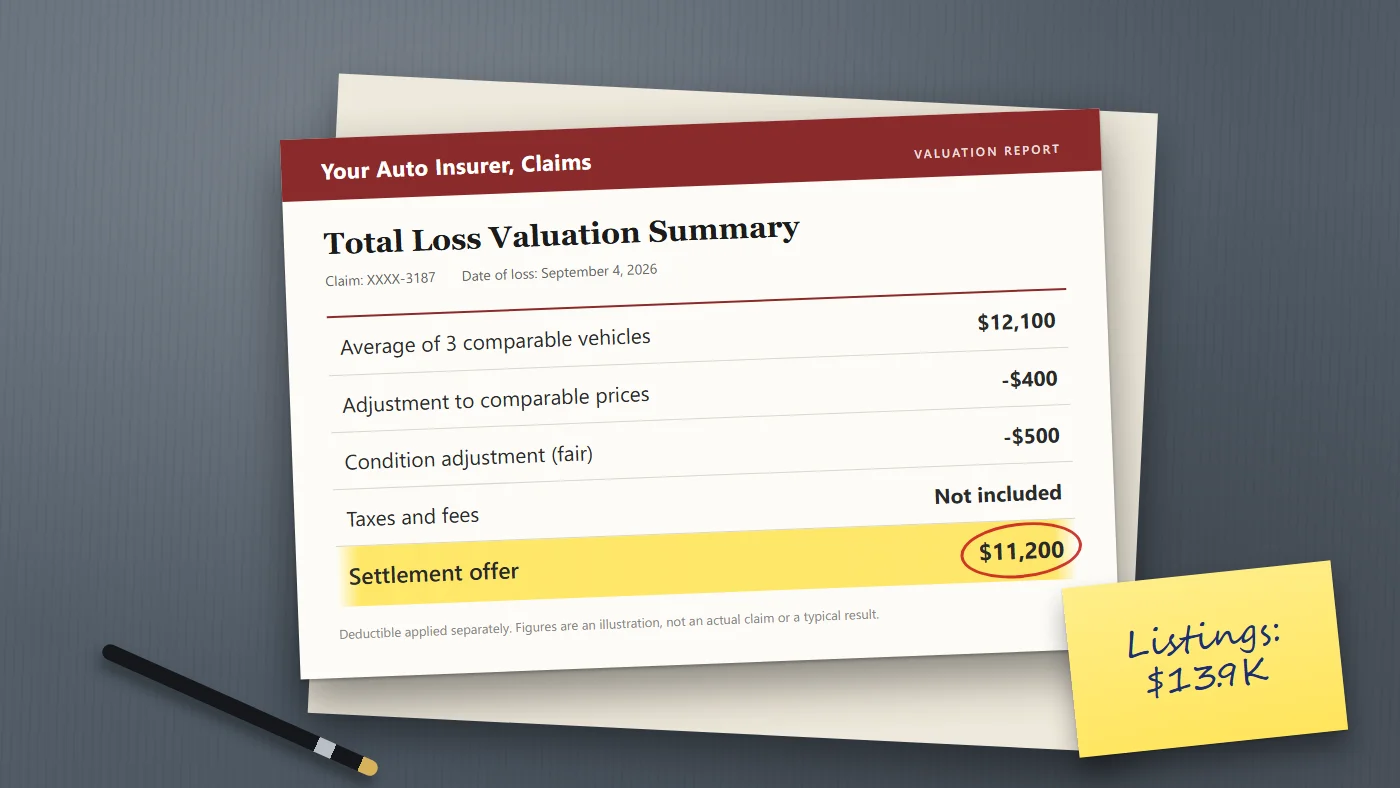
Any step in that chain can go wrong. The report can list the wrong trim, miss options, rate a well-kept car as "fair," pull comparables from 140 miles away or from listings that sold months ago, or leave out sales tax and title fees your state requires. None of that takes bad intent. It only takes nobody checking, and the one person with a reason to check is you. In the example below, an $11,200 offer sits $2,700 under local listings, and five lines of the report explain nearly all of it.
23.1%. The share of U.S. auto claims that ended as total losses in 2025, a record, according to CCC Intelligent Solutions. Nearly one claim in four now ends with a valuation report instead of a repair.
What a gap looks like on paper
Say the insurer offers $11,200 for a seven-year-old SUV. You search dealer sites within 50 miles and turn up four of the same year, model and trim with similar miles, and their asking prices average $13,900. That's a $2,700 difference. It needs explaining. (These numbers are made up to show the mechanics; your gap could be smaller or larger.)
| Line in the valuation report | What to check | Effect in this example |
|---|
| Trim and options | Report lists the base trim; yours is the mid-level trim with a towing package | +$900 |
| Condition score | Rated "fair" with no inspection notes; you have service records and recent photos | +$500 |
| Adjustment to comparables | Each listing price cut by a percentage for "expected negotiation" | +$400 |
| Comparables used | Two of three are 120+ miles away in a cheaper market | +$300 |
| Taxes and fees | Sales tax and title fee not included | +$700 |
Add up the documented corrections and you get about $2,800. Notice that not all of the asking-price gap was real, though. Asking prices aren't sale prices, and a used car often sells below its listing. What you can recover is the part you can prove.
Look at the table again. No single line is dramatic: the biggest is $900, and most are a few hundred. Together they cover nearly the whole gap, and each one ties to a piece of paper, whether that's a window sticker, a dated photo, a saved listing or a state rule. "My car was worth more" gives an adjuster nothing to work with. A VIN printout showing the towing package does.
That's the heart of a dispute. You aren't arguing that the offer feels low. You're correcting specific lines, with evidence.
Can software really shave money off every comparable?
It can, and it's been fought over in court. Some valuation reports knock a set percentage off every comparable listing on the theory that buyers negotiate below the sticker. Court filings call it a "projected sold adjustment."
Drivers have sued over it in several states, arguing the deduction is arbitrary and not based on actual sales. One large national insurer agreed to a $48 million settlement covering New York total loss claims, about 93,000 policyholders, and a $43 million settlement in Georgia. The Georgia class was roughly 151,000 people, with an estimated average payment of about $173 each. Other cases have gone the insurers' way or are still pending, and no court has declared the practice illegal nationwide.
Two things follow from that. The deductions often come to a few hundred dollars per car, not thousands. And they're visible, as line items in the valuation report, which means you can only question them once the report is in your hands.
So the first move is simple, and it's easy to skip when you're rattled and need a car by Monday.