Medicare
Turning 65? The Medicare Enrollment Deadlines That Carry Lifetime Penalties
Medicare gives you seven months to sign up. Miss them without the right kind of other coverage, and the surcharge follows you for as long as you have Part B.
 Margaret Linwood
Updated Sep 22, 2026 · 11 min read
Maybe you figured the Medicare card would just show up in the mail at 65. For most people, it doesn't anymore. If you aren't already collecting Social Security when you hit 65, nobody signs you up. You do it yourself, and you get seven months.
What happens if those months slip by? Without the right kind of other insurance, Medicare tacks a surcharge onto your Part B premium. It's 10% of the standard premium for every full 12 months you could have had Part B and didn't. And it isn't a one-time fee. It shows up on every monthly bill for as long as you have Part B, which for most people means the rest of their life.
People who pay it rarely ignored Medicare; usually they made an assumption that sounded sensible and happened to be wrong. COBRA feels like the same employer plan, so surely it counts. A retiree plan from a former employer seems like reason enough to wait. And if you don't take a single prescription, why pay for drug coverage? Medicare accepts none of them.
Born in 1961? You turn 65 this year. Born in 1962 and assuming this is a 2027 problem? Maybe not. The window opens three months ahead of your birthday month, so a mid-January 1962 birthday puts the start on October 1 of this year.
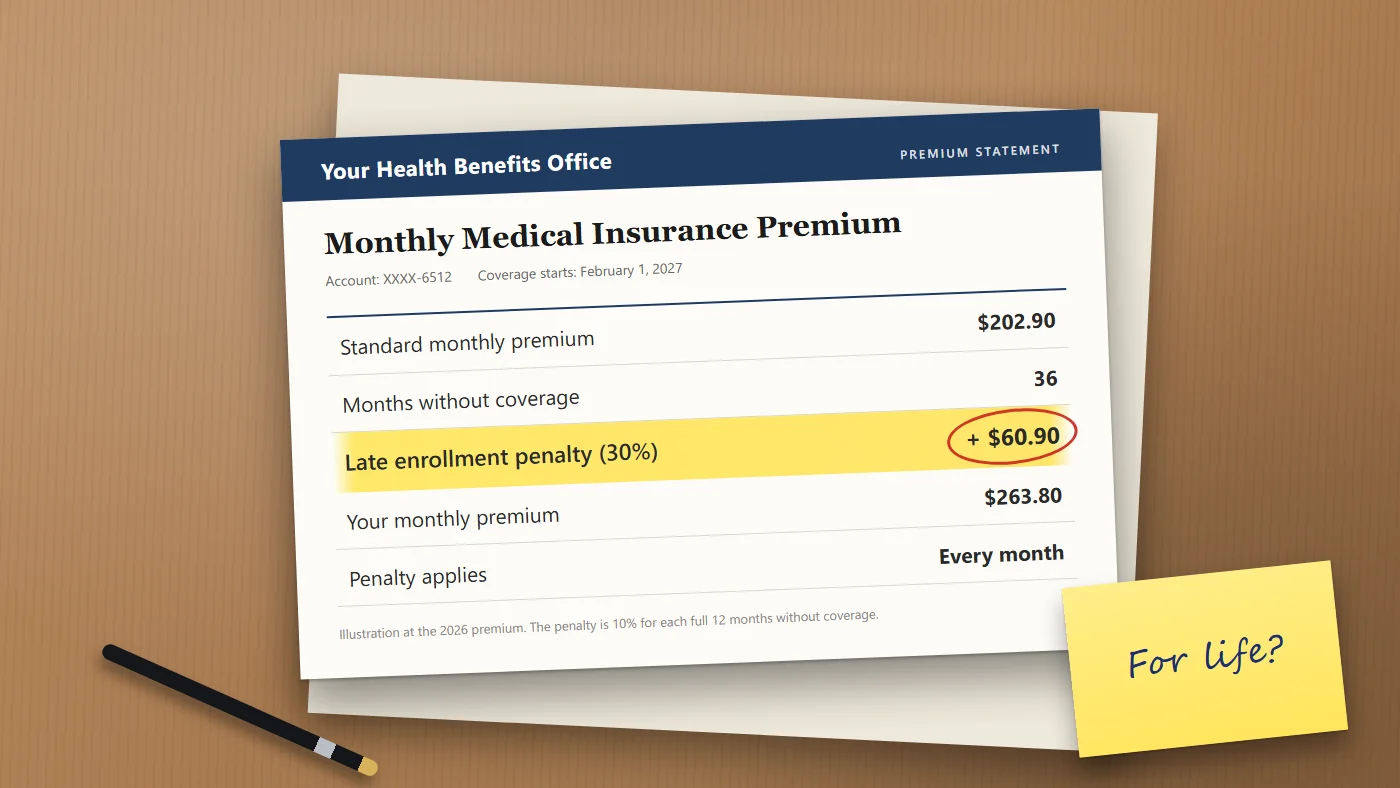
The number to know: 10% for every 12 months. Put off Part B for three full years without qualifying coverage and your premium runs 30% higher, every month, for life. On the 2026 premium of $202.90, that's about $61 extra a month. Over a year it's roughly $730, and it grows whenever the premium does.
Seven months, and the day coverage starts
Take a birthday on June 14. Your sign-up window opens March 1 and closes September 30. Three months before the birthday month, the month itself, three after: Medicare calls that your Initial Enrollment Period.
Apply in any of the three months before your birthday month, and Part B starts on the first day of that month. Wait until the birthday month or later, and coverage begins on the first of the month after you sign up. No penalty for applying late in the window. You could still be uncovered for a few weeks, though. (A birthday on the 1st shifts the whole window a month earlier.)
Why doesn't Medicare just enroll you? It does, but only if you've been getting Social Security or Railroad Retirement benefits for at least four months before your 65th birthday. If you were born in 1960 or later, your full retirement age is 67, so plenty of people are still working at 65, or holding off on claiming on purpose. Then you apply yourself: online through Social Security, by phone at 1-800-772-1213, or at a local office.
Three penalties, three different clocks
Each part has its own late penalty, and they work differently.
| Part | What triggers it | How much | How long you pay |
|---|
| Part A (hospital) | Signing up late, only if you have to buy Part A | 10% added to the Part A premium | Twice the number of years you waited |
| Part B (medical) | Each full 12 months without Part B or job-based coverage from current work | 10% of the standard premium per 12 months | As long as you have Part B |
| Part D (drugs) | 63 days or more in a row without Part D or other creditable drug coverage | 1% of the national base premium per month | As long as you have Medicare drug coverage |
You're unlikely to owe the Part A penalty. Most people get Part A premium-free, since they or a spouse paid Medicare taxes for at least ten years, and a zero premium leaves nothing to add a penalty to.
Healthy and taking nothing? That's exactly who the Part D penalty catches. Say you go 14 months without drug coverage after you become eligible. When you finally join a plan, 14% of the national base beneficiary premium gets added to your monthly premium. For 2027 that base is $41.33, so you'd pay about $5.80 a month extra. Small. But it's refigured every year as the base moves, and it never drops off.
Does your job's drug plan stop that clock? Only if it's "creditable," meaning it's expected to pay at least as much as standard Part D. Employer and union plans have to tell you in writing every year whether theirs qualifies. Keep that letter. You may need it a decade from now.
Part B is where the money adds up. Medicare.gov's own case: wait two full years with no Special Enrollment Period, and the penalty is 20%. Take the 2026 standard premium of $202.90 and add 20%. After Medicare rounds it, the monthly bill comes to $243.50.
A 20% penalty costs about $487 a year at today's premium. Keep paying it for 20 years and you're at roughly $9,740, and that assumes the premium never goes up, which it almost always does. With a 30% penalty, the same 20 years comes to more than $14,600. Plain multiplication, not a forecast.
The surcharge isn't the only damage. Miss your window without a special enrollment right and you're left with the General Enrollment Period, January 1 through March 31. Coverage then starts the month after you apply. Catch the mistake in April, and you could spend the better part of a year with no Part B at all.
It all comes down to one question: does the coverage you have right now let you put off Part B without a penalty? That depends on where it comes from, and that's where the wrong guesses happen.