Maybe you figured the Medicare card would just show up in the mail at 65. For most people, it doesn't anymore. If you aren't already collecting Social Security when you hit 65, nobody signs you up. You do it yourself, and you get seven months.
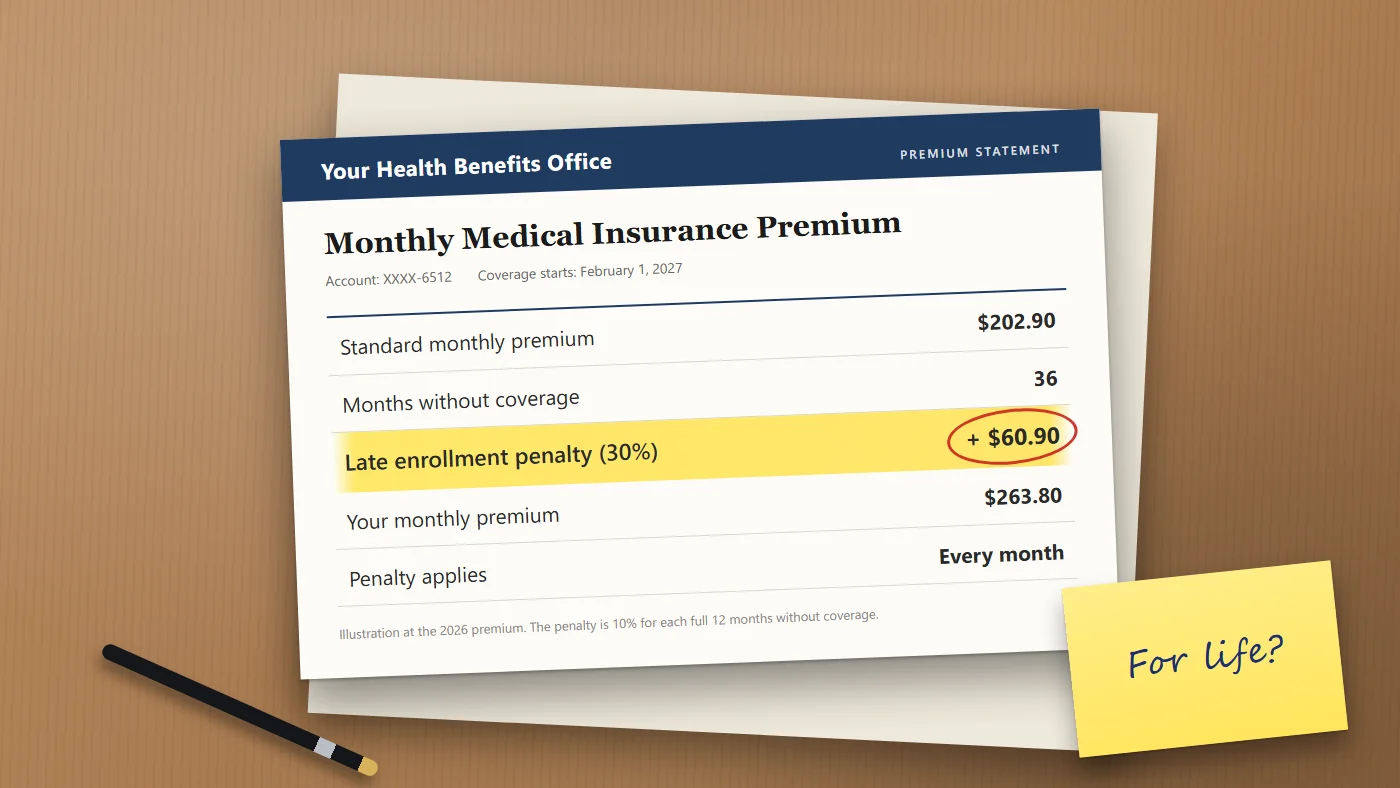
What happens if those months slip by? Without the right kind of other insurance, Medicare tacks a surcharge onto your Part B premium. It's 10% of the standard premium for every full 12 months you could have had Part B and didn't. And it isn't a one-time fee. It shows up on every monthly bill for as long as you have Part B, which for most people means the rest of their life.
People who pay it rarely ignored Medicare; usually they made an assumption that sounded sensible and happened to be wrong. COBRA feels like the same employer plan, so surely it counts. A retiree plan from a former employer seems like reason enough to wait. And if you don't take a single prescription, why pay for drug coverage? Medicare accepts none of them.
Born in 1961? You turn 65 this year. Born in 1962 and assuming this is a 2027 problem? Maybe not. The window opens three months ahead of your birthday month, so a mid-January 1962 birthday puts the start on October 1 of this year.
The number to know: 10% for every 12 months. Put off Part B for three full years without qualifying coverage and your premium runs 30% higher, every month, for life. On the 2026 premium of $202.90, that's about $61 extra a month. Over a year it's roughly $730, and it grows whenever the premium does.
Seven months, and the day coverage starts
Take a birthday on June 14. Your sign-up window opens March 1 and closes September 30. Three months before the birthday month, the month itself, three after: Medicare calls that your Initial Enrollment Period.
Apply in any of the three months before your birthday month, and Part B starts on the first day of that month. Wait until the birthday month or later, and coverage begins on the first of the month after you sign up. No penalty for applying late in the window. You could still be uncovered for a few weeks, though. (A birthday on the 1st shifts the whole window a month earlier.)
Why doesn't Medicare just enroll you? It does, but only if you've been getting Social Security or Railroad Retirement benefits for at least four months before your 65th birthday. If you were born in 1960 or later, your full retirement age is 67, so plenty of people are still working at 65, or holding off on claiming on purpose. Then you apply yourself: online through Social Security, by phone at 1-800-772-1213, or at a local office.
Three penalties, three different clocks
Each part has its own late penalty, and they work differently.
| Part | What triggers it | How much | How long you pay |
|---|
| Part A (hospital) | Signing up late, only if you have to buy Part A | 10% added to the Part A premium | Twice the number of years you waited |
| Part B (medical) | Each full 12 months without Part B or job-based coverage from current work | 10% of the standard premium per 12 months | As long as you have Part B |
| Part D (drugs) | 63 days or more in a row without Part D or other creditable drug coverage | 1% of the national base premium per month | As long as you have Medicare drug coverage |
You're unlikely to owe the Part A penalty. Most people get Part A premium-free, since they or a spouse paid Medicare taxes for at least ten years, and a zero premium leaves nothing to add a penalty to.
Healthy and taking nothing? That's exactly who the Part D penalty catches. Say you go 14 months without drug coverage after you become eligible. When you finally join a plan, 14% of the national base beneficiary premium gets added to your monthly premium. For 2027 that base is $41.33, so you'd pay about $5.80 a month extra. Small. But it's refigured every year as the base moves, and it never drops off.
Does your job's drug plan stop that clock? Only if it's "creditable," meaning it's expected to pay at least as much as standard Part D. Employer and union plans have to tell you in writing every year whether theirs qualifies. Keep that letter. You may need it a decade from now.
Part B is where the money adds up. Medicare.gov's own case: wait two full years with no Special Enrollment Period, and the penalty is 20%. Take the 2026 standard premium of $202.90 and add 20%. After Medicare rounds it, the monthly bill comes to $243.50.
A 20% penalty costs about $487 a year at today's premium. Keep paying it for 20 years and you're at roughly $9,740, and that assumes the premium never goes up, which it almost always does. With a 30% penalty, the same 20 years comes to more than $14,600. Plain multiplication, not a forecast.
The surcharge isn't the only damage. Miss your window without a special enrollment right and you're left with the General Enrollment Period, January 1 through March 31. Coverage then starts the month after you apply. Catch the mistake in April, and you could spend the better part of a year with no Part B at all.
It all comes down to one question: does the coverage you have right now let you put off Part B without a penalty? That depends on where it comes from, and that's where the wrong guesses happen.
Still working at 65? Who can wait on Part B
You can delay Part B with no penalty if you have group health coverage based on current employment, yours or your spouse's. "Current" is doing all the work in that sentence. The coverage has to come from a job somebody still shows up for.
Employer size changes the picture:
- 20 or more employees. The group plan pays first and Medicare second. A lot of people in this spot hold off on Part B and skip the premium.
- Fewer than 20 employees. Medicare pays first. You'll generally need Part A and Part B at 65, because the employer plan may pay little or nothing for services Medicare would have covered.
Not sure which applies? Ask your benefits administrator. Get the answer in writing.
Got a Health Savings Account? Once any part of Medicare begins, you can't contribute to it anymore. And Part A can be backdated up to six months when you apply. Medicare.gov's advice: stop HSA contributions, yours and your employer's, six months before you retire or apply for benefits.
When the job or the coverage ends, whichever comes first, you get an eight-month Special Enrollment Period that starts the next month. Sign up inside it and there's no Part B penalty.
COBRA looks like job coverage. Medicare disagrees
COBRA lets you keep your old employer's plan, usually for up to 18 months, as long as you pay the full premium yourself. Same card, same network. For Medicare's purposes, though, it isn't coverage from current employment, and signing up for COBRA doesn't stretch your Special Enrollment Period. Retiree coverage gets the same treatment.
Picture it on a calendar. Say you retire at 66 on June 30, 2025, and elect 18 months of COBRA, which carries you through December 2026. Your eight-month Special Enrollment Period ran from July 2025 until February 28, 2026, and the whole time you were sitting on COBRA, paying the full premium and probably not thinking about Medicare at all.
When COBRA runs out, there's no special right left. You wait for the General Enrollment Period, sign up in January 2027, and Part B starts February 1. Count it up: 19 months without Part B after your job coverage ended, which is one full 12-month block. A 10% penalty, for life.
A second problem bites sooner. Once you're eligible for Medicare, COBRA pays after Medicare. Without Part B, the COBRA plan can refuse to pay the share Medicare would have picked up, and Medicare.gov warns you may end up covering most of those costs yourself.
Your sign-up timeline
- Six months before 65, take stock. Are you or your spouse on a group plan from a current job? How many employees does that employer have? Do you have an HSA?
- Three months before your birthday month, apply if you need Medicare at 65. You can do it online through your my Social Security account. Applying early gets you coverage on the first day of your birthday month.
- Delaying Part B? Think about taking Part A anyway. It's premium-free for most people. The exception is if you want to keep putting money into an HSA.
- Get your drug plan's creditable coverage letter and file it with your records.
- Once you know your retirement date, line up Part B to start the day after employer coverage ends. You'll need two forms: CMS-40B, the application for Part B, and CMS-L564, which your employer fills out to show you had coverage from current employment.
- Don't use up the eight months. The Special Enrollment Period protects you from the penalty. It doesn't protect you from a gap in coverage.
- Within 63 days of losing employer drug coverage, join a Part D plan or a Medicare Advantage plan that includes drugs.
The window nobody mentions: Medigap
Signing up for Part B quietly starts another clock. Why would you need anything on top of Original Medicare? It generally pays 80% of the approved amount for outpatient care after the deductible, and there's no yearly cap on what you can owe. Most people add one of two things. One is a Medicare Supplement policy (Medigap) paired with a separate Part D plan. The other is a Medicare Advantage plan, which bundles hospital, medical and usually drug coverage through a private insurer with its own network.
Timing matters most for Medigap. You get a six-month Medigap Open Enrollment Period, and it begins the first month you're both 65 or older and enrolled in Part B. Buy during those six months and your health stays out of it: an insurer can't turn you down or charge you more because of it. After that, in most states, insurers can ask health questions and can refuse to sell you a policy. A few states go further. Your state insurance department will know if yours does.
If I could get people turning 65 to circle one date, it'd be the last day of that six-month window.
That's the time to shop. Medigap plans are standardized by letter, so a Plan G from one company covers the same things as a Plan G from another. What differs is the price, sometimes by a lot, and how the company raises rates as you age. With Medicare Advantage, look at the provider network, the yearly out-of-pocket maximum and the drug list.
You can compare on Medicare.gov, with a free counselor from your State Health Insurance Assistance Program (SHIP), or with a licensed Medicare agent or broker. Agents earn commissions from insurers, so it's reasonable to ask how many companies they represent in your county.
Already missed it? What you can still do
It isn't hopeless. Moving quickly helps, because the penalty is counted in full 12-month blocks.
- Sign up in the next General Enrollment Period, January 1 through March 31. Coverage starts the month after you sign up.
- Check for an exceptional-conditions Special Enrollment Period. Since 2023, Medicare has allowed late sign-up without a penalty in certain cases, such as a natural disaster, wrong information from an employer or health plan, or release from incarceration. The request form is CMS-10797.
- Ask about equitable relief if a federal employee gave you wrong information that caused the delay. Write down who told you what, and when.
- Look into Medicare Savings Programs. These state-run programs help people with limited income pay Part B premiums. Enroll in one and, according to Medicare.gov, you generally won't owe the Part B penalty. Income limits vary by state.
- Appeal a penalty you think is wrong. Your notice explains how to ask for a review, and proof of employer coverage, such as a completed CMS-L564, is the document that carries the case.
Mistakes that keep showing up
- Treating COBRA or a retiree plan as job coverage. Neither one pushes back the deadline.
- Assuming a small employer's plan is enough. Under 20 employees, Medicare is supposed to pay first.
- Skipping Part D because you take nothing. The penalty clock starts after 63 days.
- Waiting for a letter. If you aren't on Social Security yet, no enrollment notice is coming.
- Letting the Medigap window lapse. It opens once, with Part B, and lasts six months.
Before your window opens, call the benefits office with two questions: how many employees the plan counts, and whether its drug coverage is creditable. Write down the answers, the date and the name of the person you spoke with.
This article is general information, not financial, legal, tax or medical advice.