Insurance
Car Insurance Discounts for Drivers 55+: The Ones You Have to Ask For
A course that costs about $30, a mileage update and a five-minute phone call can lower a bill that your insurer won't lower on its own.
 Ray Castellano
Updated Sep 22, 2026 · 11 min read
Your car insurer knows your birthday. It doesn't know you retired in March, that the 40-mile round trip to the office is gone, or that the car now mostly goes to the grocery store and the grandkids' ball games. Nothing in its system picks up those changes. Until you call, you're rated as the person you were the day you bought the policy.
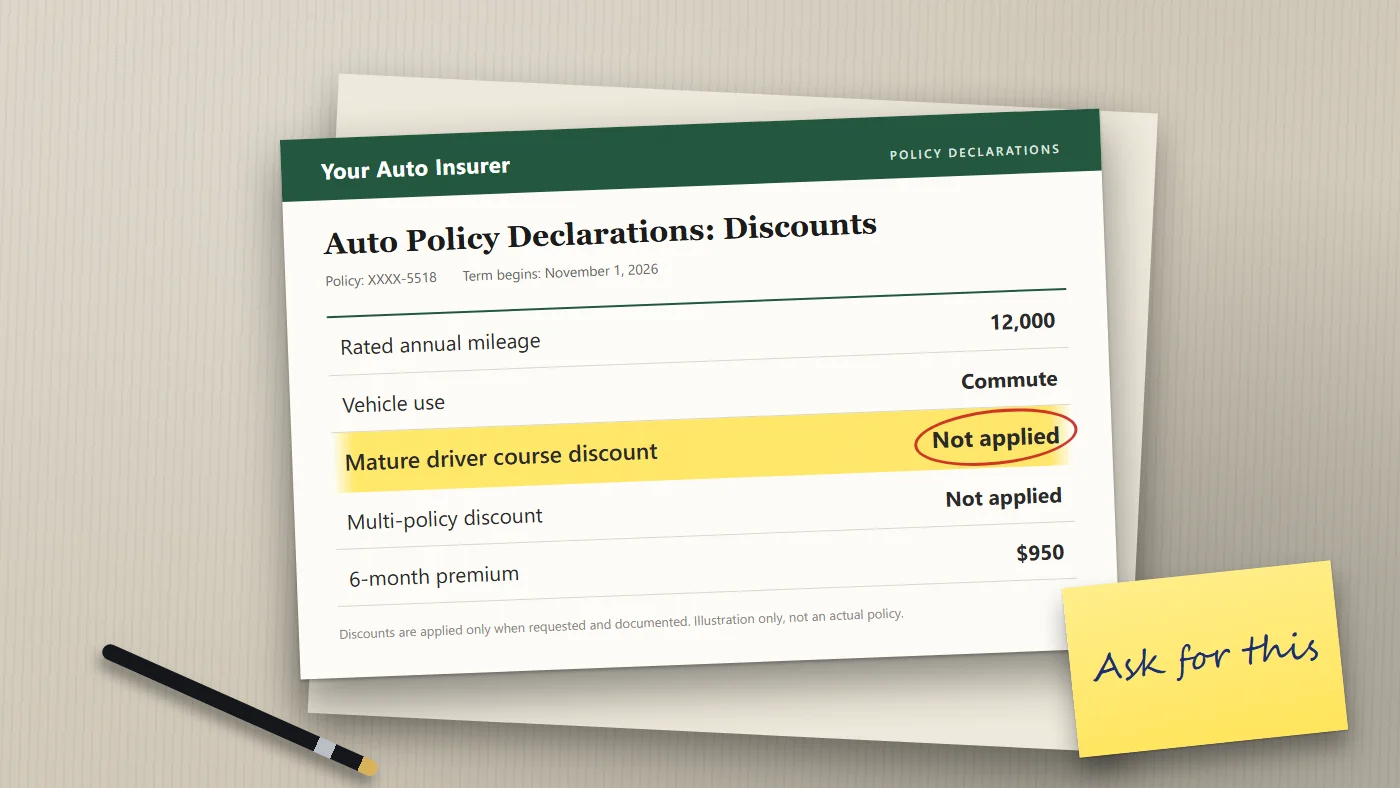
That matters, because several of the biggest discounts for drivers over 55 aren't automatic. The Insurance Information Institute, the industry's own education group, says most insurers offer discounts to drivers over 55, and it splits them into two kinds. Some come with age. Others are "earned upon completion of approved accident prevention courses." The second kind needs a certificate. No certificate, no discount, and nobody mails you a reminder.
The course isn't a road test. It's a classroom or online refresher, usually four to eight hours, with no driving and usually no exam you can fail. The best-known online version lists at $27 for members of the group that sponsors it and $30 for everyone else in a typical state, and you get 60 days to finish (30 in New York and Connecticut). In many states the law then requires your insurer to give you a discount, and it generally runs three years.
Is that worth an afternoon? Run the math. Say you pay $1,900 a year. A 5% course discount is $95 a year, or $285 over the three years a certificate lasts. At 10% it's $190 a year and $570 in total. In practice the discount often applies only to certain coverages on the policy, not the whole bill, so your real number will be smaller than that. It'll still be several times what the course costs.
About $30, once every three years. That's the price of the course. In New York, the DMV says an approved course cuts the base rate of your premiums by 10% each year for three years.
Why doesn't the insurer just apply it?
Insurers price from what's in your file. Your age updates by itself. Almost nothing else does.
Your mileage was estimated the day you applied, and so was your "use," which for most working people was set to commuting, with a one-way distance attached. Stop commuting and the file still says you drive to work five days a week. Federal Highway Administration figures put the average driver aged 35 to 54 at about 15,300 miles a year, drivers 55 to 64 at about 12,000, and drivers 65 and older at about 7,600. That's an older federal survey, but the pattern hasn't gone anywhere: people drive a lot less once they stop working. Your rate reflects that only if somebody tells the insurer.
The course discount works the same way. A state can require insurers to offer it, but your company has no way of knowing you took a course until you send in the certificate. States don't report completions to insurance companies.
There's a quieter problem, too. Prices tend to creep up the longer you stay put, a little at each renewal, and because nobody compares a bill with the one from four years ago, the drift can go on for a long time before anyone notices. Consumer Reports surveyed more than 40,000 policyholders in 2024 and found that more drivers 60 and older had seen a rate increase in the past 12 months than younger policyholders had. Among people of all ages who switched insurers, the median saving was $461 a year. Loyalty isn't a discount. Sometimes it's the opposite.
Four states, four versions of the rule
There's no federal rule here. Mature driver discounts are set state by state, and depending on who's counting, somewhere between two dozen and three dozen states require insurers to give one to older drivers who finish an approved course. In the rest, plenty of insurers offer it voluntarily. The qualifying age, the size of the discount and the course length all differ.
| State | Who qualifies | What the state says | How long it lasts |
|---|
| Florida | Age 55 and older | Insurer must give a discount after an approved course; each insurer sets the amount | Typically three years, as long as you aren't cited in a crash or convicted of a moving violation |
| New York | Any licensed driver | 10% off the base rate of your premiums; if several people on one policy take it, only the principal operator gets it | Three years; retake every 36 months |
| Pennsylvania | Age 55 and older | At least 5% off after the 7-hour basic course | Take a refresher course every three years |
| California | Age 55 and older | Insurer must give a discount; each insurer sets the amount | About three years; the renewal course is shorter than the first one |
Two things jump out. The age is usually 55, not 65, and plenty of drivers wait a decade longer than they have to. And in Florida and California the law requires a discount but lets each company pick the size. Two insurers in the same state can give very different amounts for the same certificate. Same course, same driver. That's one more reason to compare.
Not in the table? Search your state insurance department or DMV site for "mature driver" or "accident prevention course." It'll list the approved providers, and only approved courses count.
Honestly, the course is the easy part. For most retired drivers the larger savings sit in four other lines on the policy, and those take one phone call.