Your car insurer knows your birthday. It doesn't know you retired in March, that the 40-mile round trip to the office is gone, or that the car now mostly goes to the grocery store and the grandkids' ball games. Nothing in its system picks up those changes. Until you call, you're rated as the person you were the day you bought the policy.
That matters, because several of the biggest discounts for drivers over 55 aren't automatic. The Insurance Information Institute, the industry's own education group, says most insurers offer discounts to drivers over 55, and it splits them into two kinds. Some come with age. Others are "earned upon completion of approved accident prevention courses." The second kind needs a certificate. No certificate, no discount, and nobody mails you a reminder.
The course isn't a road test. It's a classroom or online refresher, usually four to eight hours, with no driving and usually no exam you can fail. The best-known online version lists at $27 for members of the group that sponsors it and $30 for everyone else in a typical state, and you get 60 days to finish (30 in New York and Connecticut). In many states the law then requires your insurer to give you a discount, and it generally runs three years.
Is that worth an afternoon? Run the math. Say you pay $1,900 a year. A 5% course discount is $95 a year, or $285 over the three years a certificate lasts. At 10% it's $190 a year and $570 in total. In practice the discount often applies only to certain coverages on the policy, not the whole bill, so your real number will be smaller than that. It'll still be several times what the course costs.
About $30, once every three years. That's the price of the course. In New York, the DMV says an approved course cuts the base rate of your premiums by 10% each year for three years.
Why doesn't the insurer just apply it?
Insurers price from what's in your file. Your age updates by itself. Almost nothing else does.
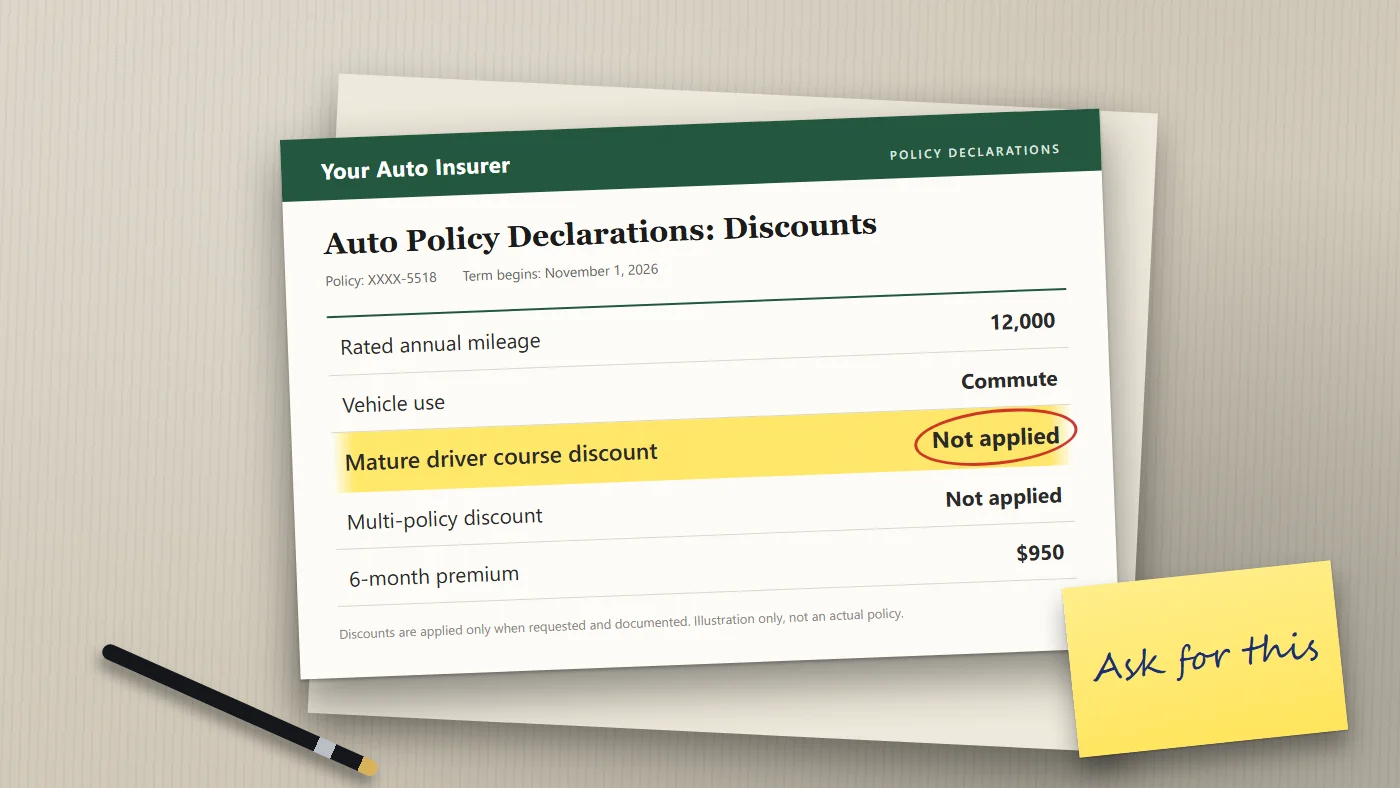
Your mileage was estimated the day you applied, and so was your "use," which for most working people was set to commuting, with a one-way distance attached. Stop commuting and the file still says you drive to work five days a week. Federal Highway Administration figures put the average driver aged 35 to 54 at about 15,300 miles a year, drivers 55 to 64 at about 12,000, and drivers 65 and older at about 7,600. That's an older federal survey, but the pattern hasn't gone anywhere: people drive a lot less once they stop working. Your rate reflects that only if somebody tells the insurer.
The course discount works the same way. A state can require insurers to offer it, but your company has no way of knowing you took a course until you send in the certificate. States don't report completions to insurance companies.
There's a quieter problem, too. Prices tend to creep up the longer you stay put, a little at each renewal, and because nobody compares a bill with the one from four years ago, the drift can go on for a long time before anyone notices. Consumer Reports surveyed more than 40,000 policyholders in 2024 and found that more drivers 60 and older had seen a rate increase in the past 12 months than younger policyholders had. Among people of all ages who switched insurers, the median saving was $461 a year. Loyalty isn't a discount. Sometimes it's the opposite.
Four states, four versions of the rule
There's no federal rule here. Mature driver discounts are set state by state, and depending on who's counting, somewhere between two dozen and three dozen states require insurers to give one to older drivers who finish an approved course. In the rest, plenty of insurers offer it voluntarily. The qualifying age, the size of the discount and the course length all differ.
| State | Who qualifies | What the state says | How long it lasts |
|---|
| Florida | Age 55 and older | Insurer must give a discount after an approved course; each insurer sets the amount | Typically three years, as long as you aren't cited in a crash or convicted of a moving violation |
| New York | Any licensed driver | 10% off the base rate of your premiums; if several people on one policy take it, only the principal operator gets it | Three years; retake every 36 months |
| Pennsylvania | Age 55 and older | At least 5% off after the 7-hour basic course | Take a refresher course every three years |
| California | Age 55 and older | Insurer must give a discount; each insurer sets the amount | About three years; the renewal course is shorter than the first one |
Two things jump out. The age is usually 55, not 65, and plenty of drivers wait a decade longer than they have to. And in Florida and California the law requires a discount but lets each company pick the size. Two insurers in the same state can give very different amounts for the same certificate. Same course, same driver. That's one more reason to compare.
Not in the table? Search your state insurance department or DMV site for "mature driver" or "accident prevention course." It'll list the approved providers, and only approved courses count.
Honestly, the course is the easy part. For most retired drivers the larger savings sit in four other lines on the policy, and those take one phone call.
Six things to ask about on the call
Have the declarations page in front of you when you call your insurer or agent. It's the one- or two-page summary at the front of the policy listing each coverage, each driver and each discount already applied. I'd read that discount list before dialing, so you know what you've already got.
Then take these one at a time.
- Start with mileage, since it's the number most likely to be wrong. Ask what annual figure the policy uses now. Say it's 12,000, and the odometer tells you that you drove 6,000 last year. That's worth fixing. Many insurers have a low-mileage tier, often somewhere around 7,500 miles a year, though each company draws its own line. Today's odometer reading helps, and so does last year's if it's printed on a service receipt.
- How is the car classified? At most companies "commute" costs more than "pleasure," so if nobody in the house drives that car to work anymore, tell them. Still working part time? Give the real number of days and the real distance.
- The course comes next, but don't pay for one yet. First find out whether the company gives the discount in your state, how big it is and which coverages it touches, and ask which courses it accepts. When you finish, send the certificate that same day and ask for written confirmation that it's been applied.
- Who's listed as a driver? A grown child who moved out years ago may still be there. So may a spouse who's stopped driving. Taking off someone who truly doesn't use the car can lower the bill, but leave on anyone who still drives it, even now and then, because an unlisted regular driver is an easy reason for a claim dispute.
- Bundling and payment are small money that stacks. If your home and auto policies sit with different companies, ask each one for a bundled price, and while you're at it, ask what paying the full term up front, automatic payments and paperless billing would knock off.
- Leave deductibles for last, because strictly speaking this one's a trade, not a discount. Raising a deductible from $200 to $500 could cut the cost of collision and comprehensive coverage by 15% to 30%, according to the Insurance Information Institute. Go to $1,000 and the saving can reach 40% or more. It's only a good trade if you could write that check tomorrow without borrowing.
Before you hang up, jot down who you spoke to, the date and every change they agreed to. When does the new price kick in? Is a revised declarations page coming? Ask both, and when the page shows up, check it against your notes.
What about the plug-in device or the phone app?
Somewhere on that call you may hear about a program that tracks your driving, either through an app or a small device in the car, with a discount as the carrot. For a retired driver who covers few miles, mostly in daylight, these can work well.
They watch more than people expect, though. Most programs score hard braking, fast acceleration, time of day, phone handling and total miles. Some only ever lower your rate. Others can raise it if the score's poor, so ask which kind you're being offered, and get the answer in writing or find it in the program terms before you sign up.
Pay-per-mile is a different product altogether: a base rate plus a few cents a mile. It tends to make sense only for a car that barely moves. It isn't sold everywhere, either.
Don't trade away the coverage that protects your savings
Cutting coverage is the fastest way to shrink a premium. Past 55, it's usually the wrong place to save.
You probably have more to lose than you did at 30. Home equity, retirement accounts, savings. If you cause a serious crash and get sued, liability coverage is what stands between those and the lawsuit. How much is enough? Consumer Reports recommends at least $100,000 per person and $300,000 per crash, plus $100,000 for property damage. With substantial assets, it suggests considering 250/500/250. State minimums are far below either.
Keep uninsured and underinsured motorist coverage, too. It's what pays when the driver who hits you has no insurance, or not enough of it.
So is anything safe to trim? Sometimes collision and comprehensive, on an older car that's paid off. That's its own calculation, and it turns on what the car is worth.
The window between 55 and 70
Of every age group, drivers in their 60s pay the lowest rates. By how much? Insurify puts their average for full coverage at about $163 a month in its September 2026 data, while the national average for all ages sits at $187. (Insurify builds those numbers from millions of quotes.) Its figures also show prices starting to climb again around 70.
That leaves you a window. Between 55 and 70 you're the customer insurers want: experienced, fewer miles, fewer claims. It's the best time to make them compete.
After 70, prices tend to rise even with a clean record. Picture a driver who never bothered with the course or the mileage update at 60. Past 70, that driver pays the higher age rate on top of a file that still describes a commuter. That's when the course discount, the mileage fix and fresh quotes earn their keep, because they push back against an increase that's coming anyway.
Shop around last, not first
It sounds backwards, but fix your own policy before you shop. Once the mileage, use, drivers and discounts are right, you know the real price your current company will give you, and that's your benchmark.
Then get quotes from at least three other insurers, all for the same coverage. Same liability limits, same deductibles, same drivers, same mileage. A quote with lower limits will always look cheaper, and it tells you nothing. Some companies focus on drivers over 50 and price that group well, some are strong on low-mileage drivers, and some give a bigger course discount than their competitors. Line the quotes up on one sheet of paper and the gaps show.
Each company should hear the questions you asked your own. What's the mature driver discount here? Where's the low-mileage line? Does the price jump after the first term? If you belong to an association, a credit union, a veterans group or an alumni group, ask about a group rate as well. Even the NAIC's list of discounts to ask about includes a "mature driver" discount for people between 50 and 65.
Timing helps. Three to four weeks before renewal, the new price is in your hands and you can still switch without a gap. If you do switch, keep the old policy until the new one is active. A lapse of even a day can raise what you pay later.
Before your next renewal
- Find the declarations page and read the discounts listed on it.
- Write down today's odometer reading.
- Look up your state's approved mature driver courses on the DMV or insurance department site.
- Call your insurer about mileage, use, drivers, the course discount and bundling.
- Get three outside quotes for identical coverage.
- Put a reminder on the calendar three years out, when the course certificate runs out.
If you only make one call this month, make the one about your mileage. It's five minutes, and the insurer can't fix that number until you give it the real one.
This article is general information, not financial, legal, tax or medical advice.