Insurance
Car Insurance Went Up Again With No Tickets or Claims: Why, and What to Do at Renewal
Most of what moved your premium has nothing to do with how you drive, and some of it can be fixed with a phone call.
 Ray Castellano
Updated Sep 22, 2026 · 11 min read
You haven't had a ticket in years. You haven't filed a claim. The renewal letter shows up anyway, and the number on it is higher than last time.
You're not imagining it. Insurify's 2026 Mid-Year Auto Insurance Report found that full-coverage premiums rose in 27 states during the first half of this year, and it projects increases in 32 states by the end of December. The national average for full coverage stood at $2,237 a year in June.
That national figure moved only about 1% over those six months, which sounds mild. Averages hide a lot, though. Connecticut drivers saw a 10.5% jump. Kentucky was up 6.4%. And inside every state, individual renewals swing much further than the average does, up for some drivers and down for others.
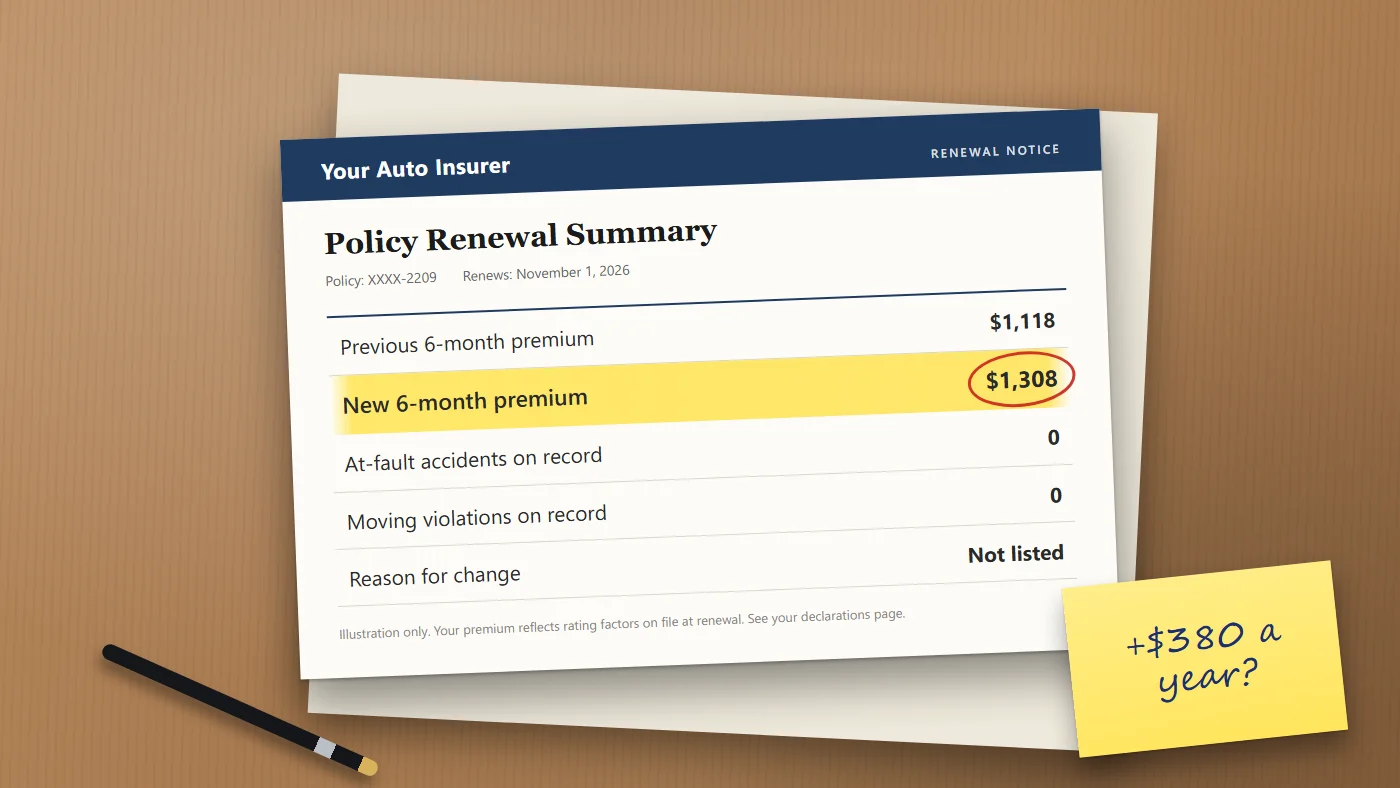
Say your six-month premium goes from $1,118 to $1,308 at renewal. That's $190 more per term, or $380 a year, a 17% increase on a spotless record. The letter will show the new amount and the due date. It usually won't say why.
+$380 a year: the cost of that example renewal. A renewal notice tells you the new premium and when it's due. It rarely tells you which rating factor changed.
The reason matters, because some causes are out of your hands and some aren't. A statewide rate increase follows you to almost any company. A lost discount, a wrong mileage figure or a pricing habit aimed at long-time customers doesn't, and that second group is where a driver with a clean record can often get money back.
Why a clean record doesn't protect your rate
Your premium is built in two layers. The first is the insurer's base rate for your state and territory, which it files with the state insurance department. The second is your own set of rating factors and discounts. Your driving record is just one item in that second layer.
When claim costs climb across a state, the insurer files for a higher base rate and everyone's bill goes up. That's been happening for several years now. Insurify points to auto repair and maintenance costs that rose 45% over the past five years, about double the rate of inflation, and it cites collision claim costs up 42% and bodily injury claim costs up 36% from 2020 to 2024.
Newer cars are part of it. A bumper packed with cameras and radar sensors costs far more to replace than a plain one, and you pay for that in your collision premium whether or not you ever hit anything.
Weather's another piece. Hail, flooding and wind damage are paid under comprehensive coverage, and Insurify notes that Kentucky averaged 178 hail events a year from 2023 through 2025, up from 76 a year in 2020 through 2022. Rates there followed.
So why did yours jump 17%? The first layer explains why nearly everyone's bill drifts up. It doesn't explain a 17% jump in a half-year when the national average rose about 1%, or even when Connecticut's rose 10.5%. For that you have to look at the second layer.
The personal factors that change quietly
| What changed | How it shows up | Can you do anything? |
|---|
| Statewide base rate increase | Everyone with that insurer pays more | Only by comparing other insurers |
| Your ZIP code's claim history | Rate rises after local thefts, crashes or storms | Not unless you move |
| An age band | Rates tend to climb again after 65 to 70 | Ask about mature-driver and low-mileage discounts |
| A discount expired | New-customer, paperless, telematics or multi-policy discount drops off | Yes, ask to have it reviewed |
| Your credit-based insurance score | Premium changes with no driving event | Yes, in most states; check your credit reports |
| Your vehicle's loss history | That model became costlier to repair or easier to steal | Compare insurers; they weigh models differently |
| Mileage or use on file | Still rated as a daily commuter after retiring | Yes, update it |
| Length of time with the insurer | Renewal price creeps above the new-customer price | Yes, shop around |
For drivers over 50, two rows stand out.
Age cuts both ways. Rates fall through middle age and then turn back up. Insurance.com's 2026 numbers, based on one sample driver with good credit, a clean record and a Honda Accord driven 10,000 miles a year, show an average of $2,353 a year at 65, $2,498 at 70 and $2,742 at 75. That's $389 more at 75 than at 65 with the same car and the same record. Insurers move drivers between age bands at different birthdays, so the step can land at a single renewal and seem to come out of nowhere.
The last row is the one people find hardest to believe. Regulators call it price optimization, which means setting your renewal price partly on how likely you are to shop around, not only on how risky you are to insure. By CarInsurance.com's count, 18 states and D.C. have banned it, including California, Florida, Ohio and Pennsylvania. Elsewhere it isn't specifically prohibited.
None of this shows up on the renewal letter. It does show up in three places the letter doesn't mention, and checking all three takes less than an hour.