You haven't had a ticket in years. You haven't filed a claim. The renewal letter shows up anyway, and the number on it is higher than last time.
You're not imagining it. Insurify's 2026 Mid-Year Auto Insurance Report found that full-coverage premiums rose in 27 states during the first half of this year, and it projects increases in 32 states by the end of December. The national average for full coverage stood at $2,237 a year in June.
That national figure moved only about 1% over those six months, which sounds mild. Averages hide a lot, though. Connecticut drivers saw a 10.5% jump. Kentucky was up 6.4%. And inside every state, individual renewals swing much further than the average does, up for some drivers and down for others.
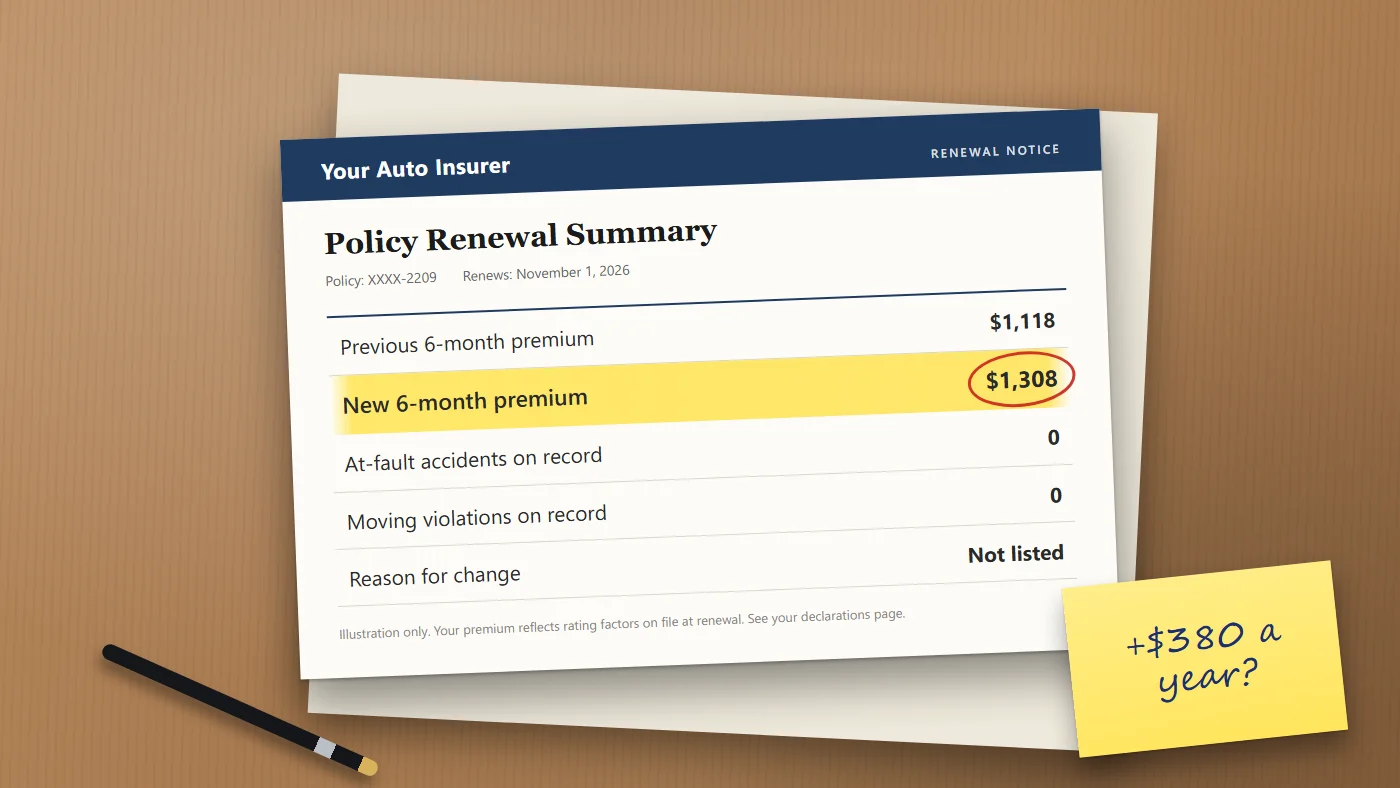
Say your six-month premium goes from $1,118 to $1,308 at renewal. That's $190 more per term, or $380 a year, a 17% increase on a spotless record. The letter will show the new amount and the due date. It usually won't say why.
+$380 a year: the cost of that example renewal. A renewal notice tells you the new premium and when it's due. It rarely tells you which rating factor changed.
The reason matters, because some causes are out of your hands and some aren't. A statewide rate increase follows you to almost any company. A lost discount, a wrong mileage figure or a pricing habit aimed at long-time customers doesn't, and that second group is where a driver with a clean record can often get money back.
Why a clean record doesn't protect your rate
Your premium is built in two layers. The first is the insurer's base rate for your state and territory, which it files with the state insurance department. The second is your own set of rating factors and discounts. Your driving record is just one item in that second layer.
When claim costs climb across a state, the insurer files for a higher base rate and everyone's bill goes up. That's been happening for several years now. Insurify points to auto repair and maintenance costs that rose 45% over the past five years, about double the rate of inflation, and it cites collision claim costs up 42% and bodily injury claim costs up 36% from 2020 to 2024.
Newer cars are part of it. A bumper packed with cameras and radar sensors costs far more to replace than a plain one, and you pay for that in your collision premium whether or not you ever hit anything.
Weather's another piece. Hail, flooding and wind damage are paid under comprehensive coverage, and Insurify notes that Kentucky averaged 178 hail events a year from 2023 through 2025, up from 76 a year in 2020 through 2022. Rates there followed.
So why did yours jump 17%? The first layer explains why nearly everyone's bill drifts up. It doesn't explain a 17% jump in a half-year when the national average rose about 1%, or even when Connecticut's rose 10.5%. For that you have to look at the second layer.
The personal factors that change quietly
| What changed | How it shows up | Can you do anything? |
|---|
| Statewide base rate increase | Everyone with that insurer pays more | Only by comparing other insurers |
| Your ZIP code's claim history | Rate rises after local thefts, crashes or storms | Not unless you move |
| An age band | Rates tend to climb again after 65 to 70 | Ask about mature-driver and low-mileage discounts |
| A discount expired | New-customer, paperless, telematics or multi-policy discount drops off | Yes, ask to have it reviewed |
| Your credit-based insurance score | Premium changes with no driving event | Yes, in most states; check your credit reports |
| Your vehicle's loss history | That model became costlier to repair or easier to steal | Compare insurers; they weigh models differently |
| Mileage or use on file | Still rated as a daily commuter after retiring | Yes, update it |
| Length of time with the insurer | Renewal price creeps above the new-customer price | Yes, shop around |
For drivers over 50, two rows stand out.
Age cuts both ways. Rates fall through middle age and then turn back up. Insurance.com's 2026 numbers, based on one sample driver with good credit, a clean record and a Honda Accord driven 10,000 miles a year, show an average of $2,353 a year at 65, $2,498 at 70 and $2,742 at 75. That's $389 more at 75 than at 65 with the same car and the same record. Insurers move drivers between age bands at different birthdays, so the step can land at a single renewal and seem to come out of nowhere.
The last row is the one people find hardest to believe. Regulators call it price optimization, which means setting your renewal price partly on how likely you are to shop around, not only on how risky you are to insure. By CarInsurance.com's count, 18 states and D.C. have banned it, including California, Florida, Ohio and Pennsylvania. Elsewhere it isn't specifically prohibited.
None of this shows up on the renewal letter. It does show up in three places the letter doesn't mention, and checking all three takes less than an hour.
Read the declarations page, not the letter
The renewal letter is a bill. What you want is the declarations page, which either comes with it or sits in your online account, because that's the real breakdown. Put this term's page next to last term's and go line by line.
Liability, collision, comprehensive, uninsured motorist and medical payments are each priced separately, so take them one at a time. Where the increase sits tells you a lot. Mostly in collision and comprehensive? Then the cause is likely your vehicle or local claims. If every line rose by a similar percentage, it's probably a base rate change.
Then go to the discount list, because discounts can fall off without any separate notice. A telematics discount can end when the monitoring period does. A multi-policy discount disappears if your home policy moved to another company. And the new-customer or "switch" discount you got when you signed up often lasts only one or two terms.
Last come the facts the insurer has on file: annual mileage, whether the car's used for commuting, who's listed as a driver and where it's garaged. Picture a retired driver still rated for a 25-mile daily commute. He's paying for risk that no longer exists.
Two reports insurers see and you usually don't
The first is a C.L.U.E. report, the claims history file LexisNexis keeps and insurers pull when they price you. It lists claims filed under your name and on your vehicles over the past several years. You can get it free, too, since the Consumer Financial Protection Bureau lists it among the specialty consumer reporting companies that have to give you a copy on request.
Order it if your increase makes no sense. Errors happen. A claim from a previous owner of your car could be sitting there, or one filed by a driver with a similar name, or a roadside call logged as a loss, and any of those can push your rate up. You have the right to dispute mistakes, and the reporting company has to investigate.
The second is your credit report. In most states insurers use a credit-based insurance score as a rating factor, and federal law gives you some leverage. If something in a credit report drove your rate up, the Fair Credit Reporting Act requires the insurer to send you an adverse action notice naming the credit bureau it used. You can then ask that bureau for a free copy within 60 days and dispute anything that's wrong.
Call your insurer before you shop
A ten-minute call can tell you whether the increase is fixable right where you are. Keep a pen handy, because you'll want the answers in writing later.
- Start by asking, flat out, what changed in your rating since last term. The person on the phone can usually pull it up in seconds. Find out, too, whether the whole state got a rate hike and by how much, since that part won't be negotiable.
- Then go after lost discounts. "What was I getting last term that I'm not getting now?" is the question, and if something dropped off, ask what it'd take to get it back.
- Read them your odometer. If you've retired or stopped commuting, the mileage and use on file are probably wrong, and that's money.
- Ask which discounts you qualify for that aren't on the policy yet, and name them so nothing gets skipped: a mature-driver or defensive driving course, low mileage, paying in full, paperless, bundling. If you're 55 or older, the course is the one to push on. California and Florida are among the states that make insurers give drivers that age a discount after an approved accident-prevention course, and the course usually costs less than the discount saves.
- Ask what your premium would be with a $1,000 deductible. A higher collision deductible lowers the premium, but it only makes sense if you could cover that amount from savings.
- "Is there a lower-priced tier or sister company I qualify for?" Large insurers often sell through more than one underwriting company at different price levels.
Own an older car outright? Also ask what collision and comprehensive cost per year and compare that with what the car's worth. Dropping them is a judgment call, not a rule. You should still know the figure.
Then compare, because prices differ more than you'd guess
Every insurer weighs the same facts its own way. One company leans hard on age bands, while the next cares more about your ZIP code or the model sitting in your driveway. The spread that produces isn't small: drivers with similar profiles can be quoted $100 to $200 a month apart for full coverage, depending only on which company they ask (Insurify's finding, from the same report).
Most people never find out, because they never ask. In the second quarter of 2026, only 12.6% of auto policyholders shopped for a new policy, going by J.D. Power's tracking. Fewer still, 4.5%, actually switched. The rest renewed at whatever price arrived in the mail.
A fair comparison starts with your declarations page. Give every company the same liability limits, the same deductibles and the same drivers, and don't let anyone improve a quote by quietly changing them. Picture a quote that looks $400 cheaper because it cut your liability limits in half. That isn't a cheaper policy. It's a different one.
You'll want at least three quotes, and it helps if they don't all come through the same kind of door. Try one company that sells direct and one that sells through its own agents, then make the third an independent agent, who can check several regional insurers at once. Regional and mutual insurers often price older, low-mileage drivers well, and you'll rarely see them in national advertising. If you only make one call this month, I'd make it to an independent agent.
Start about 30 days before renewal. Why so early? Some insurers give a discount when you buy a policy a week or more ahead of its start date, and a month leaves room to compare without rushing. Don't drop the old policy until the new one is active, not even for a day, since a lapse in coverage is itself a rating factor.
Still looks wrong after all that? Your state insurance department reviews rate filings and takes consumer complaints, and the NAIC keeps a directory that links to each state's complaint form. Filing one won't overturn an approved rate. What it does is make the company explain your premium in writing, and that's how real errors get caught.
Many state departments also publish premium comparison tools or sample rates by ZIP code, which is a quick way to see whether your insurer has become one of the expensive ones where you live.
Mistakes to avoid at renewal
The big one is letting the policy auto-renew without ever opening the declarations page. You keep paying the increase you didn't read.
Close behind it comes cutting liability limits to bring the price down. Liability is the coverage that protects your house and your savings if you injure someone, so trim deductibles and extras before you touch it.
Don't assume loyalty is being rewarded, either. In states that haven't banned price optimization it may be working against you, and even where it's banned, a competitor may simply rate you better.
And don't switch on price alone. Before you move, look up the new insurer's complaint record with your state insurance department. Then lay its quote beside your current declarations page and check the limits, the deductibles and the listed drivers one more time.
This article is general information, not financial, legal, tax or medical advice.