For almost forty years, interest on a personal car loan wasn't deductible. The tax law signed in July 2025 changed that. For tax years 2025 through 2028, you can deduct up to $10,000 a year of interest paid on a loan for a new vehicle, and you can take it even if you claim the standard deduction.
Everything hangs on the word "qualified." The vehicle has to be new, its final assembly has to have happened in the United States, and the loan behind it must have been taken out after December 31, 2024, which rules out anyone who signed in the last days of 2024. The car has to be for personal use, and your income has to be under a limit. When you claim the deduction, the law requires the vehicle identification number on your return.
That last detail is why so much advice on this deduction boils down to "check the VIN." The 17-character VIN records the plant that built the vehicle, and the IRS accepts it as a way to confirm where final assembly took place. A U.S. brand on the grille proves nothing. Not even close. Plenty of vehicles from domestic brands are assembled in Mexico or Canada, and plenty from Japanese, Korean and German brands roll out of plants in Alabama, Ohio, Indiana or South Carolina.
Be realistic about the size of the benefit, too. The $10,000 is a ceiling on the interest you can deduct. It isn't the tax you save, and few borrowers pay anywhere near that much interest in a year.
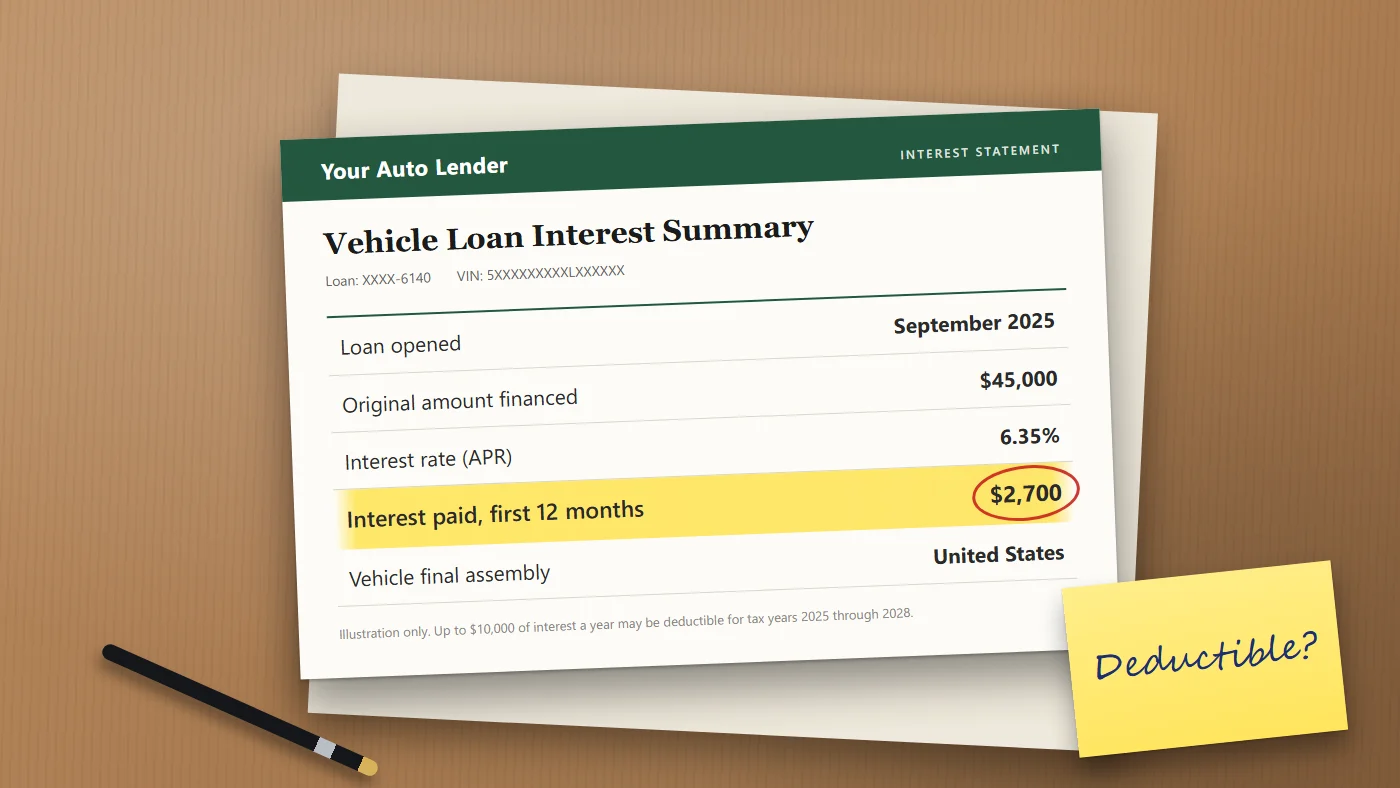
Take a $45,000 loan at 6.35% for 72 months, close to the average new-vehicle loan Experian reported for the second quarter of 2026. Interest in the first 12 months comes to about $2,700. In the 22% bracket, deducting it lowers your federal tax by roughly $590. In the 12% bracket, about $320.
Real money, for filling out one section of one form. Not a reason to buy a car, though, and the rest of this article treats it that way.
The rules, as the IRS and Treasury wrote them
Treasury and the IRS published proposed rules on January 2, 2026, and final regulations in the Federal Register on September 8, 2026. They take effect November 9. Together with the statute and the IRS's own summary, they give a fairly complete picture.
The vehicle. A car, minivan, van, SUV, pickup truck or motorcycle with a gross vehicle weight rating under 14,000 pounds, and final assembly in the United States.
New only. The statute says the "original use" of the vehicle has to start with you. A used car doesn't qualify, even if it's new to you. A lease doesn't, because lease financing is excluded outright, and buying out your own lease at the end of the term generally won't qualify either. A dealer demonstrator can, since a car a dealer holds for sale isn't treated as used by the dealer.
The loan. It has to be taken out after December 31, 2024, to buy the vehicle, and it has to be secured by a first lien on that vehicle. A personal loan or a home equity loan used to buy a car won't count under this provision. Neither will a loan from a relative or another related party; the statute excludes debt owed to a related person.
Personal use. The vehicle has to be bought for personal use, not for business. The final rules test this once, when you take out the loan, and don't re-test it every year.
The years and the cap. Interest paid in 2025, 2026, 2027 and 2028 counts. After that, it doesn't, unless Congress extends the law. No more than $10,000 of interest per return per year, whatever your filing status.
Does the income limit hit sooner than it looks?
Yes. The deduction starts to shrink when your modified adjusted gross income passes $100,000, or $200,000 on a joint return. Schedule 1-A spells out the math: for every $1,000 over the threshold, or any part of $1,000, you lose $200 of the deduction.
The rounding is what catches people, because a single dollar past a $1,000 step costs the full $200 for that step, so an income of $100,001 on a single return already trims $200 off whatever interest you paid.
Most summaries say it's gone at $150,000 single and $250,000 joint. That's only true if you paid the full $10,000 in interest. The reduction comes off your actual interest, so an ordinary loan phases out much sooner.
Go back to the borrower with $2,700 in interest. Single, with income of $105,000, the excess is $5,000, the reduction is $1,000, and $1,700 stays deductible. At $112,400 the excess rounds up to 13 thousands, the reduction is $2,600, and what's left is $100. At $114,000 it's zero.
For a typical loan, then, the deduction is gone about $14,000 above the threshold. If you're anywhere near $100,000 single or $200,000 joint, I'd run the numbers before counting on it.