For almost forty years, interest on a personal car loan wasn't deductible. The tax law signed in July 2025 changed that. For tax years 2025 through 2028, you can deduct up to $10,000 a year of interest paid on a loan for a new vehicle, and you can take it even if you claim the standard deduction.
Everything hangs on the word "qualified." The vehicle has to be new, its final assembly has to have happened in the United States, and the loan behind it must have been taken out after December 31, 2024, which rules out anyone who signed in the last days of 2024. The car has to be for personal use, and your income has to be under a limit. When you claim the deduction, the law requires the vehicle identification number on your return.
That last detail is why so much advice on this deduction boils down to "check the VIN." The 17-character VIN records the plant that built the vehicle, and the IRS accepts it as a way to confirm where final assembly took place. A U.S. brand on the grille proves nothing. Not even close. Plenty of vehicles from domestic brands are assembled in Mexico or Canada, and plenty from Japanese, Korean and German brands roll out of plants in Alabama, Ohio, Indiana or South Carolina.
Be realistic about the size of the benefit, too. The $10,000 is a ceiling on the interest you can deduct. It isn't the tax you save, and few borrowers pay anywhere near that much interest in a year.
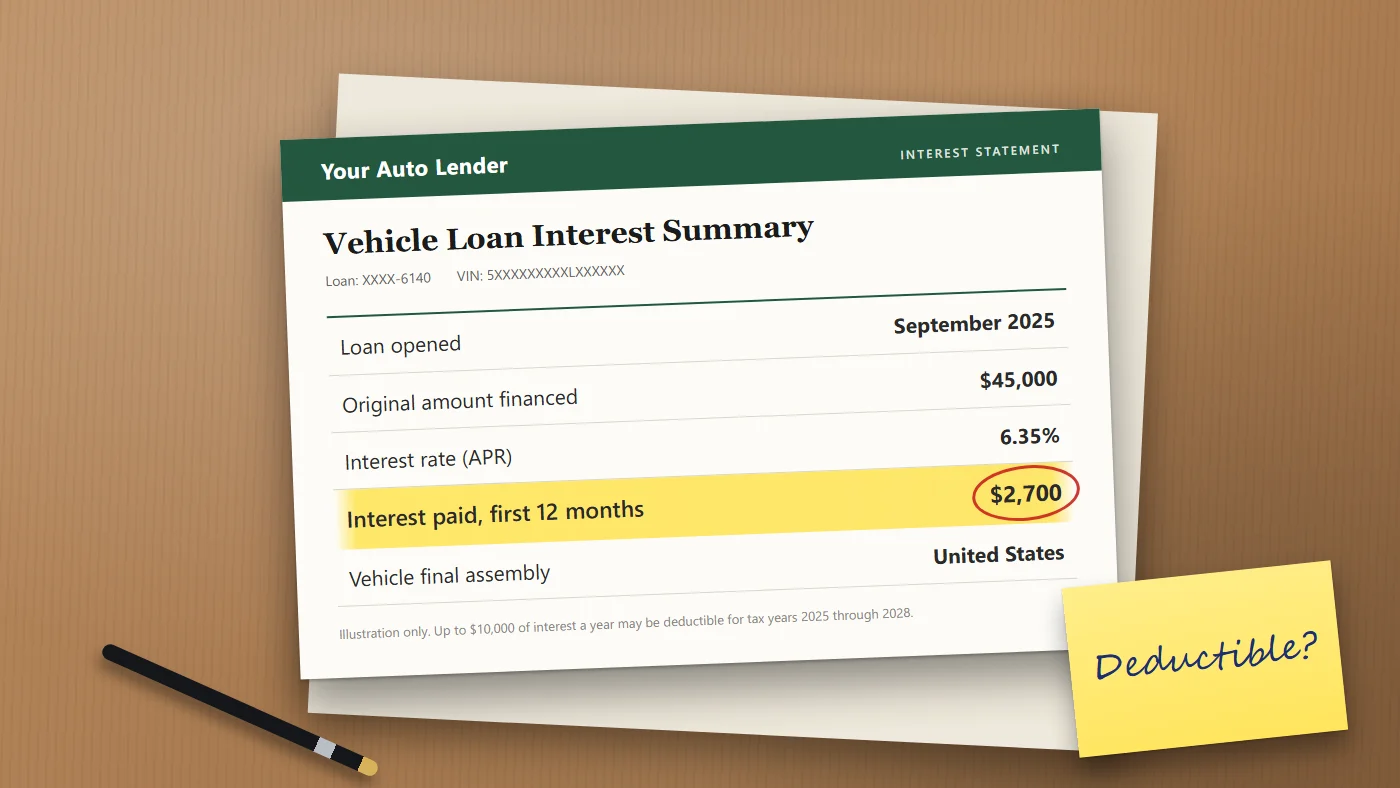
Take a $45,000 loan at 6.35% for 72 months, close to the average new-vehicle loan Experian reported for the second quarter of 2026. Interest in the first 12 months comes to about $2,700. In the 22% bracket, deducting it lowers your federal tax by roughly $590. In the 12% bracket, about $320.
Real money, for filling out one section of one form. Not a reason to buy a car, though, and the rest of this article treats it that way.
The rules, as the IRS and Treasury wrote them
Treasury and the IRS published proposed rules on January 2, 2026, and final regulations in the Federal Register on September 8, 2026. They take effect November 9. Together with the statute and the IRS's own summary, they give a fairly complete picture.
The vehicle. A car, minivan, van, SUV, pickup truck or motorcycle with a gross vehicle weight rating under 14,000 pounds, and final assembly in the United States.
New only. The statute says the "original use" of the vehicle has to start with you. A used car doesn't qualify, even if it's new to you. A lease doesn't, because lease financing is excluded outright, and buying out your own lease at the end of the term generally won't qualify either. A dealer demonstrator can, since a car a dealer holds for sale isn't treated as used by the dealer.
The loan. It has to be taken out after December 31, 2024, to buy the vehicle, and it has to be secured by a first lien on that vehicle. A personal loan or a home equity loan used to buy a car won't count under this provision. Neither will a loan from a relative or another related party; the statute excludes debt owed to a related person.
Personal use. The vehicle has to be bought for personal use, not for business. The final rules test this once, when you take out the loan, and don't re-test it every year.
The years and the cap. Interest paid in 2025, 2026, 2027 and 2028 counts. After that, it doesn't, unless Congress extends the law. No more than $10,000 of interest per return per year, whatever your filing status.
Does the income limit hit sooner than it looks?
Yes. The deduction starts to shrink when your modified adjusted gross income passes $100,000, or $200,000 on a joint return. Schedule 1-A spells out the math: for every $1,000 over the threshold, or any part of $1,000, you lose $200 of the deduction.
The rounding is what catches people, because a single dollar past a $1,000 step costs the full $200 for that step, so an income of $100,001 on a single return already trims $200 off whatever interest you paid.
Most summaries say it's gone at $150,000 single and $250,000 joint. That's only true if you paid the full $10,000 in interest. The reduction comes off your actual interest, so an ordinary loan phases out much sooner.
Go back to the borrower with $2,700 in interest. Single, with income of $105,000, the excess is $5,000, the reduction is $1,000, and $1,700 stays deductible. At $112,400 the excess rounds up to 13 thousands, the reduction is $2,600, and what's left is $100. At $114,000 it's zero.
For a typical loan, then, the deduction is gone about $14,000 above the threshold. If you're anywhere near $100,000 single or $200,000 joint, I'd run the numbers before counting on it.
The VIN is on the driver's side of the dashboard where it meets the windshield, on the sticker inside the driver's door jamb, and on your registration and insurance card.
Two warnings for shoppers. The same model can come out of more than one plant, so one SUV on the lot can qualify while an identical-looking one parked beside it doesn't. And the model year makes no difference at all; what counts is the plant that built that particular vehicle.
| Situation | Deductible under this provision? |
|---|
| New U.S.-assembled SUV, loan signed March 2025, personal use | Yes |
| Same vehicle, loan signed December 2024 | No, the loan is too early |
| New vehicle assembled in Mexico, Canada, Japan or Korea | No |
| Used vehicle of any origin | No |
| Leased vehicle, or buyout of your own lease | No |
| New U.S.-assembled pickup bought for business use | No under this rule. Business interest has its own rules |
| Qualifying loan that you later refinance | Generally yes, up to the balance that was refinanced |
| Part of the loan that covered negative equity from your trade-in | No, that share of the interest is excluded |
What about the last row? It matters if you traded in a car you still owed money on. The final regulations say debt rolled over from an old loan wasn't borrowed to buy the new vehicle, and interest gets split pro rata. If $5,000 of a $50,000 loan was old debt, 90% of the interest is deductible. Items customarily financed along with a vehicle, such as a service contract, GAP coverage, sales tax and title fees, are treated as part of the purchase.
How to claim it
- Find your interest total for the year. For 2025, lenders didn't have to send a tax form. Under IRS transition relief, they could instead make the figure available through an online portal, a monthly statement or an annual statement. Can't find it? Call the lender and ask for the total interest received on your loan in 2025. For 2026 and later, a lender that receives $600 or more in interest from you is due to send a new statement, Form 1098-VLI, by January 31 of the following year.
- Get the VIN. Copy it from the registration, not from memory. One wrong character can hold up the return.
- Fill out Schedule 1-A, Part IV. It's the form titled "Additional Deductions." On the 2025 version, Part IV is called "No Tax on Car Loan Interest" and runs from line 22 to line 30. Line 22 has a box for each VIN and columns for the interest, with room for two vehicles; if you have more, the instructions explain what to do.
- Apply the cap and the income limit. Line 24 caps the interest at $10,000, and lines 25 through 29 subtract $200 for each $1,000 of income over the threshold. Part I of the same schedule is where you work out your modified adjusted gross income.
- Carry the result to Form 1040. Line 30 is the deduction. The schedule's total goes on line 13b of the 2025 Form 1040, and it comes off your income whether or not you itemize.
Tax software walks you through all this, but it only knows what you type in. It can't tell where your vehicle was built. You can.
Unlike the tips, overtime and senior sections of Schedule 1-A, Part IV carries no warning that married couples must file jointly, and the final regulations say filing status doesn't affect eligibility. The $10,000 cap applies per return.
Already filed 2025 without it?
Plenty of people did. The deduction was new, lenders sent no tax form for 2025, and some buyers never learned their vehicle qualified.
You can still claim it on an amended return, Form 1040-X, with Schedule 1-A attached. Generally you have three years from the date you filed the original return, and a return filed before the April deadline counts as filed on the deadline. Weigh the effort against the benefit. Bought in October 2025? You may have paid only a few hundred dollars of interest that year, and the tax saved could be smaller than a preparer's fee for the amendment. Bought in January 2025, with a full year of interest, and the amendment is more likely to pay for itself.
Mistakes that cost people the deduction
- Assuming the brand settles it. Only the assembly plant matters.
- Claiming a used car. "New to me" isn't new.
- Claiming a lease. Lease payments include a finance charge, but the statute excludes lease financing.
- Deducting the whole payment. Only the interest counts, and it shrinks every year as the balance falls.
- Ignoring the income limit. With a typical loan, the deduction's gone well before $150,000.
- Leaving off the VIN. The law requires it for every year you claim the deduction.
- Forgetting about your state. This is a federal deduction. Whether your state income tax follows it depends on the state.
Shopping for a car, or for tax help, this year
If you plan to buy before the end of 2028, the deduction is one more reason to read the assembly point on the label while you compare new car deals. It shouldn't decide the purchase, since on a typical loan it's worth a few hundred dollars a year, and a better price on the car or a lower rate on the loan can easily be worth more than that. When two vehicles are otherwise close, though, the one built in a U.S. plant carries a small tax edge for the next few years. Lists of American-assembled models are easy to find, and the VIN decoder settles any doubt about a specific car.
The rate matters more than the deduction. A deduction gives back 12 to 24 cents of each interest dollar for many households; a lower rate means you never pay that dollar in the first place. Comparing auto loan rates from a credit union, a bank and the dealer before you sign is still the bigger saving.
If your return already includes other new deductions, such as the senior deduction, tips or overtime, they all go on the same Schedule 1-A. A tax preparer who's filed these forms for a season can usually add the car loan section in a few minutes. Need an amended 2025 return? Ask about the fee first and compare it with the tax you'd get back.
Start with the registration card in your glove box. Put the VIN into the NHTSA decoder, and the plant line will tell you in about a minute if the rest of this is worth your time.
This article is general information, not financial, legal, tax or medical advice.