Insurance
Does Your Credit Score Affect Car Insurance? In Most States, More Than Your Driving
Same car, same clean record, about $1,550 a year apart: how credit-based insurance scores work and where you have leverage.
 Ray Castellano
Updated Sep 22, 2026 · 10 min read
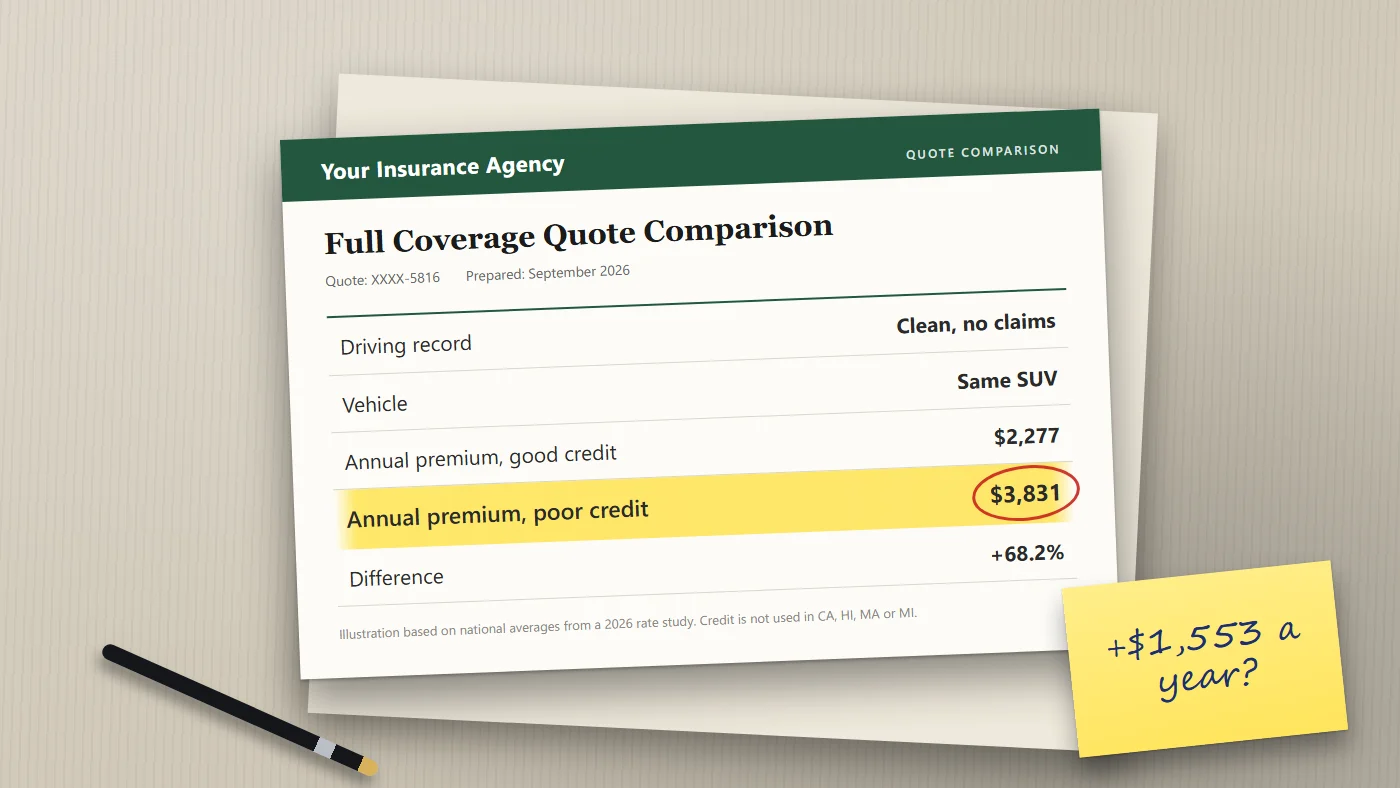
Picture two neighbors. Same age, same street, same eight-year-old SUV, and neither has had a ticket or a claim. One pays about $2,280 a year for full coverage. The other pays about $3,830.
What separates them isn't on the road. It's in their credit files. A LendingTree study using rate data pulled in June 2026 found that drivers with poor credit pay an average of 68.2% more for full-coverage car insurance than drivers with good credit, or $1,553 a year. Its sample driver is a 30-year-old man with a clean record and a 2018 Honda CR-V, so your own dollar figures will differ. The gap itself is the point.
MoneyGeek ran its own numbers in September 2026, comparing excellent credit with poor credit across the 46 states that allow the practice plus D.C., and put the average gap at $2,102 a year. It also found that in most of those states the credit penalty is bigger than the surcharge after a DUI conviction, which it puts at roughly $1,200 to $2,600 a year.
That's the part drivers find hardest to swallow. Someone with a perfect driving record and a rough credit history can pay more than someone with good credit and a drunk-driving conviction. It's legal in most of the country, too. FICO estimates, in a figure the NAIC repeats, that about 95% of auto insurers use credit-based insurance scores where the law allows them.
68% more: the average premium gap in LendingTree's study. Same driver profile, same car, same clean record. Good credit averaged $2,277 a year for full coverage, poor credit $3,831. Source: LendingTree analysis of Quadrant Information Services data, June 2026.
What are insurers actually scoring?
Not the FICO or VantageScore number in your banking app. Insurers use a credit-based insurance score, built from the same credit reports but designed to predict something else: how likely you are to file claims, rather than how likely you are to repay a loan. Same raw data, different question.
The inputs will sound familiar. Payment history, how much of your available credit you're using, how long your accounts have been open, how often you've applied for new credit and the mix of account types all feed in. Income, job and bank balances aren't in a credit report, so they aren't in the score.
Insurers defend the practice with data. In a 2007 report to Congress, the Federal Trade Commission concluded that these scores are effective predictors of risk under auto policies, meaning that, as a group, people with lower scores filed more claims or costlier ones than people with higher scores. The same report found the scores are distributed differently across racial and ethnic groups, which is a big part of why consumer advocates and some regulators want them gone.
You don't have to settle that argument to deal with your own bill. What matters is that many companies recalculate the score at renewal, that it can move your price with no change in how you drive, and that the insurer doesn't have to tell you the score itself.
Say a retired couple puts a $9,000 roof repair on a credit card and pays it down over a year. They've never missed a payment, and their driving hasn't changed. Then the statement posts. The card sits close to its limit, their credit usage jumps, and the insurance score built from that file drops. At the next renewal their premium can go up, and the letter won't mention the roof.
Where it's banned or limited
It's state law, and it varies.
| State rule | Where | What it means for you |
|---|
| Credit may not be used to set auto rates | California, Hawaii, Massachusetts, Michigan | Your credit file shouldn't affect your car insurance price |
| Credit use is limited in specific ways | A number of states, including Maryland and Oregon | Some bar using credit to raise your premium at renewal, or to cancel or refuse to renew |
| Credit allowed with consumer protections | Most other states | Usually can't be the sole reason to deny, cancel or raise rates; notice required |
In the LendingTree data, those four top-row states showed a 0% difference between good and poor credit. At the other end, poor credit more than doubled the premium in six places, led by Washington, D.C., Virginia and New York.
The list isn't frozen. MoneyGeek counted six states with 2026 bills to ban or restrict the practice, including Illinois and New York. If you live in one of them, check your state insurance department's site for the current rule.
Age makes it worse. LendingTree found that 80-year-old drivers saw the largest percentage jump for poor credit, 87%, with the average premium in its sample going from $2,625 to $4,910. For a retiree on a fixed income who's carrying a card balance after a hospital bill, a new roof or a spouse's funeral, and who hasn't had a ticket in decades, that's a rough thing to find on a renewal notice.
So what can you do about it? In most states you can't switch the scoring off. You can find out whether it hit you, fix what's wrong in the file and look for insurers that weigh it less. Those are three separate jobs, and the first one starts with a piece of mail most people toss.