Home & Mortgage
Mortgage Payment Went Up? How to Read Your Escrow Analysis and Catch Errors
Your rate didn't change. The account your servicer uses to pay your taxes and insurance did, and the letter explaining it follows federal rules you can check.
 Ray Castellano
Updated Sep 22, 2026 · 10 min read
You took a fixed-rate mortgage so the payment would stay put. Then a letter shows up, or the autopay just comes out higher, and the new number is $200 or $300 more than last month.
The rate didn't change. A fixed rate locks two things, principal and interest, and that's all it locks. Most mortgage payments carry two more pieces along for the ride: property taxes and homeowners insurance. Nothing fixes those.
Your servicer collects them in a side account called escrow, pays the bills for you, and once a year checks whether it collected enough. When taxes or insurance go up, the account comes up short, and your payment rises twice. Once to cover the bigger bills going forward. Once more to pay back the gap.
That yearly check has a name, the escrow analysis. It arrives as a statement most people never read past the first line, and it's worth ten minutes of your time for two reasons: federal rules limit what the servicer can collect, and the two bills underneath are the only part of your payment you can actually push down.
$209 a month. That's what the average single-family mortgage holder paid for property insurance in the second quarter of 2026, according to the September 2026 ICE Mortgage Monitor as reported by HousingWire. It's 9.6 percent of the average monthly payment, up 8.7 percent in a year and nearly 80 percent higher than at the start of 2020.
Taxes are moving too, just more slowly. ATTOM put the average single-family property tax bill at $4,427 for 2025, up 3 percent.
Stack the two and a payment that sat still for years can jump in a single month.
The timing makes it worse. The analysis runs on the servicer's calendar, not yours. Your insurance renewal might have gone up in March and your tax bill in October, but you feel both at once, months later, when the new payment kicks in. By then the renewal notice is in a drawer somewhere, and the tax bill may have gone straight to the servicer, so you might never have seen it.
What escrow is, and what your servicer may collect
Escrow is a holding account. Most mortgages have one, and loans with a small down payment nearly always do. Every month, one-twelfth of your expected yearly tax and insurance bills goes in, and when the county or the insurer sends a bill, the servicer pays it from that pot.
The federal rule behind all this is Regulation X, section 1024.17, enforced by the Consumer Financial Protection Bureau. Four limits matter to you:
- The servicer has to analyze the account once a year and send you a statement within 30 days of the end of the escrow year.
- It can keep a cushion, but no more than one-sixth of the year's total payouts. That's two months of escrow deposits.
- If the analysis shows a surplus of $50 or more and you're current on the loan, the servicer must refund it within 30 days.
- If there's a shortage of one month's escrow payment or more, the servicer can't demand it all at once. It can leave the shortage alone or spread it over at least 12 months.
Some states set a smaller cushion or require interest on escrow balances. Your state banking regulator can tell you what applies.
Where a $325 jump comes from
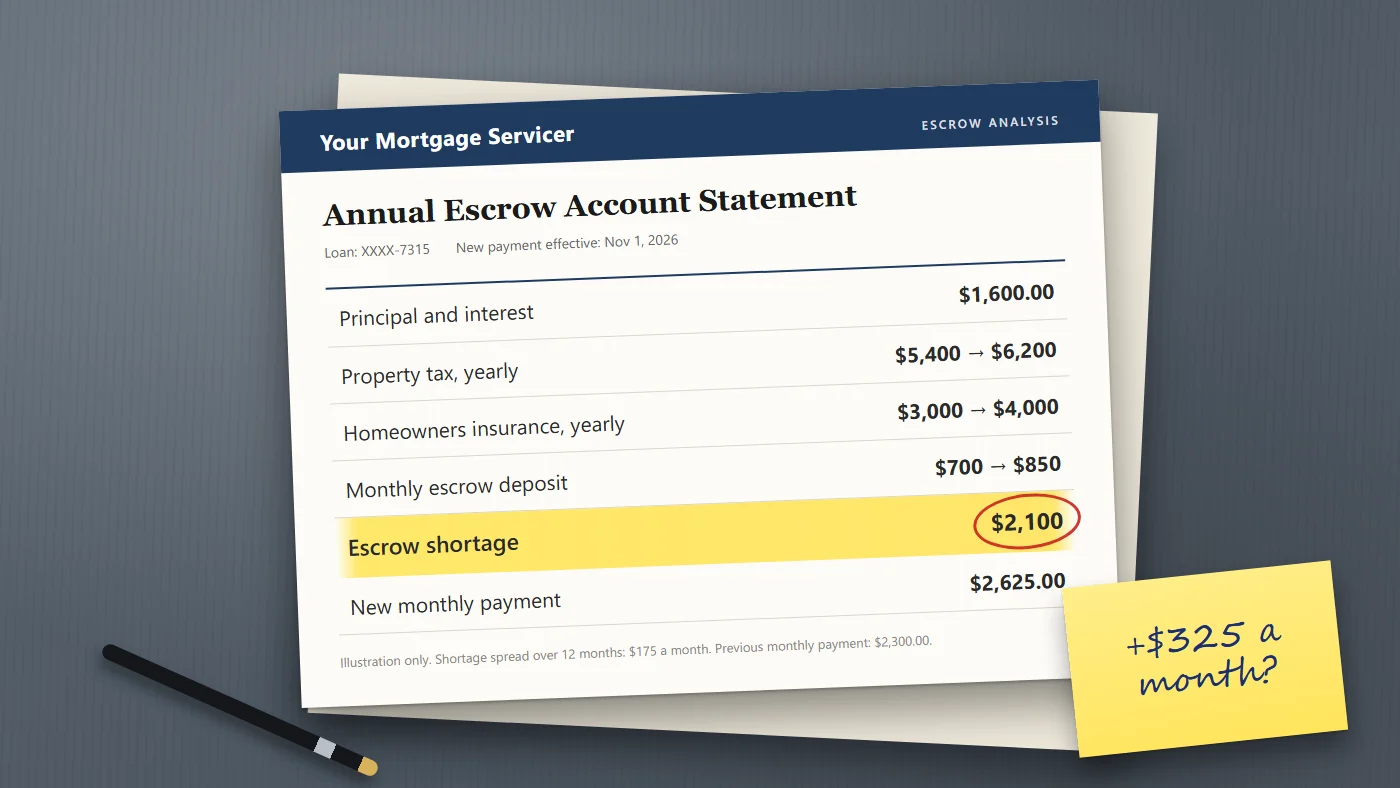
Say you pay $1,600 a month in principal and interest. Last year the tax bill was $5,400 and the insurance premium was $3,000, so escrow collected $700 a month. Total payment: $2,300.
This year the county reassessed and the tax bill came in at $6,200. The insurance renewal came in at $4,000. The servicer paid both in full, $1,800 more than it had collected, so the account ran dry before the year was out.
| Line on the analysis | Last year | This year |
|---|
| Principal and interest | $1,600 | $1,600 |
| Property tax, yearly | $5,400 | $6,200 |
| Homeowners insurance, yearly | $3,000 | $4,000 |
| Monthly escrow deposit | $700 | $850 |
| Allowed cushion (two months) | $1,400 | $1,700 |
| Shortage, spread over 12 months | none | $175 a month |
| Total monthly payment | $2,300 | $2,625 |
The shortage is $2,100. That's the $1,800 the account fell behind, plus $300 to bring the cushion up to the new two-month level. Divide by 12 and you get $175 a month.
So the $325 increase has two layers. About $150 sticks around until the bills change again. The other $175 is a one-year catch-up, and in month 13 the payment should drop to $2,450 if next year's bills hold steady. The example is simplified; real statements spread payouts across the months they're actually due.
The letter rarely spells any of that out. It also rarely mentions that you get a say in how the shortage is paid, or that the projected bills on the statement are sometimes wrong. Those are the parts to check.